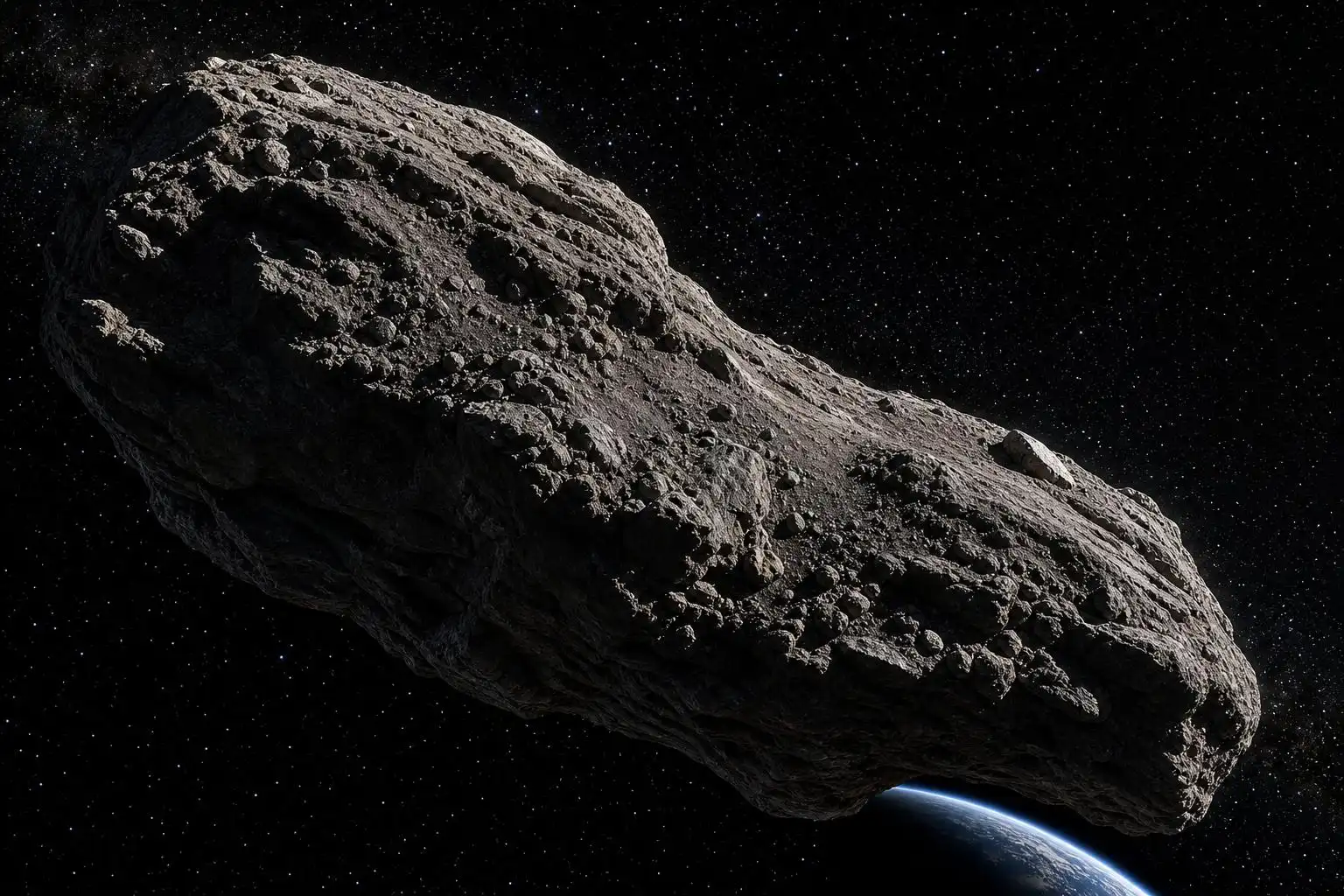

On 7 May 2026, in a room at the Embassy of Italy in Berlin, two space agency directors signed a piece of paper that will send a spacecraft to ride shotgun with a mountain-sized asteroid as it skims closer to Earth than satellites in geosynchronous orbits. ESA Director General Josef Aschbacher and JAXA President Hiroshi Yamakawa formalised the partnership that will define the Rapid Apophis Mission for Space Safety — Ramses — and in doing so committed their agencies to one of the most scientifically loaded flybys in the history of planetary science [1].
The asteroid in question is (99942) Apophis, and if you haven’t been keeping track, here’s the headline: on Friday 13 April 2029, a 375-metre-wide rock will pass just 32,000 kilometres above Earth’s surface. That’s one-tenth the distance to the Moon, and well inside the belt of geosynchronous satellites that carry your television signal and financial data. There is no risk of impact — the orbital mechanics are settled — but the event is extraordinary by any measure. An asteroid of this size passes this close only once every 5,000 to 10,000 years, and up to two billion people on Earth will be able to watch it move across the sky with the naked eye [1].
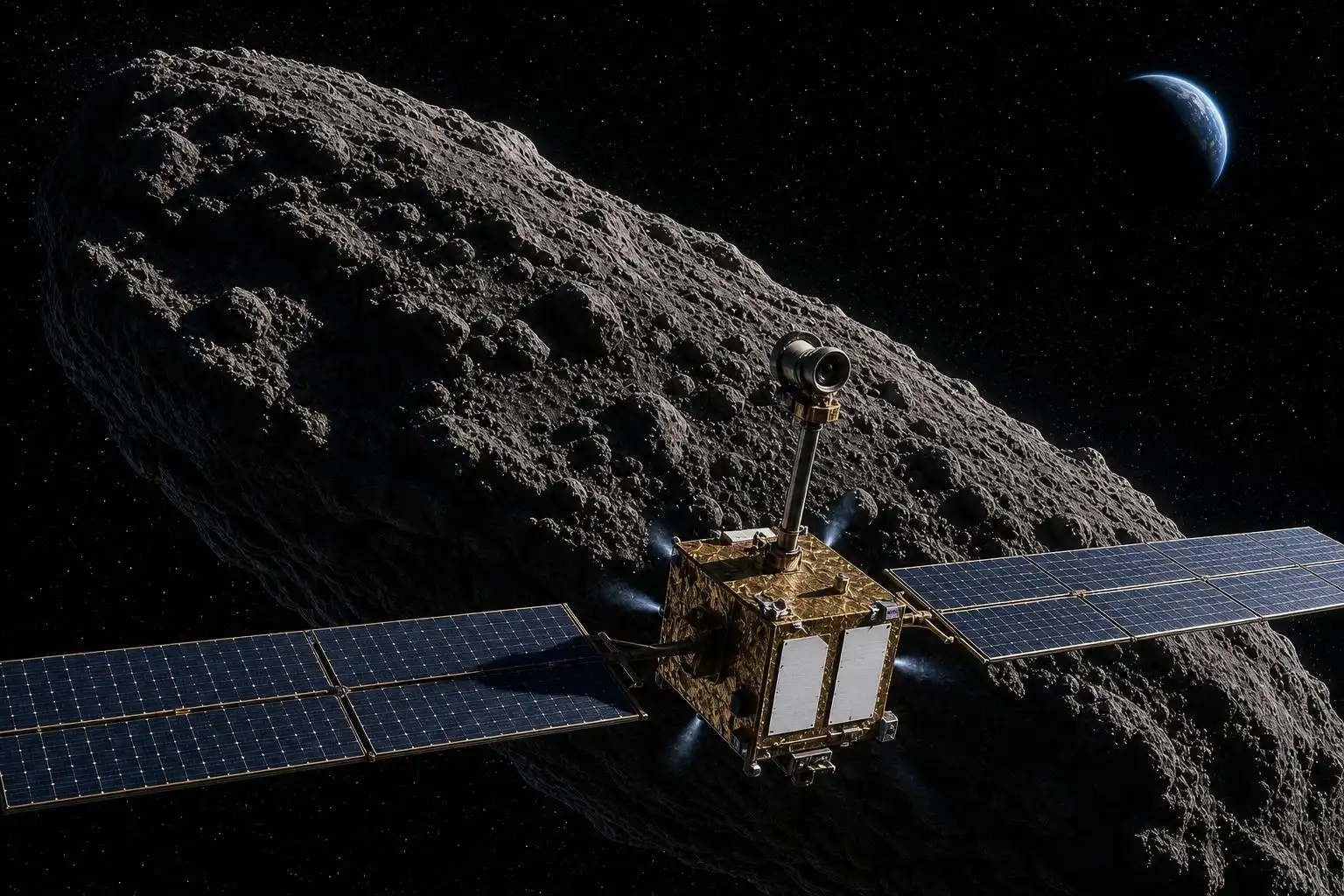
Ramses will be there to watch something the naked eye cannot see: the moment Earth’s gravity begins to knead and reshape the asteroid itself.
A Spacecraft Arrives Before the Drama Begins
The mission timeline is tight but deliberate. Ramses launches in 2028 aboard JAXA’s H3 rocket — one of the key hardware contributions Japan brings to the partnership — and rendezvouses with Apophis before the close approach [2]. That “before” matters enormously. The science isn’t just about watching Apophis zip past Earth; it’s about comparing the asteroid’s state before, during, and after the gravitational encounter. You can only do that comparison if you’re already there, already mapping, already taking baseline measurements.
Think of it like instrumenting a bridge before a heavy truck crosses it. The sensors placed before the crossing are the ones that tell you how much the structure flexed, where the stress concentrated, and whether anything shifted permanently. Ramses is those sensors. The flyby is the truck.
ESA is responsible for the spacecraft bus, integration, and mission operations, while JAXA is supplying the lightweight solar arrays and a critical infrared imager in addition to the launch vehicle [1]. The Italian connection runs deeper than just the signing venue: ESA has selected OHB Italia as the prime contractor for the spacecraft, which is why the Italian Space Agency (ASI) co-hosted the signing ceremony in Berlin.
What Earth’s Gravity Will Do to a Rubble Pile
Here’s the physics that makes April 2029 so compelling. Apophis is almost certainly what planetary scientists call a rubble pile — a gravitationally bound collection of rock and dust rather than a single solid mass. Most asteroids in the size range of a few hundred metres have this structure; the JAXA Hayabusa2 mission confirmed it for Ryugu, and NASA’s OSIRIS-REx found the same at Bennu. Solid monoliths are the exception, not the rule.
When a rubble pile passes through a planet’s tidal gravitational field, the planet pulls harder on the near side than the far side. For a sufficiently close pass, this differential force — the tidal force — can trigger surface avalanches, shift boulders, alter the spin rate, and even cause mass shedding if the rotation gets fast enough. At 32,000 kilometres, Apophis’s encounter with Earth is well within the range where these effects become measurable, and possibly dramatic.
The infrared imager provided by JAXA will be central to detecting thermal signatures associated with freshly exposed material — surfaces turned over by avalanches or mass movement show a different thermal inertia than weathered, space-aged regolith. Combine that with visible imaging to track boulder positions and surface texture changes, and you have a before-and-after record that no ground-based telescope could ever assemble. The spacecraft will also carry instruments to characterise Apophis’s composition and internal structure, feeding directly into the question that every planetary defence planner wants answered: if we ever needed to deflect an asteroid, what exactly are we pushing against? [2]
Why This Partnership Happened Now
The ESA-JAXA collaboration on Ramses didn’t emerge from nowhere. It builds on a joint statement from November 2024 in which both agencies committed to expanding large-scale cooperation, and it extends a working relationship that already includes BepiColombo — the dual-spacecraft mission to Mercury that I’ve written about before — as well as the EarthCARE Earth-observation mission [1]. JAXA also contributed to ESA’s Hera mission, which will arrive later this year at the Didymos–Dimorphos binary system to assess the aftermath of NASA’s DART kinetic impactor test. That thread — DART hits, Hera measures, Ramses observes natural tidal effects — represents a coherent, multi-mission arc in planetary defence science.
The institutional logic is sound. JAXA brings unmatched heritage in small-body rendezvous. Hayabusa returned samples from Itokawa in 2010. Hayabusa2 returned samples from Ryugu in 2020 and then dispatched its extended mission spacecraft toward asteroid 1998 KY26. No other agency has twice landed on, sampled, and departed from an asteroid. ESA brings deep expertise in spacecraft systems, European industrial capacity through contractors like OHB Italia, and operational experience from Rosetta’s comet rendezvous. The combination is genuinely complementary rather than redundant.
The Deeper Science: Reading an Asteroid’s Interior
One of the most profound questions Ramses can help answer is what Apophis is made of on the inside — not just at the surface. This matters for deflection planning in a way that surface mineralogy alone cannot address. A solid nickel-iron body responds to a kinetic impactor very differently than a loosely packed rubble pile, and the momentum transfer efficiency (the key parameter for deflection) depends critically on internal structure.
Tidal deformation is one of the few natural experiments that probes bulk mechanical properties. By tracking how Apophis’s shape and spin evolve through the encounter — using precise imaging and, ideally, radio tracking of the spacecraft’s orbit around the asteroid to sense gravitational anomalies — scientists can constrain the asteroid’s internal cohesion and density distribution. It’s a technique borrowed from planetary science: we learned about Earth’s interior from how seismic waves travel through it; here, we’re using Earth’s own gravity as the probe, and Apophis’s response as the readout.
This is also why the timing baseline matters so much. If Ramses arrives only days before closest approach, it sees the tidal effects but has no pre-encounter baseline. Arriving weeks or months earlier means the mission can build a detailed shape model, map the surface in multiple wavelengths, establish the spin state precisely, and then watch all of those parameters evolve in real time as the flyby unfolds.
A Lineage of Close Encounters
It’s worth placing Apophis in the context of what we already know from asteroid missions, because Ramses is entering a field that has been transformed in the last two decades. When Galileo flew past Gaspra in 1991 and Ida in 1993, those were opportunistic encounters on the way to Jupiter — glimpses rather than studies. NEAR Shoemaker orbited and landed on Eros in 2001, giving us our first extended look at a near-Earth asteroid. Then came the Hayabusa missions, Dawn at Vesta and Ceres, OSIRIS-REx at Bennu, and DART at Dimorphos — each one adding a new chapter to our understanding of what small bodies look like up close.
What Apophis offers that none of those missions provided is a natural stress test. We’ve visited asteroids in their undisturbed state. We’ve deliberately smashed one with a spacecraft. But we’ve never watched a large asteroid undergo a significant gravitational perturbation from a planet in real time, with instruments in place to record every detail. The 2029 flyby is that experiment, and it’s happening whether we’re ready or not. Ramses is how we make sure we’re ready.
What Comes After
The data Ramses collects will flow into planetary defence models for years after the flyby. Understanding how Apophis’s orbit and spin state change as a result of the encounter will sharpen predictions for its subsequent close approaches — there’s another notable pass in 2036 — and the tidal deformation data will feed directly into models used to assess deflection requirements for future asteroid threats. In that sense, Apophis in 2029 is both a scientific event and a calibration opportunity for the entire planetary defence enterprise.
For the two billion people who step outside on the night of 13 April 2029 and watch a faint point of light drift across the sky faster than the stars, Apophis will be a spectacle. For the scientists watching through Ramses’s instruments from a few hundred kilometres away, it will be something rarer: a controlled natural experiment that only the solar system itself could have designed.



Leave a Reply