
The Drake Equation Is Not a Formula — It’s a Mirror
In 1961, a young astronomer named Frank Drake stood at a chalkboard at the National Radio Astronomy Observatory in Green Bank, West Virginia, and wrote down seven symbols. He wasn’t trying to calculate an answer. He was trying to organize a conversation — the first serious scientific conversation humanity had ever attempted about whether we are alone in the universe.
The equation he wrote looks deceptively simple:
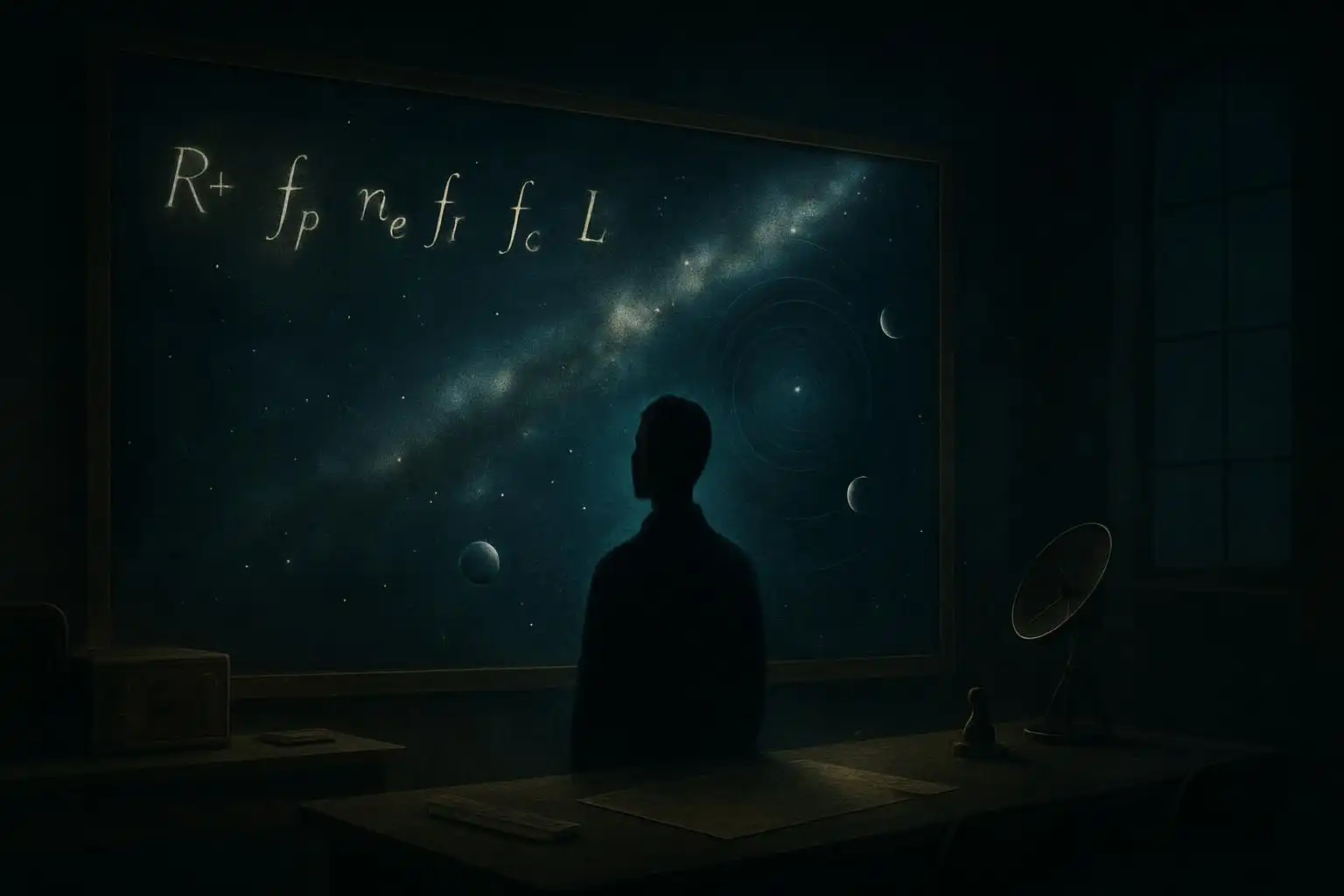
N = R* × f_p × n_e × f_l × f_i × f_c × L
Seven terms. Seven questions dressed up as variables. And more than sixty years later, we still can’t fill in most of them with confidence.
That, it turns out, is exactly the point.
What the Equation Actually Says
Let’s walk through it, because the terms themselves are a kind of poetry.
R* is the rate at which new stars form in our galaxy — roughly a handful per year, a number astronomers feel pretty good about.
f_p is the fraction of those stars that have planets. In Drake’s day, we had zero confirmed exoplanets. Today, we’ve confirmed more than 5,500, and the data from missions like Kepler suggest that planets are not the exception — they are the rule. Nearly every star you see in the night sky likely has at least one world orbiting it. That’s staggering.
n_e is the number of those planets that could support life — the ones in the so-called “habitable zone,” not too hot, not too cold, with liquid water potentially pooling on the surface. This is where things start to get genuinely uncertain, though discoveries like Proxima b — a rocky world orbiting our nearest stellar neighbor in the habitable zone — keep nudging our estimates upward.
f_l is the fraction of habitable planets where life actually arises. And here — here — the equation hits a wall. We have exactly one data point: Earth. Life appeared on our planet remarkably fast after it cooled, which some scientists take as a hopeful sign. Others caution that we might be a fluke so rare that no statistical conclusion is possible from a single case.
f_i is the fraction of life-bearing planets where intelligence evolves. Life on Earth survived for roughly 3.5 billion years before anything with a brain complex enough to ask questions about the cosmos showed up. Intelligence, it seems, is not inevitable — it’s a lucky accident layered on top of other lucky accidents.
f_c is the fraction of intelligent civilizations that develop technology capable of sending detectable signals into space. We’ve been doing this, more or less accidentally, for about a century — our radio and television broadcasts have been leaking into the cosmos since the 1920s. A sphere of “human noise” roughly 200 light-years across now drifts outward through the galaxy, carrying old episodes of I Love Lucy toward the stars whether we like it or not.
L is the length of time a civilization continues to transmit those signals before it goes silent — through extinction, technological change, or something we haven’t imagined yet. This is the term that keeps scientists up at night. If the average civilization broadcasts for only a few centuries before collapsing or going quiet, the galaxy could be full of life that we simply keep missing, like ships passing in the dark.
Why the Numbers Don’t Matter as Much as You Think
When Drake and his colleagues first plugged in their best guesses in 1961, they got an answer somewhere between 1,000 and 100,000,000 civilizations in the Milky Way. That’s a range so enormous it’s almost meaningless — like being asked how far it is to the store and being told “somewhere between one mile and one hundred thousand miles.”
Modern estimates aren’t much tighter. Optimists like the late Carl Sagan imagined a galaxy buzzing with civilizations. Pessimists invoke the “Rare Earth” hypothesis — the idea that Earth’s particular combination of a large stabilizing moon, a protective Jupiter, a long-lived stable star, and plate tectonics is so improbable that complex life might be vanishingly rare. Some researchers now put N at exactly 1. That would be us.
But here’s the thing Drake understood from the beginning: the equation was never meant to give us an answer. It was meant to show us what we don’t know.
Every term where we shrug our shoulders is a research program waiting to happen. Every blank is a question that a future generation of scientists — maybe a kid reading this right now — might spend a career trying to fill in.
The Fermi Paradox: The Silence That Screams
The Drake Equation has a famous, unsettling companion: the Fermi Paradox.
The story goes that in 1950, physicist Enrico Fermi was having lunch with colleagues and, in the middle of a conversation about UFO reports, suddenly asked: “But where is everybody?”
If the galaxy is old — and it is, roughly 13 billion years old — and if civilizations can arise and spread, then even at a fraction of the speed of light, a sufficiently motivated civilization could colonize the entire Milky Way in a few tens of millions of years. That sounds like a long time, but it’s less than 1% of the galaxy’s age. Even if interstellar travel is hard and slow, there’s been enough time for it to happen many times over.
And yet: silence. No confirmed signals. No alien megastructures (though the star KIC 8462852 — “Boyajian’s Star” — gave us a delicious scare for a while). No visitors. Nothing.
This silence is itself a data point, and it’s a haunting one.
Proposed solutions to the Fermi Paradox range from the mundane to the existential:
- The Great Filter: Something — disease, war, climate collapse, the invention of some catastrophic technology — tends to wipe out civilizations before they can spread. The terrifying version of this idea is that the filter lies ahead of us, not behind.
- The Zoo Hypothesis: Advanced civilizations are watching us deliberately and choosing not to make contact, the way we observe animals in the wild without interfering.
- The Dark Forest: Civilizations hide because the universe is dangerous and making yourself known invites destruction. (Liu Cixin’s The Three-Body Problem explores this idea with chilling elegance.)
- We’re simply early: The universe may still have immense star-forming potential ahead of it, particularly among long-lived low-mass stars. Perhaps we’re among the first civilizations to arise, and the galaxy is simply not yet full.
None of these is proven. All of them are worth sitting with.
What It Feels Like to Ask the Question
I want to step back from the variables for a moment and say something about what it actually means to take the Drake Equation seriously.
It means accepting that the question of whether we are alone is not a religious question, not a science-fiction question, but a scientific question — one with a real answer that exists in the universe whether we find it or not. Somewhere, right now, either there is another mind looking up at its own sky and wondering, or there isn’t. One of those things is true.
Think about what it would mean if we discovered microbial life on Mars, or in the oceans beneath Europa’s ice, or in the clouds of Venus. If that life proved to have arisen independently — through distinct biochemistry or a separate origin — it would mean life had emerged at least twice in a single solar system, which would strongly suggest the universe is teeming with it. The f_l term in Drake’s equation would jump from a mystery to something close to certainty. The whole calculation would shift overnight.
Or think about what it would mean if we searched thoroughly and found nothing — not in our solar system, not in the signals from a thousand nearby stars, not in the atmospheres of exoplanets analyzed by the James Webb Space Telescope. That silence would be its own answer, and a profound one.
A Mirror, Not a Calculator
Here’s what I keep coming back to: every term in the Drake Equation that we can’t answer is really a question about ourselves.
How often does life begin? We don’t know, because we don’t yet understand how life began here.
How often does intelligence evolve? We don’t know, because we don’t yet understand what intelligence is or why it emerged in us.
How long do civilizations last? We don’t know, because our own civilization is still in its adolescence, still figuring out whether it will survive its own ingenuity.
The Drake Equation is a mirror held up to humanity’s ignorance — not to mock us, but to show us the shape of what we have yet to learn. It is an invitation. It says: these are the things you need to understand. Get to work.
Frank Drake wrote seven symbols on a chalkboard to start a conversation. More than sixty years later, that conversation has grown into astrobiology, SETI, exoplanet science, and the search for biosignatures in alien atmospheres. It has given careers to thousands of scientists and wonder to millions of people who will never set foot in a laboratory.
Not bad for an equation that, technically, has never been solved.
The next time someone asks you whether you think we’re alone in the universe, notice what happens inside you when you consider the question. That feeling — the mix of hope and vertigo and strange longing — is what Frank Drake put into seven symbols. It’s what the cosmos does to a mind that’s paying attention.


Leave a Reply