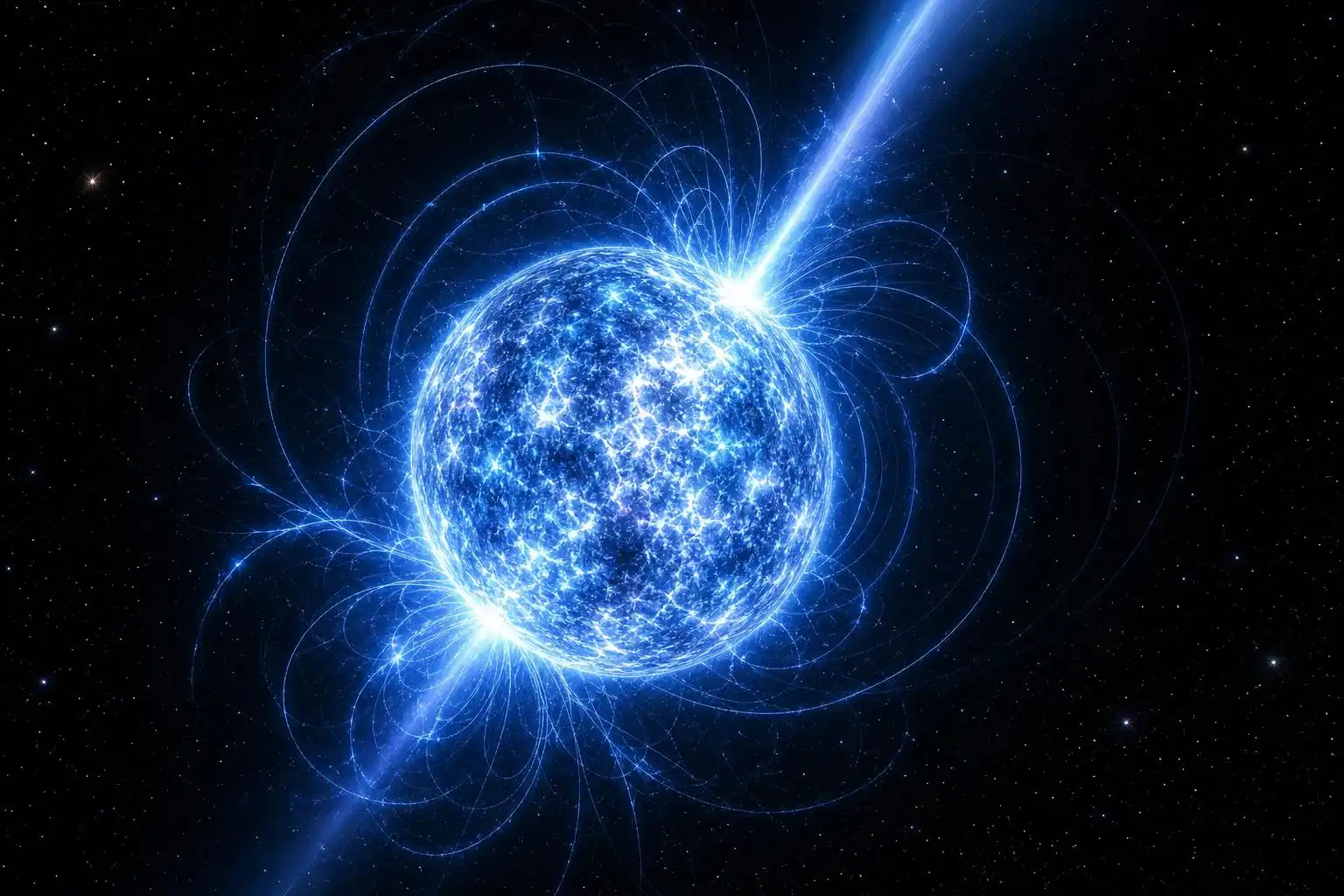

Imagine holding a sugar cube in your palm. Now imagine that sugar cube weighs as much as a mountain. That’s not a typo, and it’s not science fiction. That is, more or less, what a cubic centimeter of neutron star material would weigh if you could somehow scoop it up and bring it back to Earth.
You couldn’t, of course. But let’s go there anyway.
The Collapse That Makes a Neutron Star
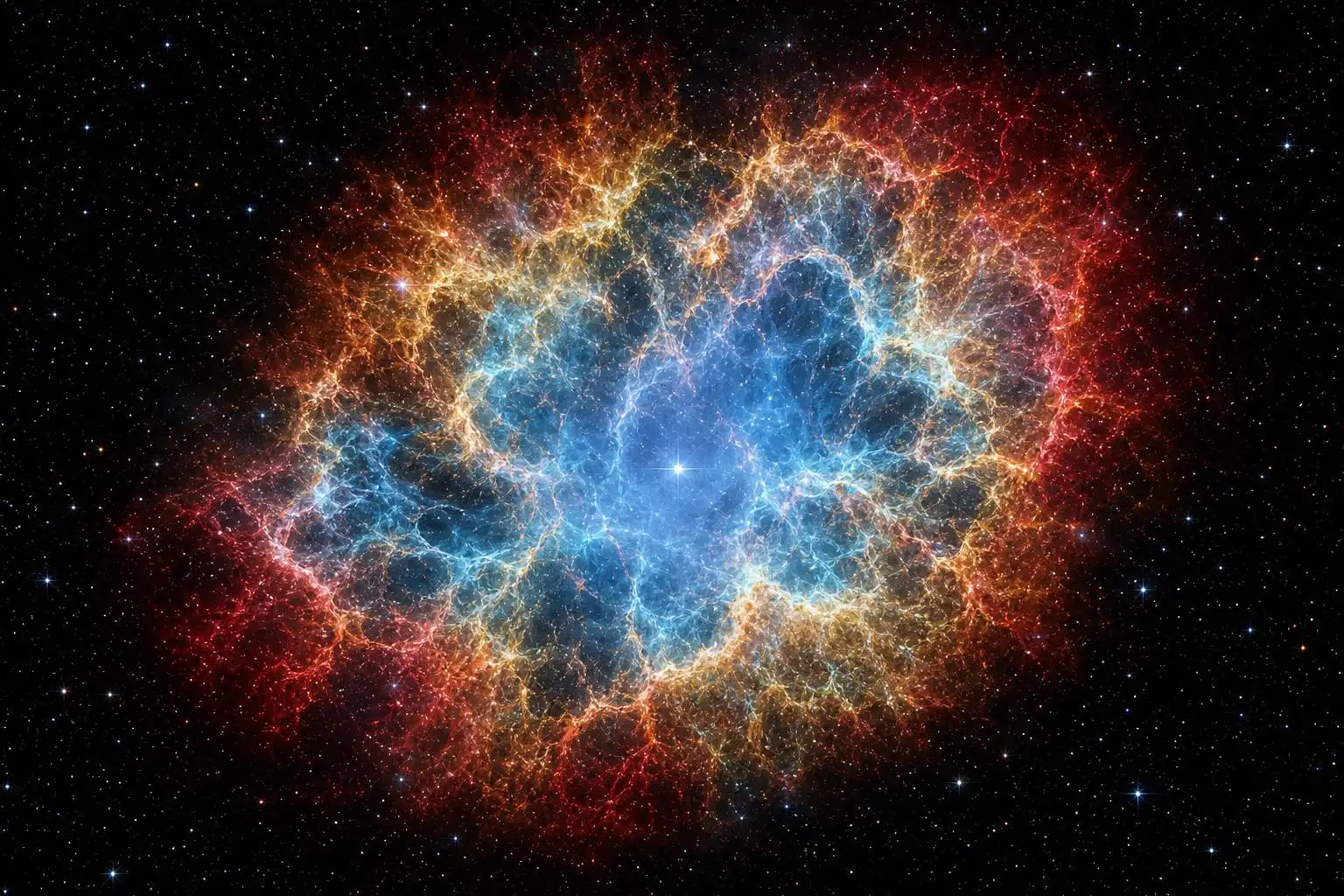
When a massive star — something eight to twenty times heavier than our Sun — runs out of fuel, its core stops fighting gravity. In less than a second, a ball of iron the size of Earth collapses into something roughly the size of a city. The outer layers, rebounding from this sudden implosion, blast outward in one of the most violent events in the known universe: a core-collapse supernova.
What’s left behind is a neutron star.
It is, in every meaningful sense, a city-sized atomic nucleus. The electrons and protons that made up ordinary matter have been squeezed together so violently that they merged into neutrons, packed shoulder-to-shoulder with no room left between them. The density is so extreme that a single teaspoon of neutron star material — about five milliliters — would weigh roughly hundreds of millions of tons. The numbers are so large they resist easy comparison.
Let that land for a moment. A teaspoon.
A Surface You Cannot Stand On
If you somehow survived the journey and found yourself hovering just above a neutron star’s surface, the first thing you’d notice is that “surface” is a generous word. The crust — a thin, crystalline lattice of exotic atomic nuclei — is perhaps a kilometer deep, and beneath it lies a fluid of pure neutrons behaving in ways that have no parallel in everyday physics. Some models suggest the very center may contain strange quark matter, a phase of matter so exotic it doesn’t have a proper name that fits comfortably in a sentence.
The gravity at the surface is roughly 200 billion times stronger than what you feel standing on Earth right now. If you dropped a marshmallow from a height of one meter above the surface, it would hit with an enormous release of energy — comparable to a large conventional explosion. A human body — well, let’s just say the concept of “standing” becomes irrelevant very quickly. You would be stretched, compressed, and atomized before you got within a thousand kilometers.
The magnetic field, meanwhile, is so intense that it would distort the electron clouds around atoms, pulling them into thin cigar shapes aligned with the field lines. Matter as we know it — the stuff that makes up your chair, your coffee cup, your bones — simply cannot exist in its normal form anywhere near a neutron star.
The Pulsar: A Cosmic Lighthouse
Many neutron stars spin. And when they spin, they spin fast. A newly born neutron star can rotate hundreds of times per second — faster than a kitchen blender on its highest setting. Because of their intense magnetic fields, they beam radiation from their poles. If that beam sweeps past Earth with each rotation, we detect a precise, repeating pulse of radio waves. We call these pulsars.
The first pulsar was discovered in 1967 by Jocelyn Bell Burnell, a graduate student at Cambridge. The signal was so regular — so impossibly regular — that for a brief, thrilling few weeks, the team half-jokingly labeled it LGM-1. Little Green Men. It was, they thought, almost too perfect to be natural.
It was natural. It was just a neutron star doing what neutron stars do: spinning with the precision of an atomic clock, slowing imperceptibly over millions of years as it radiates energy into space. Some pulsars are so stable that they outperform the best human-made clocks. Astronomers actually use them as a kind of cosmic GPS system, cross-referencing their pulses to detect gravitational waves rippling through spacetime.
Why Should You Care? (You, Specifically, Right Now)
Here’s the honest question: why does any of this matter to someone who isn’t a physicist, who will never visit a neutron star, whose morning commute involves traffic and not exotic quark matter?
I think the answer is this: neutron stars are proof that reality is far stranger than our intuitions allow.
We spend our lives in a narrow band of experience — temperatures between roughly -40 and 50 degrees Celsius, pressures within a factor of two of sea level, densities between air and iron. Our brains evolved to navigate this world. The neutron star is a reminder that the universe is not obligated to stay within those limits. It has been running physics experiments at extremes we cannot replicate in any laboratory on Earth, and it has been doing so for billions of years.
When you hear that a teaspoon of neutron star weighs hundreds of millions of tons, your brain probably rejects it — not because it’s wrong, but because you have no framework for it. And that rejection, that momentary cognitive stumble, is actually the most honest response. It means you’ve just bumped up against the edge of what human intuition can handle. That edge is where physics lives.
The Ones We’ve Actually Seen
We haven’t just theorized about neutron stars. We’ve watched them do remarkable things.
In 2017, the LIGO and Virgo gravitational wave detectors picked up the signal of two neutron stars spiraling toward each other and merging — an event called GW170817. Simultaneously, telescopes around the world caught the light from the explosion that followed, called a kilonova. That single event confirmed something scientists had long suspected: neutron star mergers are a major source of the universe’s heaviest elements. The r-process elements — gold, platinum, and others — that make up your jewelry and your electronics were forged in collisions like this one, scattered across space, and eventually incorporated into the dust cloud that became our solar system.
The heavy elements in your body have a remarkable origin story.
There’s also the Crab Nebula, the remnant of a supernova that exploded in 1054 CE — an event so bright that Chinese and Arab astronomers recorded it as a “guest star” visible in broad daylight for weeks. At the center of that beautiful, expanding cloud of gas sits a pulsar spinning 30 times per second, still pouring energy into the nebula nearly a thousand years later. You can see the Crab Nebula with a modest backyard telescope. The pulsar at its heart is one of the most studied objects in astronomy.
The Feeling of Knowing
There’s a particular kind of vertigo that comes from really sitting with what a neutron star is. Not just reading the numbers, but trying — genuinely trying — to feel them.
A city-sized object. More massive than the Sun. Spinning hundreds of times per second. Magnetic field a trillion times stronger than Earth’s. Surface gravity 200 billion times what you feel in your chair. Temperatures at birth exceeding 100 billion degrees Celsius, cooling over millions of years to a still-scorching million degrees.
And yet: we know this. We have measured it, modeled it, watched two of them collide from some 130 million light-years away, and traced the gold in a wedding ring back to their debris. That we can know this — that the universe left enough clues for creatures like us, with our fragile bodies and our 80-year lifespans and our sugar-cube thought experiments — is, to me, the most astonishing thing of all.
The neutron star doesn’t know we’re watching. It doesn’t care. It just spins, and pulses, and slowly cools, carrying inside it the record of physics at its most extreme — waiting, patiently, for someone curious enough to ask what it would feel like to visit.



Leave a Reply