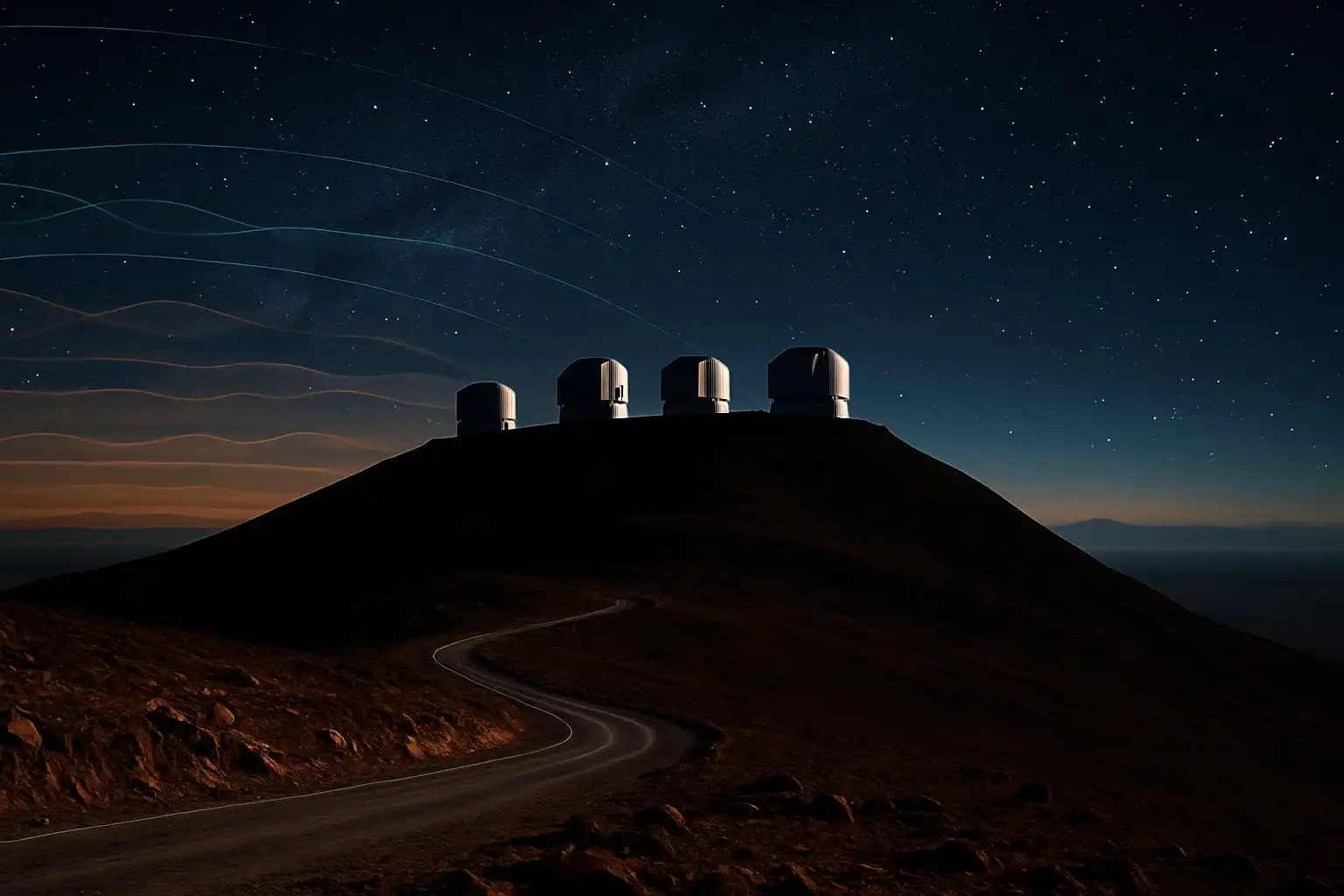

Stand on Cerro Paranal at 2,635 meters and look west across the Atacama Desert toward the Pacific, about twelve kilometers away. The air is dry enough that your lips crack. The sky is clear more than 320 nights per year. And the seeing—the angular blurring caused by atmospheric turbulence—averages 0.63 arcseconds in visible light, measured night after night, year after year, since the Very Large Telescope began operations in 1999.
That number, 0.63 arcseconds, is not an accident. It is the product of a fifteen-year site-testing campaign that began in 1983, involved more than twenty candidate mountains across Chile and Argentina, and deployed instruments that measured not just how often the sky was clear but how steady the atmosphere actually was. Paranal won because the data said it would deliver the sharpest images, and the VLT’s science return—exoplanet transits resolved to parts per thousand, stellar surfaces mapped with interferometry, high-redshift galaxies dissected with adaptive optics—depends on that choice.
This is the story of how you pick a place to see the universe clearly, and what “clearly” means when you measure it.
The Seeing Budget: Where the Blur Comes From
Seeing is the full-width at half-maximum (FWHM) of a point source—a star’s image—after atmospheric turbulence has scrambled the wavefront. On a night with 1.0 arcsecond seeing, a star that would be diffraction-limited (0.02 arcseconds at 500 nm for an 8-meter telescope) spreads into a disk one arcsecond across. The atmosphere has stolen fifty times the angular resolution.
Turbulence comes from layers. Near the ground, within tens of meters, daytime heating creates convective cells that churn the air. This is the boundary layer, and it contributes 0.3 to 0.5 arcseconds of seeing at a bad site. Higher up, between 5 and 15 kilometers, the jet stream shears across temperature gradients, creating turbulence that adds another 0.3 to 0.6 arcseconds. The free atmosphere—everything above the boundary layer—is beyond your control; you cannot move the jet stream. But the boundary layer is local, and it depends on the ground beneath the telescope.
Paranal’s advantage is that the boundary layer is thin and weak. The summit is a dry, rocky plateau with almost no vegetation and minimal thermal mass. Daytime heating is fierce—surface temperatures exceed 30°C—but after sunset the rock cools quickly, and the temperature gradient between ground and air collapses within an hour. By 22:00 local time, the boundary layer is typically 50 meters thick, and its contribution to seeing drops below 0.2 arcseconds. The free atmosphere contributes the rest, and on a median night the total is 0.63 arcseconds.
Compare that to a site at lower altitude, or near vegetation, or on a mountain with afternoon clouds that delay cooling. The boundary layer stays thick and turbulent for hours after sunset. Seeing stays above 1.0 arcseconds until midnight, and the first half of the night—often the most productive, when targets are highest—is lost.
The 1980s Campaign: Measuring Turbulence at Twenty Mountains
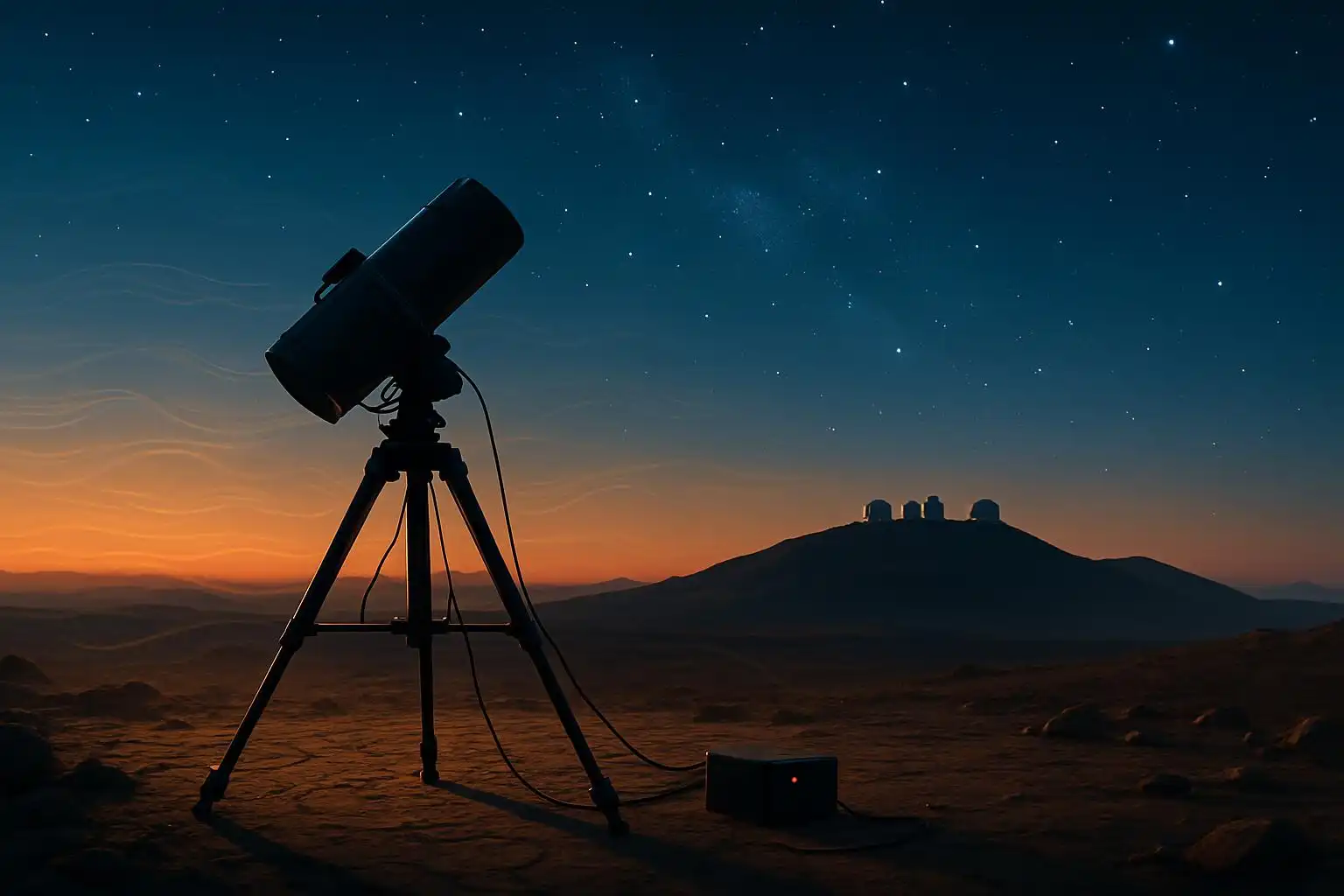
ESO’s site-testing campaign for what would become the VLT began in 1983. The goal was quantitative: measure seeing, cloud cover, precipitable water vapor, and wind speed at candidate sites, then rank them. The lead instrument was a Differential Image Motion Monitor (DIMM), which measures the motion of two star images separated by a known baseline—typically 10 to 20 centimeters—and converts that motion into a seeing estimate. The faster the images dance relative to each other, the stronger the turbulence.
A DIMM is a small telescope, often 35 cm aperture, with a mask over the entrance pupil that creates two sub-apertures. Each sub-aperture images the same star, and a CCD records both images at 10 to 100 frames per second. Software tracks the centroid of each image and computes the variance in their separation. The Fried parameter r₀, which characterizes the coherence length of the wavefront, is derived from that variance, and seeing FWHM is approximately λ/r₀ in radians.
ESO deployed DIMMs at more than twenty sites between 1983 and 1990. Cerro Paranal was added to the list in 1990, late in the campaign, after earlier surveys had ruled out wetter or cloudier mountains. The Paranal DIMM ran every clear night for three years, logging seeing measurements every minute. The median was 0.66 arcseconds. The 25th percentile was 0.50 arcseconds. The 75th percentile was 0.85 arcseconds. Nights with seeing below 0.4 arcseconds occurred roughly 10 percent of the time, and nights with seeing above 1.0 arcseconds were rare—less than 15 percent.
Other sites in the Atacama came close. Cerro Tololo, more than 600 kilometers south, had median seeing near 0.8 arcseconds. La Silla, ESO’s existing observatory 600 kilometers south of Paranal, measured 0.9 arcseconds. Armazones, a mountain 20 kilometers from Paranal and now home to the Extremely Large Telescope, showed 0.7 arcseconds in early tests. But Paranal had the best combination: excellent seeing, more than 300 clear nights per year, low precipitable water vapor (median 2.5 mm, critical for infrared work), and stable winds below 10 m/s most nights.
In 1991, ESO chose Paranal.
What the VLT Does With 0.63 Arcseconds
Seeing sets the floor for angular resolution in visible and near-infrared imaging. Without adaptive optics, the VLT’s four 8.2-meter Unit Telescopes deliver images with FWHM equal to the seeing—0.6 to 0.7 arcseconds on a typical night. That is sharp enough to resolve binary stars separated by 0.8 arcseconds, to track proper motions of stars near the Galactic center (where 0.6 arcseconds corresponds to roughly 5,000 AU at 8 kpc), and to measure photometric variability of high-redshift quasars without blending from nearby galaxies.
With adaptive optics, Paranal’s seeing becomes the starting point, not the limit. The VLT’s NACO instrument, which operated from 2002 to 2019 on Unit Telescope 4 (Yepun), used Shack-Hartmann wavefront sensors and a 185-actuator deformable mirror. On a night with 0.65 arcsecond seeing, NACO delivered Strehl ratios near 60 percent at K band (2.2 μm), corresponding to a core FWHM of 0.05 arcseconds—thirteen times sharper than the uncorrected seeing. That resolution revealed the orbits of stars within 0.1 arcseconds of Sgr A*, the supermassive black hole at the Galactic center, and allowed mass measurements accurate to a few percent.
NACO’s successor, ERIS, began operations in 2023 and pushes further. ERIS uses a pyramid wavefront sensor and a 1,170-actuator deformable mirror, achieving Strehl ratios above 70 percent at K band and 30 percent at H band (1.65 μm) under good seeing. The higher actuator count corrects turbulence in thinner layers of the atmosphere, and the pyramid sensor is more sensitive than curvature sensing, allowing guide stars as faint as R = 17 magnitude. On a 0.5-arcsecond night—10 percent of Paranal nights—ERIS delivers 0.04-arcsecond resolution at K band, approaching the diffraction limit.
Interferometry leverages Paranal’s seeing in a different way. The VLT Interferometer (VLTI) combines light from two or more of the Unit Telescopes, or from the four 1.8-meter Auxiliary Telescopes, to synthesize baselines up to 200 meters. At K band, a 200-meter baseline gives angular resolution of 2 milliarcseconds—three hundred times finer than the seeing. But the interferometer still needs stable seeing to deliver high fringe contrast. Turbulence scrambles the phase of the incoming wavefront on timescales of milliseconds, and if the seeing is poor, the coherence length r₀ is small—often smaller than the telescope diameter. That reduces the coupling efficiency into the single-mode fibers that feed the beam combiner, and the fringe signal weakens.
On a night with 0.6-arcsecond seeing, r₀ is roughly 20 cm at 500 nm, or 90 cm at 2.2 μm (scaling as λ^6/5^). The Auxiliary Telescopes, with 1.8-meter aperture, span two coherence lengths at K band, which is manageable; the AO systems on the Unit Telescopes correct the wavefront down to one coherence length or better. The GRAVITY instrument, which began science operations in 2016, routinely achieves fringe contrasts above 90 percent and astrometric precision of 10 microarcseconds, enough to track the orbit of S2 around Sgr A* and detect relativistic precession.
None of this works if the seeing is 1.2 arcseconds. The coherence length drops, the Strehl ratio collapses, the fringe contrast fades. Paranal’s median 0.63 arcseconds is not a luxury; it is the reason the VLT can do interferometry at all.
The Ongoing Measurement: DIMM and MASS
Paranal’s seeing is monitored every night. A DIMM operates continuously on a platform near the summit, measuring seeing at 500 nm with 30-second cadence. The data are logged and published in real time, and observers use them to decide whether to switch instruments, adjust AO parameters, or wait for conditions to improve.
Since 2005, Paranal has also operated a Multi-Aperture Scintillation Sensor (MASS), which measures free-atmosphere turbulence as a function of altitude. MASS observes the scintillation pattern of a bright star—the rapid flickering caused by turbulence—through four concentric annular apertures. The scintillation power in each annulus depends on the turbulence strength in different atmospheric layers, and inversion of the covariance matrix yields a turbulence profile above the lowest atmosphere: how much seeing comes from the lower troposphere, the upper troposphere, and the stratosphere. MASS is essentially insensitive to the lowest few hundred meters, so boundary-layer seeing is inferred by comparing total seeing from the DIMM with free-atmosphere seeing from MASS.
On a typical Paranal night, combined DIMM and MASS measurements indicate that 25 percent of the turbulence is in the boundary layer, 50 percent between 5 and 12 km (the jet stream), and 25 percent distributed elsewhere. The boundary layer contribution drops to 15 percent by midnight, as the ground cools. Nights with strong jet-stream winds show 70 percent of the turbulence above 8 km, and the seeing is dominated by layers the telescope cannot avoid. Those nights are still good—0.7 to 0.8 arcseconds—but they are not the 0.4-arcsecond nights that come when the jet stream is weak and the boundary layer is calm.
Combined turbulence profiles also inform adaptive optics. Ground-layer AO systems, which correct only the lowest few hundred meters of turbulence, are most effective when the boundary layer is strong. At Paranal, the boundary layer is usually weak, so full-column AO (correcting turbulence up to 10 km with laser guide stars) is more valuable. ERIS and the upcoming MAVIS instrument (planned for 2028) use sodium laser guide stars at 90 km altitude, sensing turbulence across the entire atmospheric column and correcting it with high-order deformable mirrors.
Why Not Higher?
Paranal is 2,635 meters above sea level. Mauna Kea is 4,205 meters. The Chajnantor plateau, home to ALMA, is about 5,000 meters. Why not build the VLT higher, where the atmosphere is thinner and the seeing might be better?
The answer is that seeing does not improve monotonically with altitude. The free-atmosphere turbulence—the jet stream and upper troposphere—is the same whether you are at 2,600 or 4,200 meters. You are still below it. What changes with altitude is the boundary layer and the total atmospheric thickness above you.
Mauna Kea has excellent seeing, median 0.65 arcseconds, nearly identical to Paranal. The advantage of Mauna Kea is not better seeing but lower water vapor—median precipitable water vapor is 1.5 mm, compared to Paranal’s 2.5 mm—which opens the near-infrared atmospheric windows more cleanly. The disadvantage is logistics: Mauna Kea is remote, and the summit altitude causes hypoxia. Observers and engineers work shorter shifts, and construction is slower.
The Chajnantor plateau, at about 5,000 meters, has median precipitable water vapor below 1 mm, which is why ALMA is there—submillimeter astronomy requires the driest possible air. But the seeing at Chajnantor is mediocre, 0.8 to 1.0 arcseconds, because the Chajnantor plateau is broad and flat, and daytime heating creates strong convective turbulence that persists after sunset. ALMA does not care; radio interferometry at millimeter wavelengths is insensitive to optical seeing. But an optical telescope would suffer.
Paranal balances seeing, water vapor, cloud cover, and accessibility. The site is dry enough for near-infrared work (the H and K bands are clean, and the L and M bands are usable), the seeing is among the best measured anywhere, and the summit is accessible by paved road from the coast. Engineers and staff live at the Paranal base camp, 9 km from the summit at 2,400 meters, where oxygen levels are tolerable. Construction of the VLT took six years, from 1994 to 2000, and the site has supported continuous operations for twenty-five years.
The Discipline of Choosing Where to Look
Site selection is not glamorous. It does not produce images of galaxies or spectra of exoplanets. It is years of data acquisition, statistical analysis, and comparison of numbers that differ by tenths of an arcsecond. But those tenths matter. A site with 0.9-arcsecond seeing instead of 0.6 loses a factor of two in angular resolution, a factor of four in the area of the point-spread function, and a corresponding loss in the ability to separate faint sources from bright neighbors, to measure photometry in crowded fields, or to achieve high Strehl ratios with adaptive optics.
Paranal’s 0.63 arcseconds is the result of measuring the atmosphere as carefully as astronomers measure stars. The DIMM that ran for three years in the early 1990s, logging seeing every minute, built the dataset that justified the VLT’s construction. The DIMM and MASS that run every night today ensure that the site still delivers what the campaign promised.
When you see an image from the VLT—a resolved protoplanetary disk, a spectrum of a star orbiting Sgr A*, an interferometric map of a red giant’s surface—remember that the clarity began with someone standing on a desert mountain, pointing a 35-cm telescope at a star, and counting how many pixels the atmosphere made it dance.



Leave a Reply