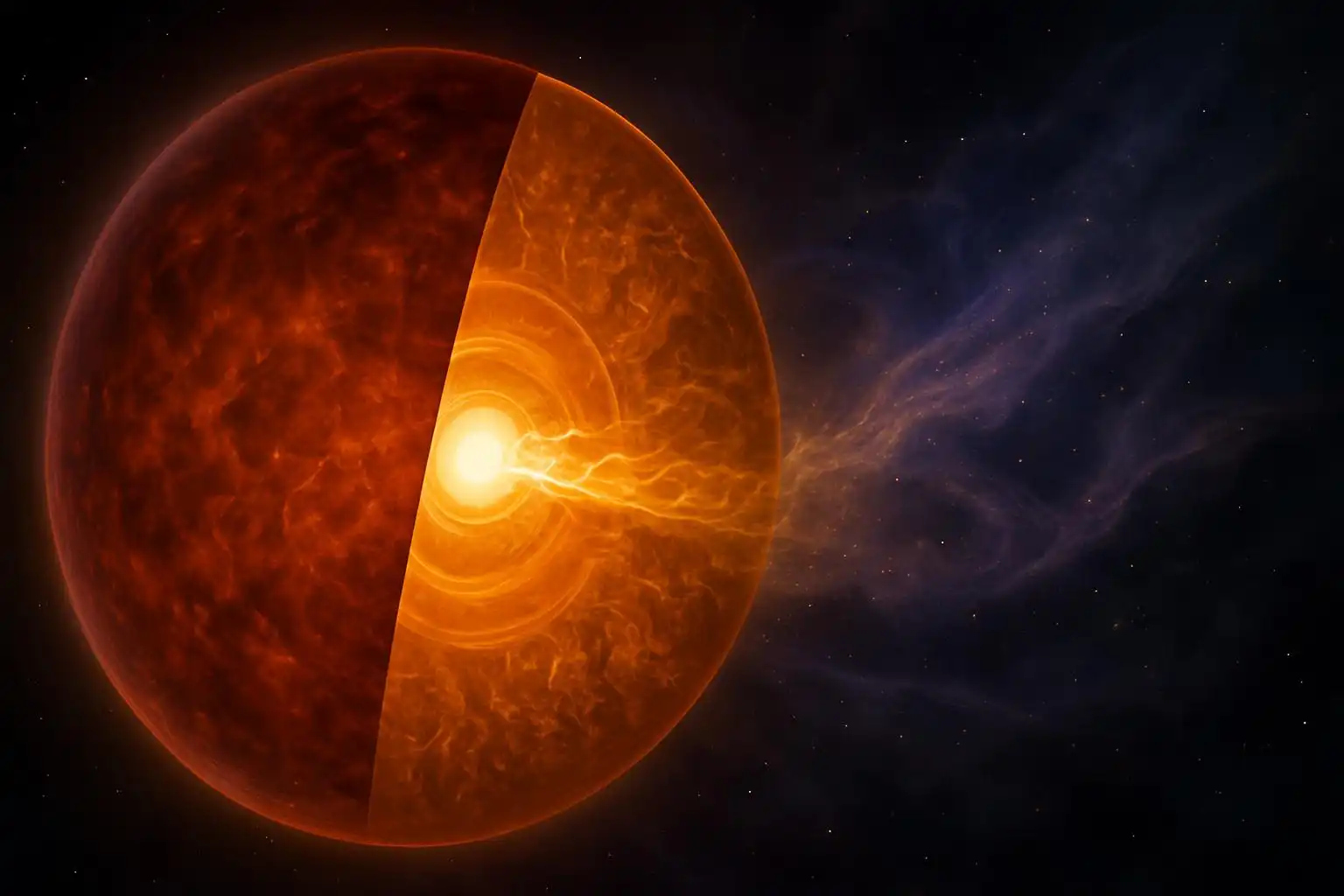

Thermal Pulses on the AGB: When Stars Breathe Fire
By the time a low- or intermediate-mass star reaches the thermally pulsing AGB after core helium exhaustion, it has already lived several dramatic lives. It spent millions to billions of years fusing hydrogen on the main sequence, swelled into a red giant as hydrogen shell burning pushed its envelope outward, then passed through a core-helium-burning phase — the horizontal branch or red clump for lower-mass stars, with more massive AGB progenitors igniting helium non-degenerately and evolving through analogous core-helium-burning stages. What comes next is anything but quiet. The star ascends the Asymptotic Giant Branch (AGB), and there, sandwiched between a helium-burning shell and a hydrogen-burning shell, something deeply unstable begins to happen. Roughly every ten thousand to one hundred thousand years, the star convulses in a thermal pulse — a helium shell flash that restructures its interior, dredges newly synthesized carbon to the surface, and helps shape the mass-loss history that will end the star’s giant-branch life.
This is the mechanism I want to focus on: not the AGB as a whole, but the specific instability that makes it one of the most chemically productive environments in the galaxy.
The Double-Shell Architecture
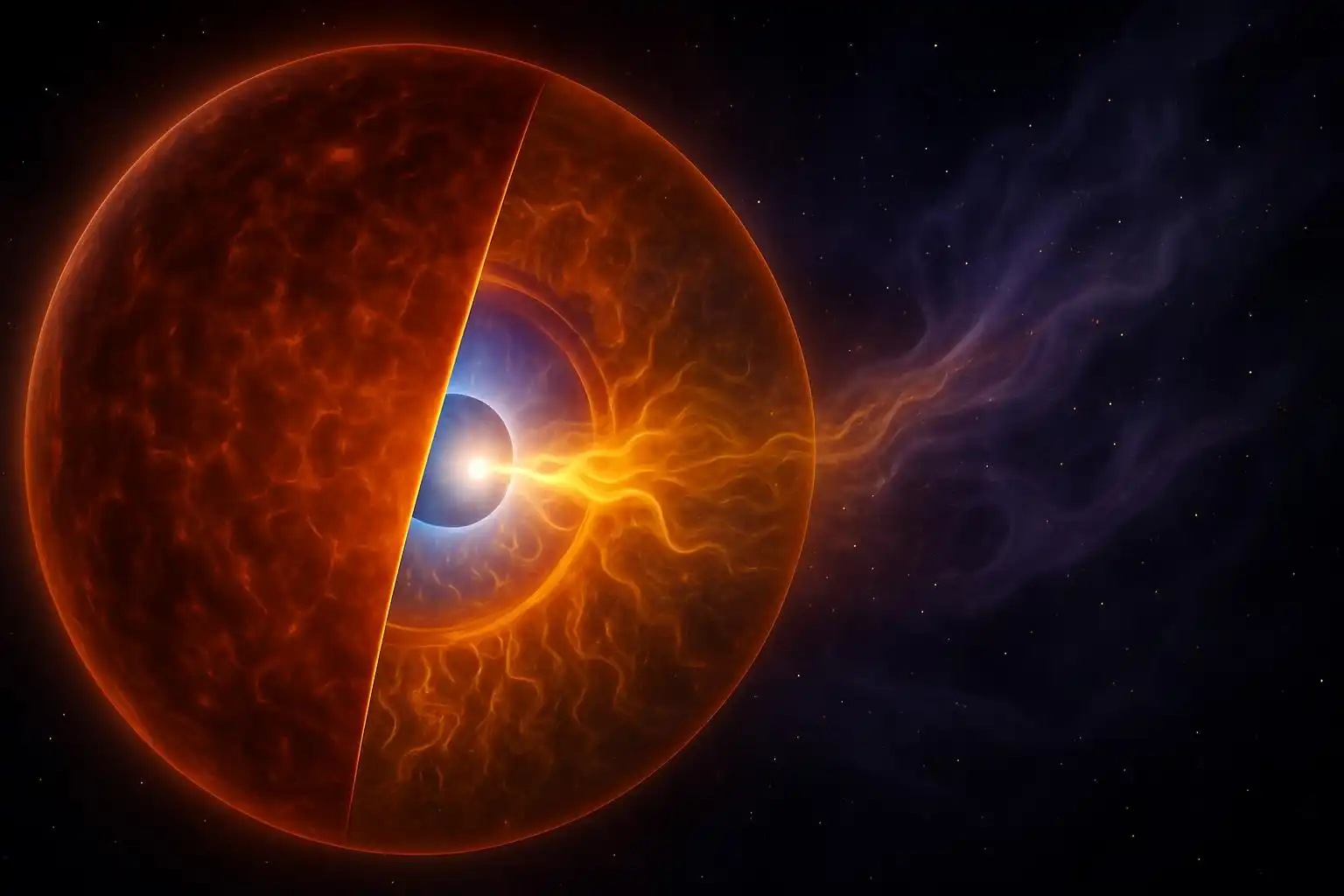
To understand why thermal pulses occur, you need to picture the AGB interior precisely. After core helium exhaustion, the star’s energy comes from two concentric shells:
- An outer hydrogen-burning shell (H-shell), fusing hydrogen via the CNO cycle at temperatures around 50–80 million K.
- An inner helium-burning shell (He-shell), sitting just above the degenerate core — carbon-oxygen in ordinary AGB stars — operating at temperatures near 150–300 million K — but not continuously.
Between these two shells lies a thin region called the intershell zone, roughly 10⁻³ to 10⁻² solar masses of material composed mostly of helium, with some carbon and oxygen mixed in from prior burning episodes. The H-shell burns steadily, depositing fresh helium ash onto the top of this intershell. The He-shell, by contrast, is thermally unstable.
The Instability: Why the He-Shell Cannot Burn Steadily
The root cause of thermal pulses is a fundamental property of thin shell burning. When a burning shell is geometrically thin relative to the radius of the star, it operates under nearly constant pressure — the weight of the overlying envelope doesn’t change much as the shell expands slightly. In a constant-pressure environment, the triple-alpha process (3α → ¹²C) has a catastrophically steep temperature dependence: the energy generation rate scales roughly as ε ∝ T¹⁸ near 150 million K, compared to T⁴ for the pp chain or T¹⁶–T²⁰ for the CNO cycle.
Here is the instability in plain terms. Suppose a small temperature fluctuation heats the He-shell slightly. The energy generation rate surges — by a factor of several for even a 10% temperature increase. In a normal stellar region, this would cause expansion and cooling, a negative feedback. But in a thin shell, the overlying pressure barely changes. The shell cannot expand its way out of the runaway. Instead, it heats further, generates more energy, heats further again. The result is a thermonuclear runaway — a helium shell flash.
This is not a gentle process. During a thermal pulse, the He-shell luminosity spikes to 10⁵–10⁸ solar luminosities on a timescale of years to decades, while the surface luminosity barely registers the event because the enormous convective region that develops — the pulse-driven convection zone (PDCZ) — absorbs most of the energy internally.
The Anatomy of a Single Pulse
A full thermal pulse cycle has four distinct phases, and understanding each one is essential to grasping why AGB stars are such prolific nucleosynthesis factories.
1. The Interpulse Phase. The H-shell burns steadily, depositing helium into the intershell. The He-shell is dormant. This phase lasts ~10⁴–10⁵ years depending on stellar mass — longer for lower-mass stars, shorter for more massive AGB stars. At the upper end, roughly 6–8 M☉ and above depending on composition and modeling, some stars ignite carbon and enter the super-AGB regime with ONe cores; the most massive of these may produce ONe white dwarfs or, in some cases, electron-capture supernovae rather than ordinary CO white dwarfs.
2. The Helium Shell Flash. When the accumulated helium layer reaches a critical mass — typically 10⁻³–10⁻² M☉ — the triple-alpha runaway ignites. A convective shell (the PDCZ) develops within the intershell, homogenizing its composition. The flash produces a wave of energy that expands the layers above the He-shell outward, temporarily extinguishing the H-shell. The star’s surface responds on a thermal timescale, so the photosphere actually contracts and dims slightly during the pulse — a counterintuitive but well-modeled result.
3. Third Dredge-Up (TDU). This is the chemically critical phase. After the flash subsides, the outer convective envelope — driven by the star’s luminosity — deepens inward, reaching into the intershell where the PDCZ has mixed carbon-rich material. The envelope convection dredges this material upward to the stellar surface. The parameter λ (lambda) quantifies the efficiency: λ = ΔM_dredge / ΔM_core, where values approaching 1 indicate highly efficient dredge-up. For a 2 M☉ AGB star, λ ≈ 0.5–0.9 depending on the model and mass loss prescription used.
Each pulse-dredge-up cycle enriches the surface in ¹²C, and after enough cycles, the carbon-to-oxygen ratio (C/O) at the photosphere can exceed 1. When C/O > 1, the star transitions from an M-type giant (oxygen-dominated molecular chemistry, TiO bands) to a carbon star (C-type, C₂ and CN bands dominating the spectrum). This is one of the most dramatic surface composition changes a star undergoes without changing its mass significantly.
4. Re-ignition. The H-shell re-ignites on top of the now-slightly-larger degenerate core, and the cycle begins again.
Nucleosynthesis in the Intershell: The s-Process
The thermal pulse cycle doesn’t just dredge up carbon. It is the primary site of slow neutron capture nucleosynthesis (s-process) for roughly half of all elements heavier than iron. The neutron source is the reaction:
¹³C + α → ¹⁶O + n (the ¹³C pocket)
During the third dredge-up, a small amount of hydrogen is mixed into the top of the intershell. In the interpulse phase, this hydrogen reacts with the abundant ¹²C to form ¹³C via:
¹²C(p,γ)¹³N(β⁺ν)¹³C
The resulting ¹³C pocket — a thin layer rich in ¹³C — releases neutrons when the next interpulse phase heats it to ~90 million K. Neutron densities reach ~10⁷–10⁸ cm⁻³, and over tens of thousands of years, seed nuclei (mostly iron-peak elements) capture neutrons sequentially, building up heavy elements: barium, lanthanum, cerium, neodymium, and ultimately lead and bismuth at the s-process termination point.
A second neutron source activates during the thermal pulse itself: ²²Ne + α → ²⁵Mg + n, operating at temperatures above 300 million K. This reaction produces higher neutron densities (~10¹⁰–10¹² cm⁻³) but for shorter durations, contributing to the synthesis of elements in the 60–90 mass range.
The s-process abundance pattern is observationally confirmed in AGB stars through spectroscopic detection of technetium — specifically ⁹⁹Tc, which has a half-life of ~210,000 years. Its presence in a stellar spectrum is unambiguous proof that nucleosynthesis is occurring in situ and that dredge-up is operating; any technetium formed before the star’s main-sequence life would have long since decayed. S. J. Merrill’s 1952 detection of Tc in S-type stars was one of the first direct confirmations that stars synthesize heavy elements during their lifetimes.
Mass Loss and the Termination of the AGB
Thermal pulses do not continue indefinitely. With each cycle, the degenerate core grows (usually CO in ordinary AGB stars, ONe in super-AGB stars), and the envelope is simultaneously eroded by stellar winds that intensify dramatically on the AGB. For stars that leave white dwarfs, typical final white dwarf masses range from ~0.5–1.1 M☉. Mass loss rates climb from ~10⁻⁸ M☉/yr early on the AGB to 10⁻⁵–10⁻⁴ M☉/yr during the “superwind” phase, driven mainly by pulsation-assisted dust formation and radiation pressure on dust grains that condense in the cool outer atmosphere (T_eff ~ 2500–3500 K for AGB stars, spectral types M, S, or C).
The interplay between pulse-driven dredge-up and mass loss determines the final white dwarf mass and the chemical yield returned to the interstellar medium. A star that loses its envelope before many dredge-up episodes occurs contributes little carbon or s-process material; one that retains its envelope through dozens of pulses may eject a carbon-rich nebula that becomes a planetary nebula with anomalous heavy-element abundances. The central star left behind — usually a bare CO white dwarf in ordinary AGB evolution, or an ONe remnant in super-AGB cases that avoid collapse — begins its long cooling sequence, but that is a story for another article.
An Open Question: The Dredge-Up Efficiency Problem
Despite decades of stellar modeling, the efficiency of third dredge-up remains poorly constrained. Observations of carbon stars in the Magellanic Clouds, where distances are well-known, show carbon stars at luminosities lower than most models predict for the onset of TDU. This implies either that dredge-up begins at lower core masses than models suggest, or that mass loss prescriptions are wrong, or both.
The problem is compounded by the treatment of convective boundaries in 1D stellar codes. The PDCZ boundary is determined by the Schwarzschild (or Ledoux) criterion, but real convective boundaries are fuzzy — overshooting, semiconvection, and internal gravity waves all transport material across the nominal boundary. The degree of overshooting at the base of the convective envelope during TDU directly sets λ, and it cannot yet be derived from first principles. Three-dimensional hydrodynamic simulations of AGB convection are only now reaching the point where they can inform 1D models, but they remain computationally prohibitive over the full pulse timescale.
This is not a minor uncertainty. The s-process yields fed into galactic chemical evolution models — used to explain the solar abundance pattern of barium, strontium, and lead — depend critically on λ and on the size of the ¹³C pocket, both of which are set by the uncertain convective physics at the pulse boundary.
Physical Intuition to Take Away
If you walk away from this article with one physical picture, let it be this: the thermal pulse cycle is nature’s consequence of putting a highly temperature-sensitive nuclear reaction under nearly constant pressure. The triple-alpha process cannot self-regulate the way hydrogen fusion does in the deep stellar interior, because the thin shell geometry removes the pressure-valve feedback. The result is a periodic runaway — not explosive enough to disrupt the star, but energetic enough to drive deep mixing, synthesize half the periodic table beyond iron, and ultimately disperse the star’s envelope into the interstellar medium.
Every atom of barium in your body, every xenon isotope in the solar wind, every lead atom in ancient Roman pipes — a significant fraction of them passed through the intershell of an AGB star, were convected upward by a thermal pulse, and were expelled in a slow stellar wind billions of years ago. The thermal pulse is not a curiosity of late stellar evolution. It is one of the galaxy’s primary chemical engines.


Leave a Reply