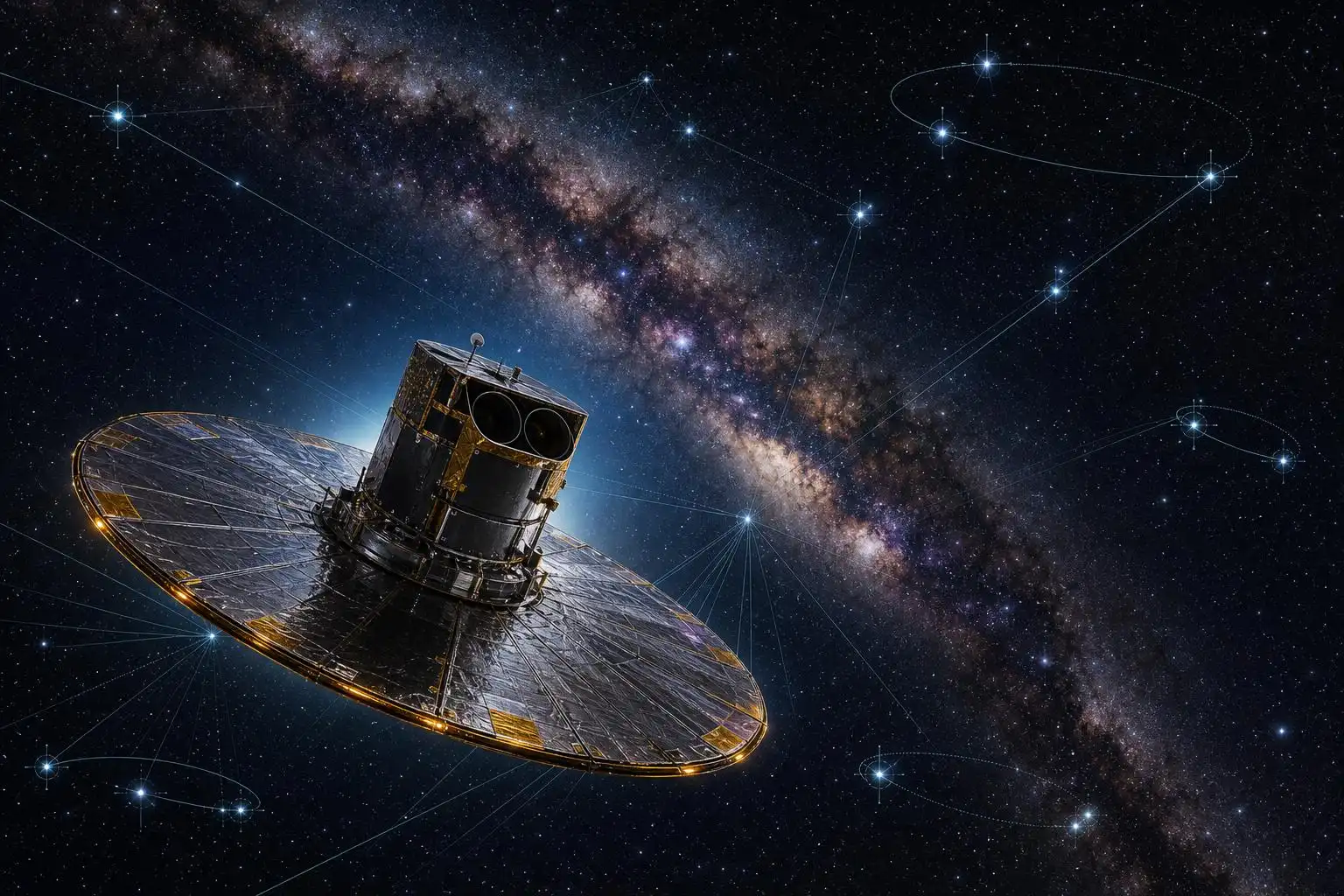

There is a telescope that measured the position of roughly 1.8 billion stars with an angular precision approaching 7 microarcseconds for the brightest sources. To put that in human terms: 7 microarcseconds is the angle subtended by a human hair viewed from 3,000 kilometers away. Gaia did this not occasionally, not for a handful of carefully chosen targets, but for every star brighter than about magnitude 21, over and over, for more than a decade. It is, without exaggeration, the most ambitious positional survey ever attempted, and the engineering behind it is as quietly radical as the science it produces.
The Problem Gaia Was Built to Solve
Astrometry — the precise measurement of stellar positions, proper motions, and parallaxes — is one of the oldest branches of astronomy and, for most of its history, one of the most brutally limited. Ground-based parallax measurements are smeared by atmospheric turbulence; the best pre-space-era catalogs carried position errors on the order of tens of milliarcseconds. ESA’s Hipparcos mission (1989–1993) changed the game by moving astrometry into orbit, delivering parallaxes for about 120,000 stars at milliarcsecond precision. But Hipparcos was a proof of concept. Gaia, approved in 2000 and launched in December 2013 aboard a Soyuz-STB/Fregat rocket from Kourou, was the full realization of what space astrometry could become.
The core requirement was simple to state and ferocious to achieve: measure stellar positions to microarcsecond precision for a catalog roughly 10,000 times larger than Hipparcos. That meant rethinking optics, detectors, thermal control, and spacecraft attitude — essentially everything.
The Orbit: Why L2 Isn’t Just for Infrared Telescopes
Gaia operated in a Lissajous orbit around the Sun-Earth L2 point, about 1.5 million kilometers from Earth in the anti-Sun direction. This is the same neighborhood as JWST, but Gaia’s reasons for being there were different. L2 provides a thermally stable environment — the Sun, Earth, and Moon all stay in roughly the same direction, behind a large sunshield — and it minimizes gravitational perturbations from Earth’s oblateness that would otherwise torment the spacecraft’s attitude. Attitude stability is everything in astrometry: if the spacecraft wobbles unpredictably, you cannot disentangle true stellar motion from platform jitter.
Gaia spun slowly on its axis at about 1 degree per minute, completing one full rotation every 6 hours. It also precessed, so that over 63 days the spin axis traced a cone around the Sun direction. This scanning law was not arbitrary — it was mathematically designed to ensure that every point on the sky was observed from multiple different scan angles over the mission lifetime. Without that angular diversity, you cannot separate the two coordinates of a star’s position; you need the sky to be “woven” together by overlapping scans. The result is a self-calibrating global reference frame, not a patchwork of local measurements.
Two Telescopes, One Focal Plane
Gaia’s optical design is a dual-telescope system sharing a single focal plane — an arrangement that sounds strange until you understand why it is indispensable. The two telescopes point in directions separated by a “basic angle” of exactly 106.5 degrees. As the spacecraft rotated, stars from both fields of view paraded across the same detector array in sequence. By measuring the precise time each star crosses a reference position, and knowing the basic angle between the two viewing directions, you can compute absolute parallaxes without needing an external reference. The basic angle is, in a very real sense, the ruler Gaia used to triangulate the universe.
Protecting that ruler was one of the mission’s central engineering obsessions. The basic angle had to remain stable to the picometer level — that is, fractions of an atomic diameter — over timescales of hours. Thermal fluctuations are the enemy. Gaia’s silicon carbide (SiC) optical bench, manufactured by Boostec in France and assembled by Airbus, was chosen precisely because SiC has an extremely low coefficient of thermal expansion. The entire optical structure — mirrors, bench, baffles — is monolithic SiC, about 3 meters across. Even so, residual basic-angle variations exist, and Gaia carried a laser metrology system (the Basic Angle Monitor, or BAM) that tracked them continuously so they could be removed in data processing.
The two primary mirrors are rectangular, each approximately 1.45 × 0.5 meters. They are not circular because the spacecraft’s rotation smears light in one direction; the elongated aperture maximizes light-gathering in the along-scan direction where the precision is highest. Effective collecting area per telescope is roughly 0.7 square meters.
The Focal Plane: 106 CCDs and a River of Data
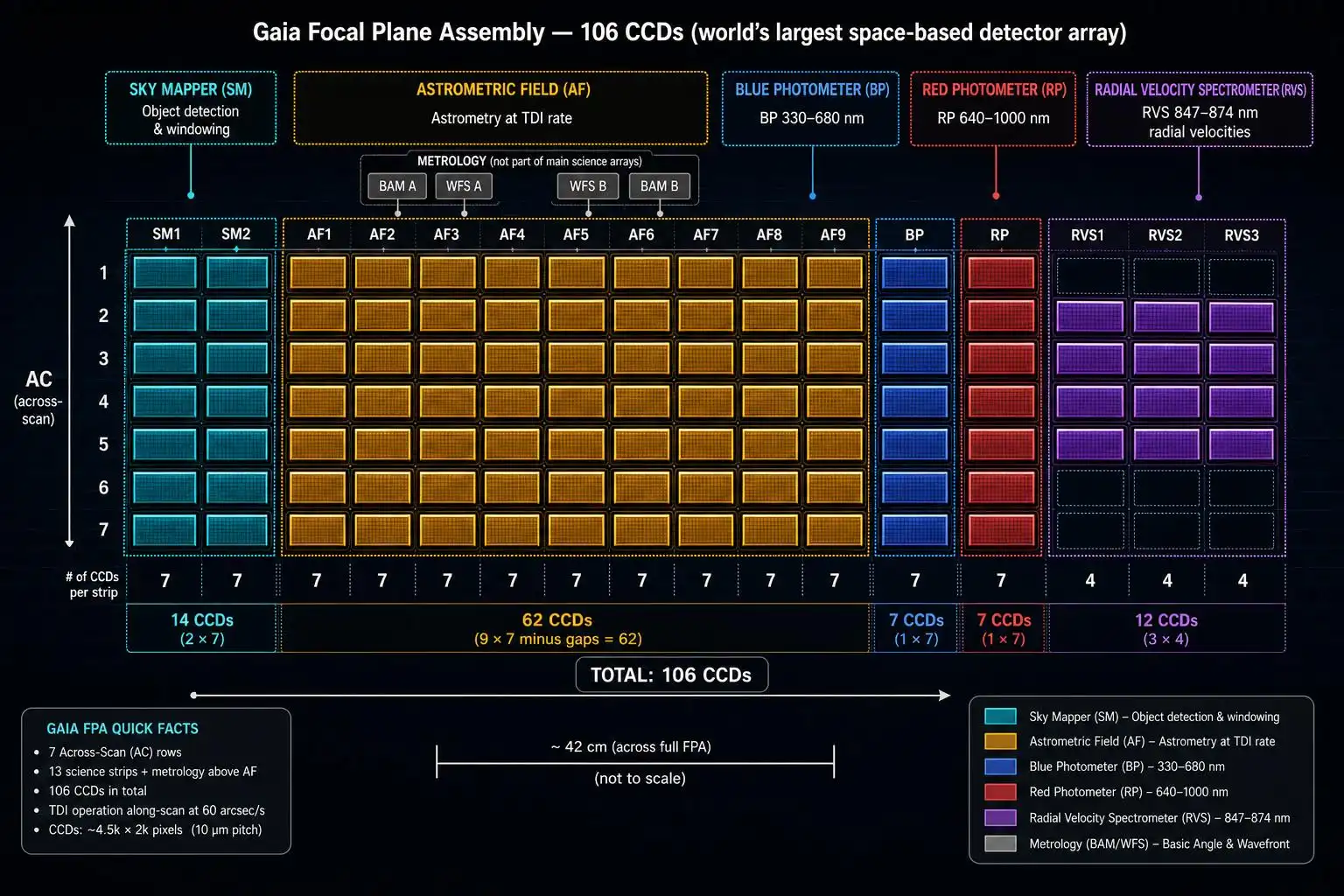
The focal plane assembly is the largest ever flown on a science mission: 106 CCDs arranged in a mosaic roughly 1 meter wide and 0.4 meters tall, containing nearly 1 billion pixels in total. The CCDs operated in time-delay integration (TDI) mode, meaning the charge was clocked along the detector at exactly the rate the stellar images drifted due to spacecraft rotation. Stars effectively “surfed” across the focal plane, accumulating signal from multiple CCD columns as they went.
The focal plane is divided into functional zones. The Sky Mapper CCDs detect incoming stars and determine which ones need to be read out. The Astrometric Field (AF) — nine columns of CCDs — is where the precision position measurements are made. The Blue Photometer (BP) and Red Photometer (RP) disperse starlight into low-resolution spectra covering roughly 330–680 nm and 640–1050 nm respectively, providing color information essential for correcting chromatic aberration. Finally, the Radial Velocity Spectrometer (RVS) measures Doppler shifts at higher spectral resolution (R ≈ 11,700) around the calcium infrared triplet at 847–874 nm, delivering line-of-sight velocities for stars brighter than about magnitude 16.
Because Gaia could not transmit raw pixel data for 1.8 billion stars — the downlink to Earth via a 35-meter ESA ground station antenna ran at about 8 Mbps on average — the onboard computer performed real-time source detection, windowing, and compression. Only small windows around detected sources were transmitted. This sounds straightforward; in practice it required a sophisticated onboard pipeline running continuously, making decisions about which stars to prioritize, all while the spacecraft spun and the focal plane processed thousands of sources simultaneously.
Calibration: The Infinite Regress of Precision
Here is what makes Gaia’s data reduction genuinely humbling: almost nothing can be calibrated on the ground. The precise geometry of the focal plane, the exact shape of each CCD’s point spread function, the detailed scanning law as actually executed (versus commanded), the true basic angle variations — all of it must be solved simultaneously from the science data itself. The Gaia Data Processing and Analysis Consortium (DPAC), a collaboration of roughly 450 scientists and engineers across Europe, has spent over a decade building the software to do this.
The astrometric solution involves simultaneously fitting the positions, parallaxes, and proper motions of hundreds of millions of stars, the attitude of the spacecraft as a function of time, the geometric calibration of the focal plane, and the basic angle variations — all in a single global least-squares problem with billions of unknowns. The iterative solver, called AGIS (Astrometric Global Iterative Solution), runs on supercomputer clusters and requires weeks of computation per data release. Each successive data release — DR1 in 2016, DR2 in 2018, EDR3 in 2020, DR3 in 2022, with DR4 anticipated from the extended mission — has refined the calibration further, squeezing more precision from the same photons.
One persistent calibration headache has been the handling of bright stars, which must be observed with shorter integration windows (gating) and different window classes, introducing subtle systematic errors that took years to characterize. Another is radiation damage. Gaia operated at L2, outside Earth’s magnetosphere, and cosmic rays gradually created charge traps in the CCDs that distort how stellar images are read out. DPAC developed detailed charge-transfer-inefficiency (CTI) models to correct for this, but it was a moving target as the detectors aged.
What the Numbers Actually Mean
Gaia’s third data release (DR3, June 2022) contains full astrometric solutions for 1.46 billion sources, with parallax uncertainties of about 0.02–0.03 milliarcseconds for stars brighter than magnitude 15, rising to about 0.5 milliarcseconds at magnitude 20. For context, a parallax of 0.02 milliarcseconds corresponds to a distance precision of roughly 10% at 5,000 parsecs — deep into the Milky Way’s disk. Proper motions reach precisions of 0.02 milliarcseconds per year for bright stars.
These numbers have rewritten Galactic astronomy. The Gaia-Enceladus merger event — evidence that the Milky Way swallowed a dwarf galaxy roughly 10 billion years ago — was identified from the kinematic signatures of stars in Gaia DR2. The Milky Way’s spiral arm structure has been mapped in three dimensions. Open clusters have been resolved into their tidal tails. Hypervelocity stars have been traced back to the Galactic center. White dwarf sequences in the HR diagram have revealed crystallization physics. Thousands of new binary star systems have been characterized. The list is not a list; it is a flood.
The Extended Mission and What Comes Next
Gaia’s nominal mission ran through 2019. ESA approved extensions that kept the spacecraft operating through January 2025, when science observations ended and the spacecraft was subsequently retired. The mission accumulated more transits per star during its extensions, improving proper motion precision — particularly valuable for detecting the astrometric wobble induced by orbiting planets and dark companions. DR4, expected to cover approximately 5.5 years of observations, will be the most comprehensive release yet, with a full-mission data release to follow.
The eventual successor concept, sometimes called GaiaNIR, would extend the astrometric survey into the near-infrared, penetrating the dust lanes that obscure the Galactic center and inner disk from Gaia’s optical detectors. It remains in study phase, unfunded, but the science case is compelling: the roughly 10–20% of the Milky Way’s stellar population hidden behind extinction is precisely where the most interesting dynamical complexity lives.
The Quiet Audacity of Counting Stars
There is something almost meditative about what Gaia did. No explosive events, no dramatic discoveries in real time, no single “image of a black hole” moment. Just a spacecraft spinning in the dark, 1.5 million kilometers from home, reading the positions of stars to a precision that would have seemed like fantasy to every astronomer who came before. The audacity is in the accumulation — a billion stars, measured again and again, until the numbers converge on something true.
Every data release is a reckoning. DPAC scientists spend months validating outputs, hunting for systematics, comparing against independent catalogs, before anything goes public. When DR3 dropped, the servers hosting the data were overwhelmed within minutes. That response is a measure of how thoroughly Gaia has become the backbone of modern stellar astronomy — the reference frame against which almost everything else is calibrated.
The spacecraft has since been maneuvered into a graveyard orbit and its transmissions have ceased. But the catalog remains, a monument to what patient, rigorous engineering can extract from a billion photons and a ruler made of silicon carbide.


Leave a Reply