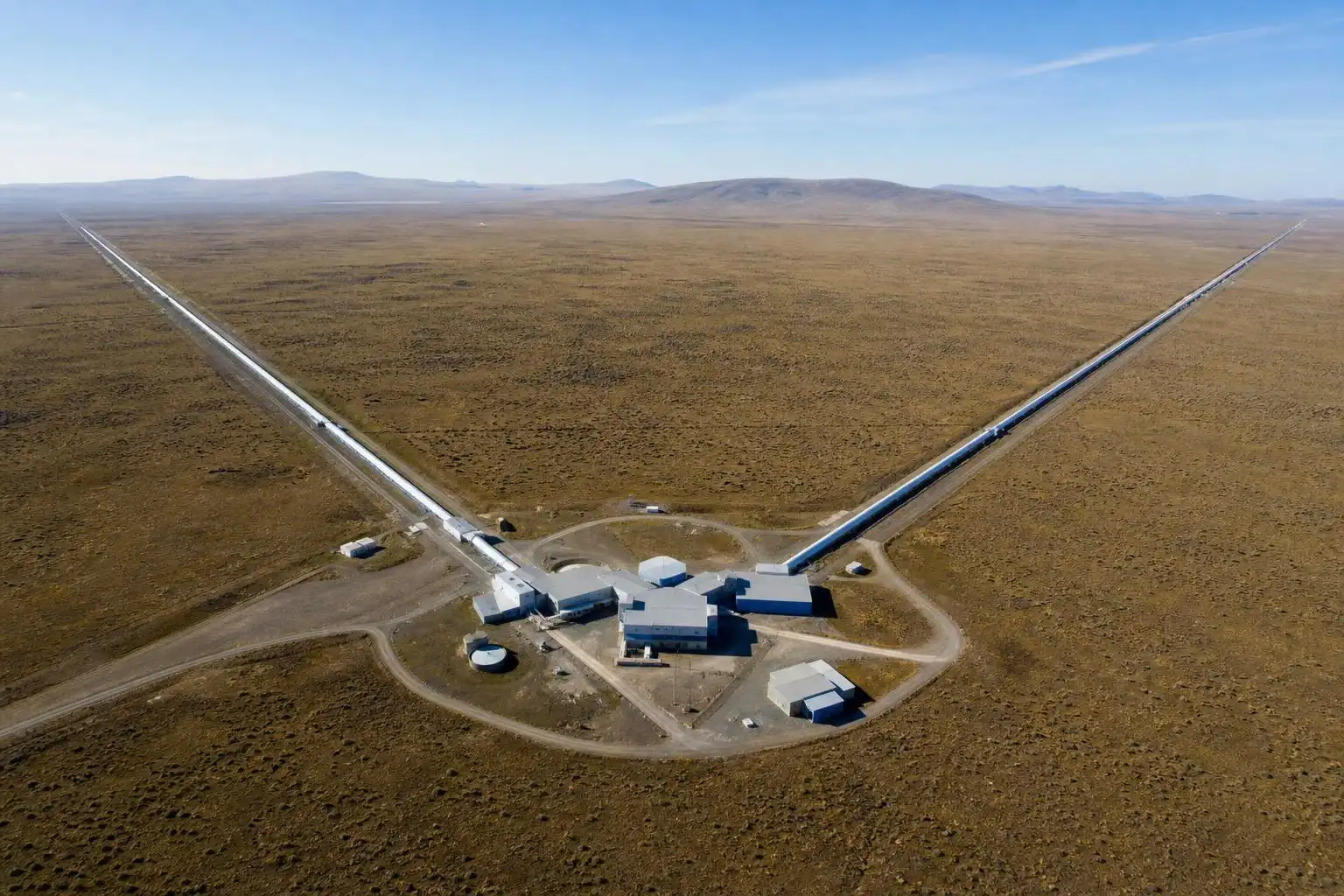

On September 14, 2015, at 5:51 a.m. Eastern time, two black holes — one roughly 29 solar masses, the other 36 — collided 1.3 billion light-years away. The merger lasted a fraction of a second. The signal that reached Earth, a chirp lasting less than half a second, displaced the mirrors at LIGO’s twin detectors by less than one-thousandth the diameter of a proton. It was the most sensitive measurement in the history of science, and it almost didn’t happen.
The story of LIGO — the Laser Interferometer Gravitational-Wave Observatory — is not primarily a story about physics. It is a story about a $1.1 billion federal bet placed against the advice of a significant fraction of the scientific community, sustained through two decades of congressional skepticism, internal leadership crises, and at least one near-cancellation. That it worked is a testament to institutional persistence. That it nearly didn’t is a lesson every large-scale science project should be required to study.
The Bet Nobody Wanted to Make
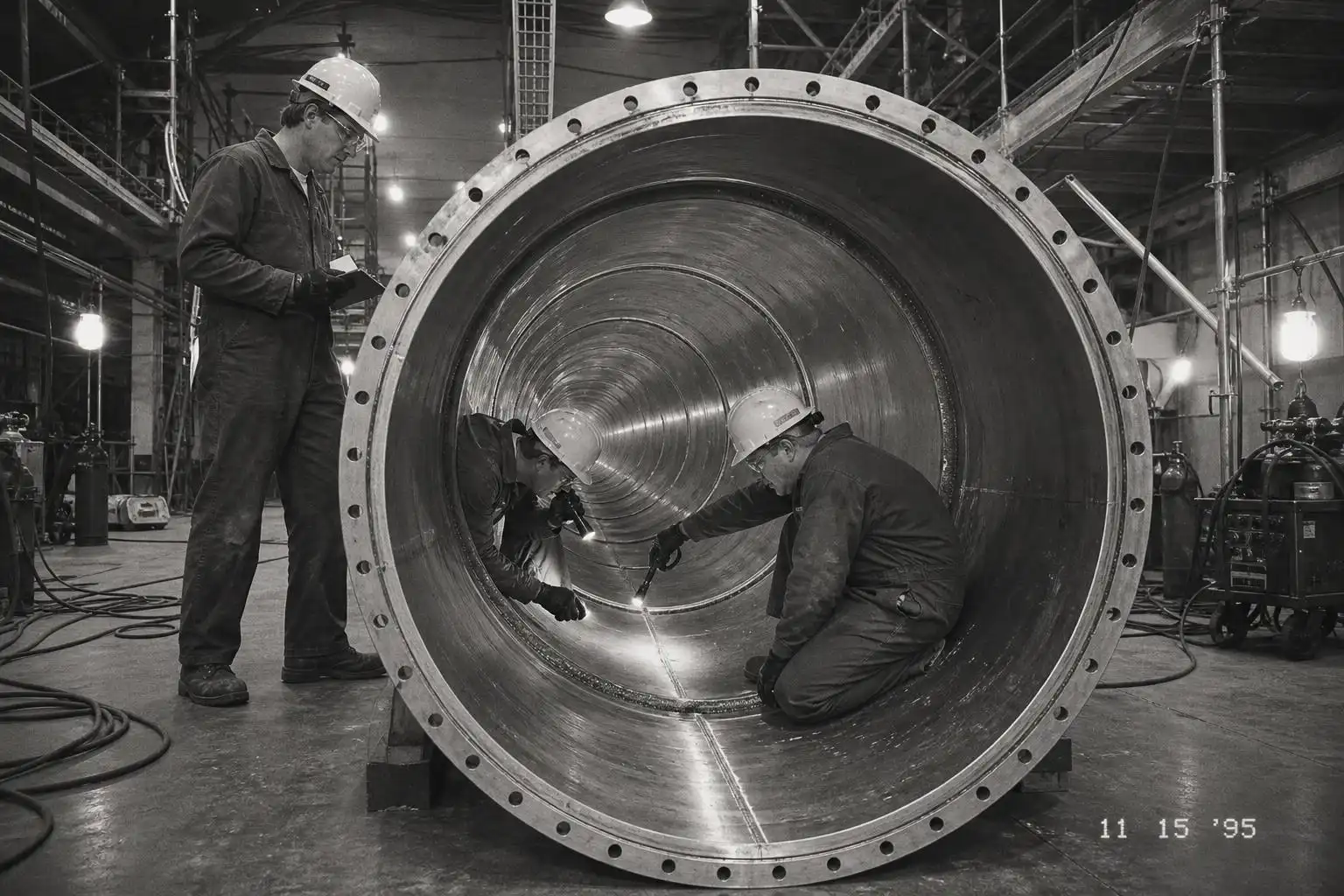
The idea of detecting gravitational waves using laser interferometry was not new when the National Science Foundation began seriously funding it in the 1990s. Kip Thorne at Caltech and Rainer Weiss at MIT had been developing the theoretical and experimental groundwork since the early 1970s. But the transition from a tabletop experiment to a facility-scale instrument — with 4-kilometer-long vacuum tubes, suspended mirror systems, and the laser stability required to detect displacements smaller than a nucleus — was a leap that many physicists considered premature, if not reckless.
The formal proposal that landed on NSF’s desk in the late 1980s asked for something in the range of $200 million, a figure that alarmed the agency’s leadership. By the time ground was broken on the two LIGO sites — one in Hanford, Washington, and one in Livingston, Louisiana — in 1994, the projected cost had grown substantially. The NSF’s own review panels were divided. A 1989 review by a committee that included prominent experimentalists questioned whether the technology was mature enough to justify the expenditure. The concern was not that gravitational waves didn’t exist — by then, the indirect evidence from the Hulse-Taylor binary pulsar was already compelling, and would go on to earn the 1993 Nobel Prize — but that LIGO’s initial design sensitivity might not be sufficient to detect anything within a reasonable observation period.
That concern was, in retrospect, correct. The original LIGO (iLIGO), which ran its first science runs between 2002 and 2010, detected nothing. Not a single confirmed gravitational-wave event. For a project that had consumed roughly $365 million in NSF funding by that point, the silence was politically dangerous.
The Vogt Crisis and the Management Overhaul
Before LIGO could fail scientifically, it nearly collapsed institutionally. Rochus “Robbie” Vogt, the Caltech physicist who served as LIGO’s first director from 1987 to 1994, was a formidable scientist and a notoriously difficult manager. His tenure was marked by conflicts with NSF program officers, disputes with the MIT side of the collaboration, and a management style that one former colleague described in a 1994 Science magazine account as “autocratic.” NSF, growing frustrated with cost growth and internal dysfunction, effectively forced Vogt out in 1994, replacing him with Barry Barish, a high-energy physicist from Caltech who had experience managing large detector collaborations.
Barish’s arrival was transformative in ways that went beyond management style. He restructured LIGO as a formal scientific collaboration — the LIGO Scientific Collaboration, or LSC — opening it to outside institutions and researchers. This was not a trivial decision. It diluted Caltech and MIT’s control over the project, created governance headaches, and required renegotiating credit and authorship norms that would later become significant when Nobel Prize time arrived. But it also brought in the talent and institutional breadth that iLIGO and, later, Advanced LIGO would require.
It also gave LIGO a political constituency. By the time Advanced LIGO was proposed to Congress, the LSC included hundreds of researchers at dozens of institutions across multiple countries. Canceling LIGO would mean canceling their science, too.
Advanced LIGO and the $205 Million Upgrade
The silence of iLIGO was always, to some extent, expected by the people who understood the physics. The original design was conceived as a proof-of-concept instrument — a demonstration that the engineering was achievable — not as a machine likely to make detections. The real bet was on Advanced LIGO (aLIGO), a comprehensive upgrade that would improve sensitivity by roughly a factor of ten, extending LIGO’s reach from tens of millions of light-years to billions.
NSF approved funding for Advanced LIGO in 2008, committing approximately $205 million for the upgrade. The decision came at a fraught moment: iLIGO had not detected anything, the global financial crisis was beginning, and NSF was facing flat budgets. The case for aLIGO rested almost entirely on theoretical predictions — models suggesting that, at the sensitivity aLIGO would achieve, detections should occur at a rate of perhaps several per year.
Those models were right. But the path to first light was not smooth.
Advanced LIGO formally began its first observing run, O1, on September 18, 2015. Four days earlier, on September 14, the signal now designated GW150914 had arrived during an engineering run still underway before O1’s official start. The detection was so clean, so unmistakably a binary black hole merger, that the team’s first instinct was suspicion. LIGO had a long history of “blind injections” — fake signals inserted into the data stream by a small group of insiders to test whether the collaboration could correctly identify and characterize an event without knowing whether it was real. When GW150914 appeared, many collaboration members assumed it was a test.
It was not. The blind injection team confirmed within days that no injection had been made. The signal was real.
The Five-Month Secret
What followed was one of the more remarkable episodes of collective secrecy in modern science. For five months, from September 2015 to February 2016, roughly one thousand scientists and engineers in the LIGO Scientific Collaboration knew — or strongly suspected — that they had detected gravitational waves for the first time. They could not publish. They could not confirm. They spent those months performing every conceivable cross-check, ruling out instrumental artifacts, seismic noise, electromagnetic interference, and the possibility of a blind injection nobody had admitted to.
The collaboration’s executive director, David Reitze, later described the period as “the most stressful five months of my professional life.” Rumors circulated. A tweet by Arizona State University physicist Lawrence Krauss in late September 2015 — “Rumor of a gravitational wave detection at LIGO. Amazing if true” — set off a wave of media speculation that the collaboration could neither confirm nor deny. Krauss later acknowledged the tweet was based on secondhand information and that he had not been asked to keep it confidential, but the episode illustrated the difficulty of maintaining secrecy within a thousand-person collaboration.
The paper announcing the detection, submitted to Physical Review Letters on January 21, 2016, listed 1,004 authors — a number that itself became a minor controversy, with some physicists questioning whether the authorship conventions of particle physics, where every collaboration member is listed regardless of individual contribution, were appropriate for gravitational-wave astronomy.
The press conference on February 11, 2016, at the National Press Club in Washington, D.C., was one of the most watched science announcements in years. Reitze’s opening line — “We have detected gravitational waves. We did it.” — was broadcast live around the world.
The Nobel and Its Discontents
The 2017 Nobel Prize in Physics went to Rainer Weiss, Kip Thorne, and Barry Barish “for decisive contributions to the LIGO detector and the observation of gravitational waves.” The prize was widely celebrated and, by the standards of Nobel controversies, relatively uncontroversial — but only relatively.
The Nobel Prize can be shared by at most three individuals, a rule that becomes increasingly awkward as science becomes increasingly collaborative. The LIGO detection was the work of more than a thousand people. Ron Drever, the Scottish physicist who had been a founding figure in LIGO’s experimental development alongside Weiss and Thorne, died in March 2017, seven months before the prize was announced. Had he lived, the committee would have faced a difficult four-person problem. As it was, many in the collaboration felt that the three-person prize inadequately represented the collective nature of the achievement.
Gabriela González, the LSC spokesperson at the time of the detection and one of the most visible faces of the announcement, was not among the laureates. Neither were the hundreds of graduate students, postdocs, and engineers whose work made the measurement possible. The Nobel’s structural inability to honor collaborative science is not a new complaint, but LIGO made it newly urgent.
What LIGO Teaches
The institutional lesson of LIGO is not that big bets always pay off. They don’t. The lesson is more specific: that the conditions under which a big bet can pay off require sustained institutional commitment across political cycles, competent management restructuring when the original structure fails, and a scientific community willing to accept that proof-of-concept instruments may produce no detections while still being necessary precursors to the instruments that will.
NSF invested in iLIGO knowing it would likely detect nothing. That investment was the price of admission to aLIGO. Congress funded aLIGO knowing that the case for it rested on theoretical predictions, not empirical results. That required a level of scientific trust in the modeling that is not always available.
It also required Barry Barish. The management overhaul of 1994 is not a footnote to the LIGO story — it is a central chapter. Without the LSC structure Barish built, the political coalition that sustained LIGO through two decades of silence would not have existed. The Nobel committee recognized this when it included Barish, a decision that surprised some physicists who considered him an administrator rather than a discoverer. But the committee was, arguably, right: in big science, the person who builds the institution that makes the discovery possible is not a lesser contributor to the discovery. They are, often, the most important one.
The gravitational-wave universe is now open. LIGO and Virgo have together detected dozens of mergers, with KAGRA joining the network more recently. A next-generation detector, Cosmic Explorer, is in the planning stages, with a proposed price tag that will again test congressional patience. The arguments being made for it — that it will detect events inaccessible to current instruments, that its sensitivity will open new science — are structurally identical to the arguments made for Advanced LIGO in 2008, and for iLIGO in 1994.
The question is whether the institutions that fund science have learned the same lesson LIGO teaches: that the instrument you build today to detect nothing is the reason you can build the instrument tomorrow that detects everything.



Leave a Reply