

On a grey November morning in 1718, Edmond Halley sat in his study on New Cross Road in London with a dog-eared copy of Ptolemy’s Almagest open across his knees and a stack of his own observing notebooks piled on the table beside him. He was sixty-two years old, Savilian Professor of Geometry at Oxford, and still possessed of the restless energy that had once driven him to sail the South Atlantic in command of the Paramore to chart magnetic variation. He had been comparing star positions — a tedious, methodical business that most of his contemporaries considered beneath serious natural philosophy. What he found that morning would overturn one of the oldest assumptions in the history of astronomy: that the so-called “fixed stars” were, in fact, fixed.
The idea of stellar permanence was not merely a convenience. It was a cosmological article of faith stretching back through Aristotle, codified in Ptolemy’s second-century catalogue, and reinforced by every astronomer who had gazed upward since. The stars formed the backdrop against which the wandering planets — the planetes asteres, the “wandering stars” — were defined. Without a fixed firmament, the very geometry of the sky became unmoored. When Halley noticed that three of the brightest stars in the sky — Sirius, Arcturus, and Aldebaran — sat measurably, undeniably south of the positions Ptolemy had recorded for them nearly fifteen centuries earlier, he did not panic. He reached for his pen.
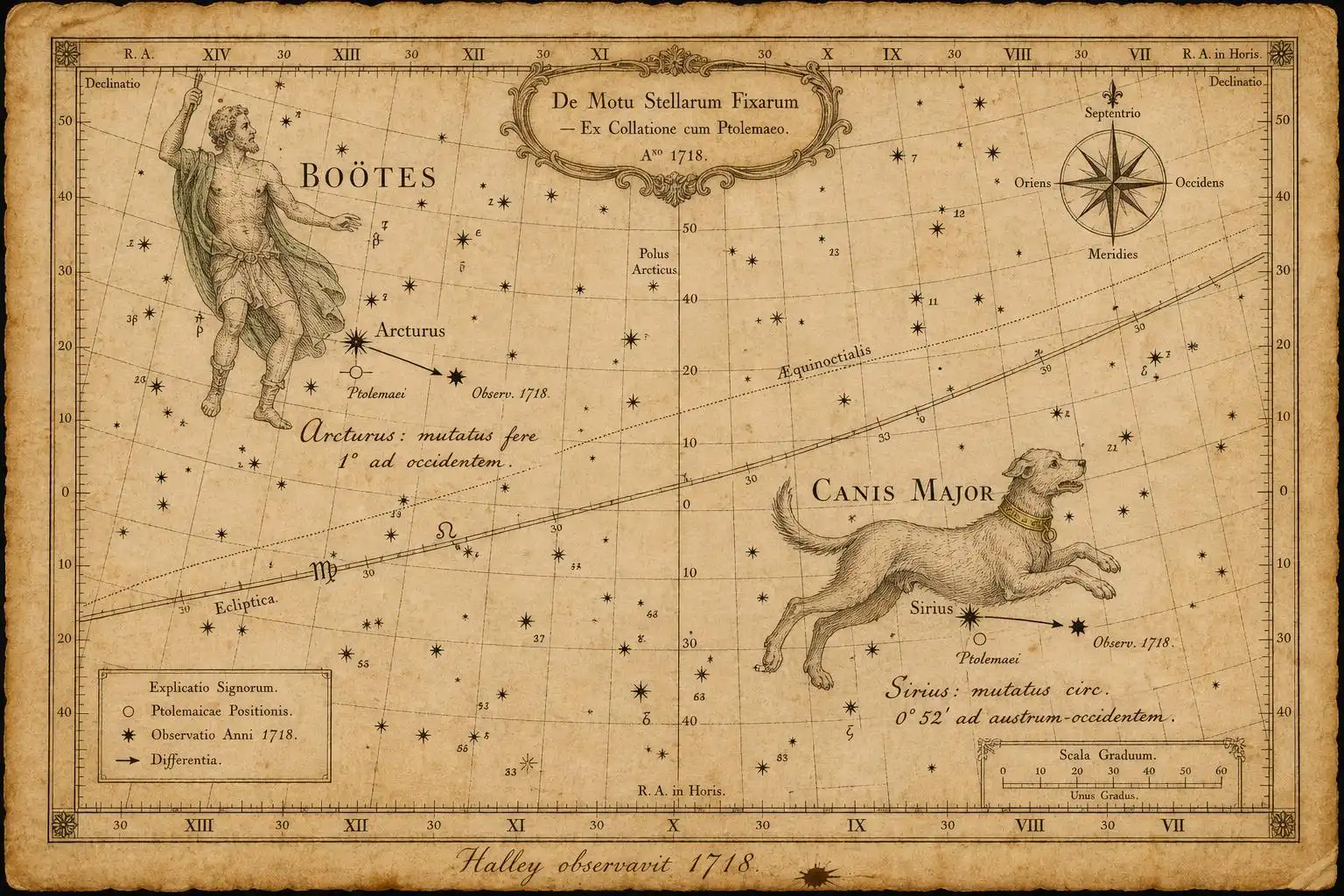
The paper he submitted to the Philosophical Transactions of the Royal Society in 1718 was characteristically brief and characteristically bold. Halley acknowledged immediately that errors might lurk in ancient observations. Ptolemy’s instruments were imprecise reeds compared to the great mural quadrant at Greenwich, and the transmission of the Almagest through Arabic and medieval Latin copies had introduced countless scribal corruptions. But the discrepancies he was examining were not of the order of minutes of arc — the kind that might be explained by a copyist’s slip or a misaligned gnomon. Sirius had shifted by more than half a degree southward. Arcturus, the orange giant riding high in Boötes, had moved by a full degree. These were shifts large enough to be seen with the naked eye if a careful observer compared a modern star chart to Ptolemy’s coordinates side by side.
Halley was careful to distinguish his claim from the ancient concept of precession — the slow wobble of Earth’s axis that shifts the equinox westward and, in ecliptic coordinates, makes stellar longitudes increase over a cycle of roughly 26,000 years, first measured by Hipparchus around 127 BCE and refined by Ptolemy himself. Precession moves all stars together, like a sheet of wallpaper sliding uniformly across a wall. What Halley had found was something different: individual stars moving in individual directions by individual amounts. Sirius was not drifting the same way as Arcturus. These were proper motions — the actual physical displacement of stars through space, projected onto the dome of the sky.
The implications were staggering, and Halley knew it. If stars moved, they were not nailed to a crystalline sphere. They were objects at various distances, travelling through a void, and the sky humans had been navigating by for millennia was a snapshot — a long-exposure photograph, as we might say today — of a universe in motion. The stars of Orion that a Babylonian scribe had used to mark the winter solstice were not quite in the same positions they occupied when Halley wrote, and they would not be in those positions when his grandchildren grew old.
To appreciate how quietly revolutionary this was, it helps to remember the intellectual atmosphere of 1718. Newton’s Principia Mathematica had been in the world for thirty-one years, and the solar system had been thoroughly mechanized: planets moved in ellipses, comets returned on schedule (Halley himself had predicted the return of the comet of 1682 for around 1758, a date he knew he would not live to see), and gravity explained the tides. But the stars remained, in most minds, a fixed and eternal backdrop to this clockwork drama. Even Newton, in his private correspondence, had speculated that the stars might be other suns at immense distances, but he had not pressed the question of whether they moved independently.
Halley had, in fact, been circling this question for decades. In 1676, at the age of twenty, he had sailed to the island of St. Helena in the South Atlantic — at that time one of the remotest inhabited places on earth — to catalogue the southern stars that were invisible from England. He spent eighteen months there with a 24-foot refracting telescope and a sextant, enduring the island’s notorious cloud cover and the social peculiarities of the East India Company garrison, and came back with a catalogue of 341 southern stars that earned him the nickname “the Southern Tycho.” The comparison to Tycho Brahe was apt: like Brahe at Uraniborg, Halley on St. Helena was doing the unglamorous but indispensable work of measuring positions precisely enough that future astronomers could detect change.
That future, it turned out, was his own. By 1718 he had access not only to his own decades of observations but to the accumulating records at the Royal Observatory at Greenwich, founded in 1675 under John Flamsteed — with whom Halley had a famously poisonous relationship. The two men had quarrelled bitterly over priority, over the publication of Flamsteed’s star catalogue (Halley had helped Newton pressure Flamsteed into releasing an incomplete version in 1712, an episode that left lasting wounds on both sides), and over matters of personality that seem, at this distance, almost comically petty. Yet it was partly Flamsteed’s meticulous Greenwich observations that gave Halley the modern baseline he needed. Science has always been like this: the data outlives the feuds.
The discovery of proper motion opened a door that Halley himself could only peer through. He had identified the phenomenon; he had no way to measure the distances that would be needed to convert angular drift into actual velocities. That problem would occupy astronomers for more than a century. Friedrich Wilhelm Bessel, working at the Königsberg Observatory in Prussia, made the first successful measurement of stellar parallax in 1838 — the tiny annual wobble of a nearby star against the background of distant ones, caused by Earth’s orbit around the Sun. His target was 61 Cygni, a faint but fast-moving star in the Swan that Halley’s successors had flagged as a likely near neighbour precisely because of its large proper motion. Bessel found it to be about 10.3 light-years away. The logic was Halley’s, even if the instrument — Bessel’s Fraunhofer heliometer at Königsberg — was a product of a later century’s precision optics.
Halley had already made another characteristically audacious proposal before 1718. In a 1716 paper, he had turned his attention to the transit of Venus — a rare alignment in which Venus crosses the face of the Sun, visible as a small dark disc creeping across the solar surface — and argued that careful timing of the transit from widely separated points on Earth could yield the distance from Earth to the Sun — the so-called astronomical unit — with unprecedented precision. He would not live to see the transits of 1761 and 1769 for which he was planning, and he said so plainly in the paper, writing with an almost theatrical resignation that he was laying out the method “for the benefit of posterity.” He was right: the 1769 transit, observed by James Cook from Tahiti and by dozens of European expeditions scattered from Siberia to Newfoundland, gave astronomers their best measurement yet of the solar distance. The proper motion discovery and the transit method together suggest something important about Halley’s mind — he was always thinking in terms of long baselines, long timescales, and observations that would only become meaningful when compared across generations.
He died in January 1742, at the age of eighty-five, at the Royal Observatory at Greenwich, where he had served as Astronomer Royal since 1720. By all accounts he remained observationally active into his final years, though his hands had grown unsteady. His comet was first spotted on its predicted return by a German amateur farmer named Johann Georg Palitzsch scanning the sky from his fields near Dresden on Christmas night 1758 — a detail that Halley, had he known it, would surely have appreciated. The cosmos did not wait for professional observers.
The proper motion paper of 1718 is not the most famous thing Halley did. It lacks the romance of the comet prediction, the drama of the St. Helena voyage, the political intrigue of the Principia publication (Halley had personally financed Newton’s masterwork when the Royal Society ran short of funds). But in the long story of how humanity came to understand the structure of the Milky Way, it is arguably the more consequential discovery. Every subsequent measurement of stellar distance, stellar velocity, and the large-scale kinematics of our galaxy rests on the recognition that stars are not fixed but moving — that the sky is a river, not a painting.
Jacobus Kapteyn, building his model of the Milky Way in the early twentieth century from thousands of proper motion measurements, was following a thread Halley had pulled. Harlow Shapley, whose globular cluster distances we have discussed in earlier articles, relied on the same foundational insight when he argued that the Sun was not at the centre of the galaxy. Even Henrietta Leavitt’s period-luminosity relation for Cepheid variables proved transformative for the distance scale — a scale whose foundations rested, in part, on the same recognition that stars are in motion that Halley had first established. The fixed stars, it turned out, were the key to everything — and it was Halley, on that grey November morning with Ptolemy’s catalogue on his knees, who first proved they were not fixed at all.
What does this episode reveal about how science actually works? Halley’s discovery depended on something that is easy to undervalue: the patience to compare. He did not build a new instrument or devise a new mathematical theory. He sat down with old data and new data and refused to assume that the discrepancies were errors. In an era when the prestige of ancient authority — Ptolemy, Hipparchus, Aristotle — still carried enormous weight, the willingness to say “the ancients were not wrong, but the sky has changed” required a particular kind of intellectual courage. It also required the infrastructure of accumulated observation: Flamsteed’s Greenwich records, the Arabic transmission of the Almagest, Halley’s own St. Helena catalogue. No single genius conjured the discovery from nothing. It emerged from a conversation across centuries, conducted in the shared language of coordinates and angles.
And it required the recognition that time itself is a scientific instrument. The longer the baseline between observations, the more clearly change reveals itself. Halley understood this instinctively. He designed the transit-of-Venus method for observers who would not be born for decades. He predicted his comet for a year he would not live to see. He compared his own observations to those of a man who had died fifteen centuries before him. In doing so, he was not merely doing astronomy. He was practicing a kind of temporal humility — an acknowledgment that the universe operates on timescales that dwarf any single human life, and that the proper response to this fact is not despair but careful, patient measurement, handed forward like a torch.



Leave a Reply