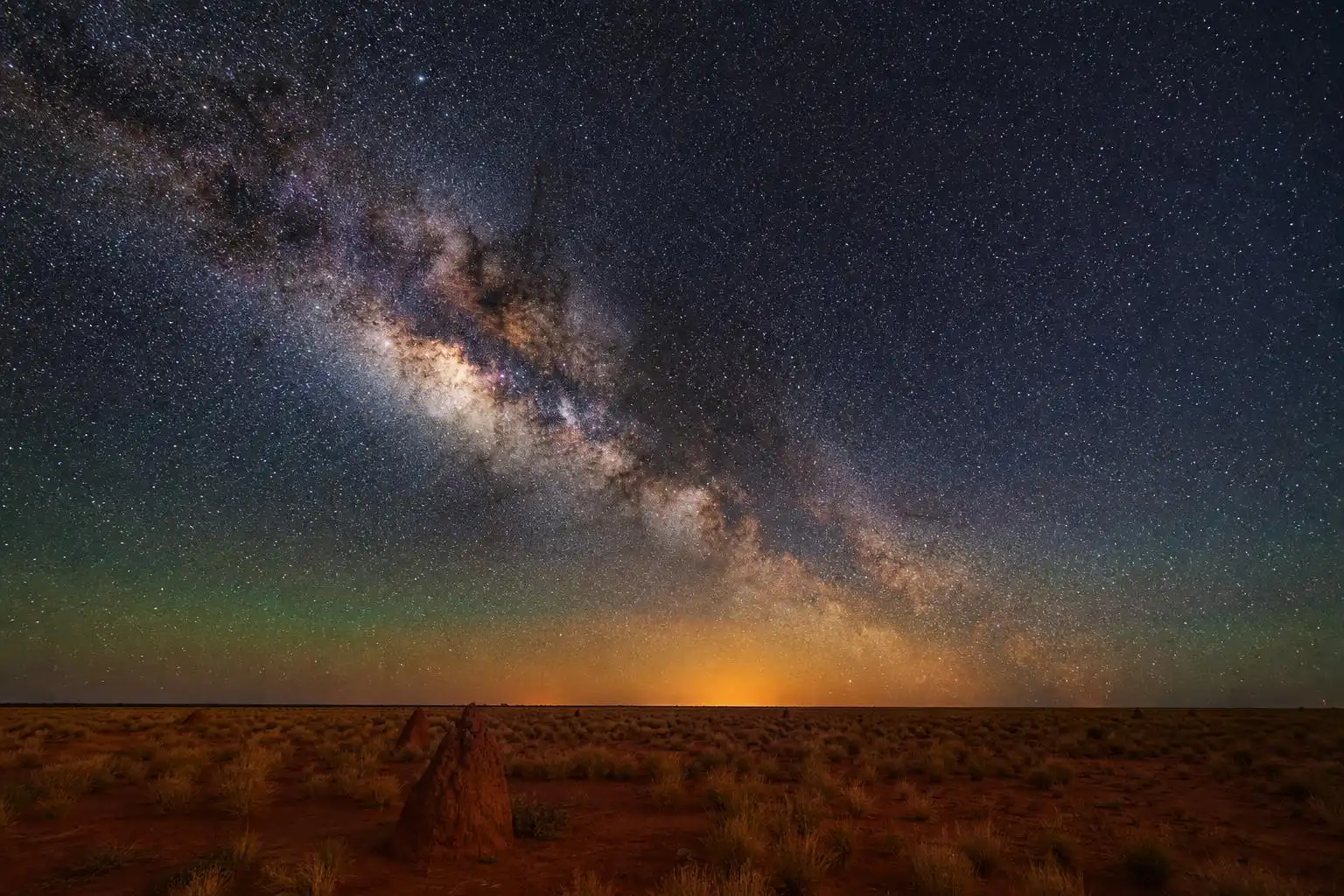

Long before Hipparchus catalogued the stars of the Mediterranean sky, long before Ptolemy assembled his Almagest, the Aboriginal peoples of Australia were reading the heavens with a precision and depth that modern science is only beginning to appreciate. Their astronomical traditions — some of which scholars now estimate stretch back many thousands of years — represent not merely a cultural curiosity but a fully realized intellectual system: one that encodes orbital mechanics, seasonal ecology, navigation, and cosmological philosophy into an unbroken oral and ceremonial tradition.
A Sky Alive with Darkness
Most astronomical traditions focus on the points of light scattered across the night sky. Aboriginal Australians did something remarkably different. Across dozens of language groups — from the Wardaman people of the Northern Territory to the Kamilaroi and Euahlayi of New South Wales — sky watchers developed what researchers now call dark constellation astronomy: a practice of reading the shapes formed not by stars, but by the dark clouds of dust and gas that ribbon the Milky Way.

The most celebrated of these is the Emu in the Sky, a figure traced entirely from the Coal Sack Nebula (the head), through the dark lanes of the Milky Way (the neck and body), and out toward the tail near Scorpius. This is not a vague cultural metaphor. Duane Hamacher, an astronomer at the University of Melbourne who has collaborated extensively with Aboriginal knowledge holders, has documented that the Emu rises horizontally above the horizon in autumn — precisely when emus are nesting and their eggs can be found on the ground. The sky, in other words, functions as a calendar of extraordinary ecological accuracy. The stars tell you not just when the season has changed, but what to do about it.
This integration of astronomy with land management, food sovereignty, and ceremonial life is one of the defining features of Aboriginal sky knowledge. It is not astronomy in isolation. It is astronomy as a living operating system for existence on a specific landscape.
The Wardaman and the Law of the Sky
Among the Wardaman people, the astronomer and elder Bill Yidumduma Harney has shared an intricate cosmological framework in which the Milky Way is understood as a river of spiritual law, and individual stars carry the identities of ancestors, animals, and events from the Dreaming — the foundational ontological framework of Aboriginal thought. With the late astrophysicist Hugh Cairns, Harney produced the landmark book Dark Sparklers (2003), which documented Wardaman star maps, naming conventions, and the astronomical knowledge encoded within them.
One intriguing but debated interpretation of Wardaman sky knowledge concerns proper motion — the slow drift of stars across the sky over millennia. Some descriptions of stars as having “moved” from traditional positions have been compared with the known proper motion of those stars over long timescales. If such interpretations are correct, they would suggest observational traditions preserved across an extraordinary span of time, but they should be treated as speculative rather than settled evidence.
Kamilaroi and Euahlayi: The Celestial Emu and the Seven Sisters
The Kamilaroi and Euahlayi peoples of New South Wales possess one of the richest documented astronomical traditions in the continent. Their sky lore, recorded in detail by researchers including Robert Fuller and Ghillar Michael Anderson, includes sophisticated accounts of the Pleiades — known in their tradition as the Meamei, a group of seven sisters pursued across the sky by the stars of Orion’s belt, the Berai Berai brothers.
This story, in various forms, appears across Aboriginal Australia and, remarkably, across cultures worldwide — from the Greek myth of the Pleiades to the Japanese Subaru to the stories of the Lakota Sioux. Some researchers have proposed that the widespread appearance of “seven sisters” narratives may reflect very ancient observations of the Pleiades at a time when the cluster’s apparent stellar positions or visibility differed from today. Such hypotheses are fascinating, but they remain debated and do not demonstrate a continuous 100,000-year astronomical memory.
The Kamilaroi and Euahlayi also tracked Gegenschein (the faint glow opposite the sun caused by reflected sunlight on interplanetary dust), described the aurora australis in ceremonial terms, and maintained detailed knowledge of lunar cycles for timing ceremonies and regulating social life.
Navigating by the Southern Sky
While Polynesian wayfinding across the Pacific has received growing scholarly attention, Aboriginal coastal and inland navigation by stars remains comparatively understudied. Yet the evidence is substantial. The Yolŋu people of Arnhem Land in the Northern Territory, who have maintained extensive maritime contact with Makassan traders from Sulawesi for centuries, developed star-path navigation systems analogous in function to the Hawaiian kilo hōkū (star watching) tradition. Specific stars were used to orient travel across featureless terrain at night — a practice of particular importance in the arid interior, where landmarks are sparse and distances enormous.
The star Canopus — the second-brightest star in the night sky, prominent in the southern hemisphere — holds special significance across numerous Aboriginal groups. To the Boorong people of Victoria, whose sky lore was partially documented in the nineteenth century by William Stanbridge (one of the earliest Western records of Aboriginal astronomy), Canopus was known as Waa, the Crow, a figure of considerable ceremonial importance. The Boorong corpus, now being re-examined by contemporary researchers, includes references to the Eta Carinae Nebula and what may be a record of the great eruption of Eta Carinae in the 1840s — an event that briefly made it the second-brightest star in the sky.
Stone Arrangements and Solar Alignments
Aboriginal astronomical knowledge was not purely oral. Across the continent, stone arrangements — sometimes called sacred sites or ceremonial grounds — may encode astronomical alignments with striking precision. The most studied is the Wurdi Youang egg-shaped stone arrangement in Victoria, attributed to the Wathaurong (Wadawurrung) people. Surveys conducted by Hamacher and colleagues have argued that the arrangement’s major axis aligns with the setting sun at the equinoxes, and that outlying stones may mark the solstice sunsets. However, the site’s intentional astronomical function has not been conclusively established, and there is no secure dating that would confirm it is more than 11,000 years old or older than Stonehenge.
Unlike Stonehenge, Wurdi Youang has received almost no international recognition. It sits quietly in the Victorian countryside, a possible testament to the capacity of a non-literate tradition to embed precise scientific knowledge in durable physical form.
What Aboriginal Astronomy Teaches the World
The standard narrative of astronomical history moves from Babylon to Greece to the Islamic Golden Age to Renaissance Europe, with occasional nods to Mesoamerica and China. Aboriginal Australian astronomy does not fit this narrative — and that is precisely its value.
It demonstrates that astronomical sophistication does not require writing, metal instruments, or institutional patronage. It can be sustained through ceremony, song, story, and the careful education of each new generation. It demonstrates that the sky can be read through absence as well as presence — through dark nebulae as well as bright stars. It demonstrates that ecological and astronomical knowledge are not separate domains but a single integrated system, a lesson of profound relevance as humanity confronts a changing climate and the collapse of ecological knowledge worldwide.
Most importantly, Aboriginal astronomy forces a reckoning with the question of what counts as science. The possible Wardaman references to stellar movement, the Boorong record of Eta Carinae’s eruption, the Kamilaroi stories of a seven-star Pleiades — these are not merely myths that happen to resemble science. They may preserve observations, with extraordinary fidelity across time, in a medium — living human memory and ceremony — that Western science has never taken seriously as an archive.
To study the Aboriginal sky is not to supplement our understanding of the cosmos with a colorful cultural footnote. It is to discover that the universe has been watched, named, and understood by human minds for far longer, and in far more ways, than the history books have ever acknowledged. The sky over Australia was never empty of meaning. We are only now learning how to read it.



Leave a Reply