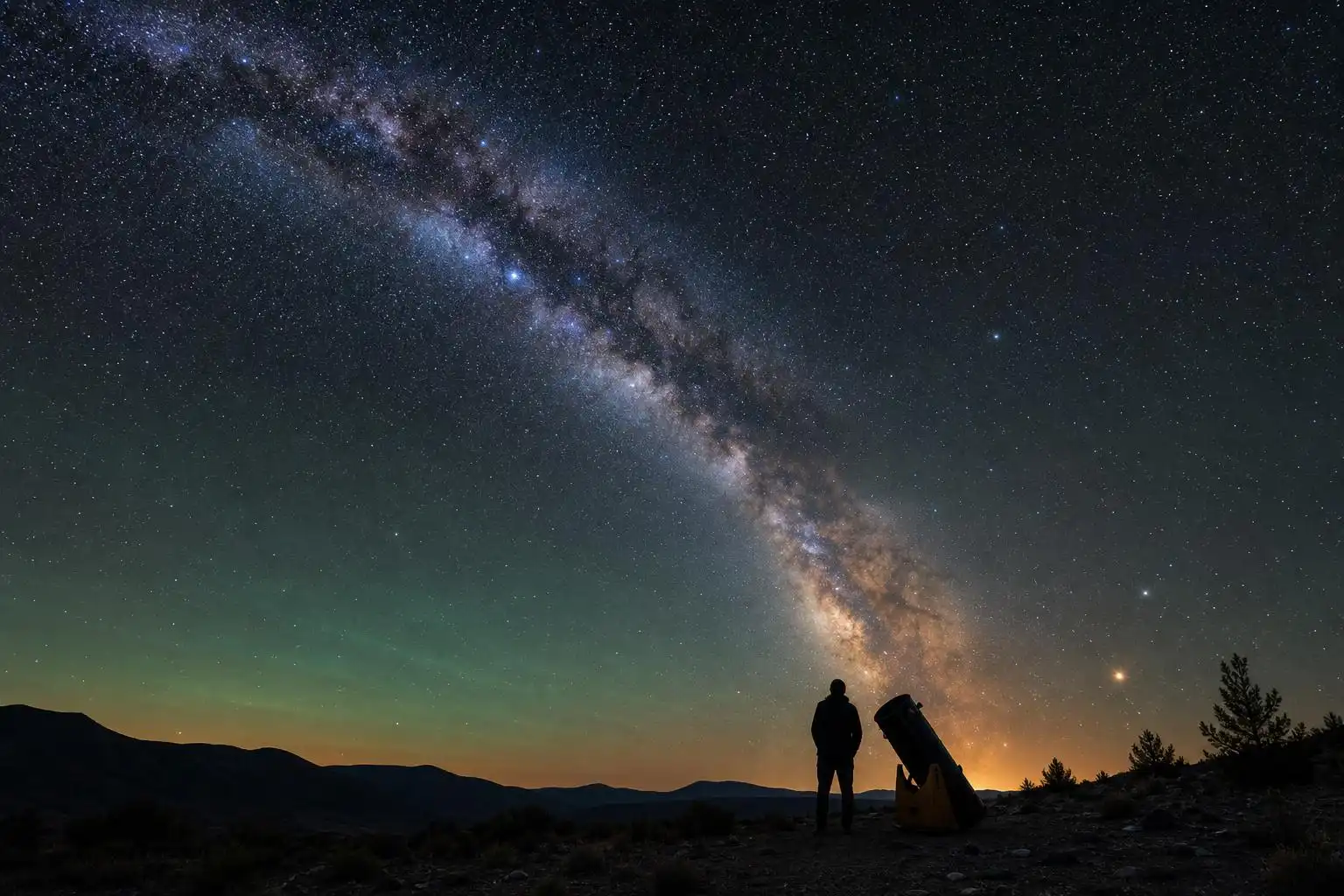

The summer solstice has come and gone, and with it arrives one of the most rewarding stretches of the observing year. The evenings are warm, the Milky Way is climbing, and the southern sky is loaded with globulars and nebulae that reward even modest aperture. This week I want to walk you through a handful of targets that are worth your time right now — from a naked-eye planet trio in the west at dusk to a faint asteroid you can track night to night, and a ghostly globular cluster that deserves far more attention than it gets.
The Evening Planet Lineup: Mercury, Venus, Jupiter
Step outside shortly after sunset this week and face west. The show starts almost immediately. Venus blazes at magnitude –4.0 in central Cancer, and if you have binoculars, here’s a treat worth lingering over: Venus is sitting just 45 arcminutes north of M44, the Beehive Cluster [5]. That’s a genuinely beautiful pairing — the planet’s hard blue-white point floating above a loose spray of stellar dust. Even a small refractor at low power will frame both in the same field. Don’t dawdle, though; Venus moves quickly, and the geometry changes night to night.
Below Venus and to its lower right sits Jupiter at magnitude –1.8, and further still in that same diagonal is Mercury at magnitude 0.7 [5]. Mercury is only about 5° above the horizon at the best viewing time, so you’ll need a flat, unobstructed western horizon and clear air down low. A pair of 10×50 binoculars will help you pull it out of the twilight glow. Three planets in a single binocular sweep at dusk — that’s the kind of casual grandeur that makes you feel like the solar system is showing off.
Earlier in the week, the Moon added itself to this lineup as well [2], strung out alongside Regulus, Venus, Jupiter, and Mercury in one of those rare evenings where the ecliptic practically draws itself across the sky. If you missed it, don’t fret — the planets are still there, and the Moon will be back.
Libra’s Ghost Cluster: NGC 5897
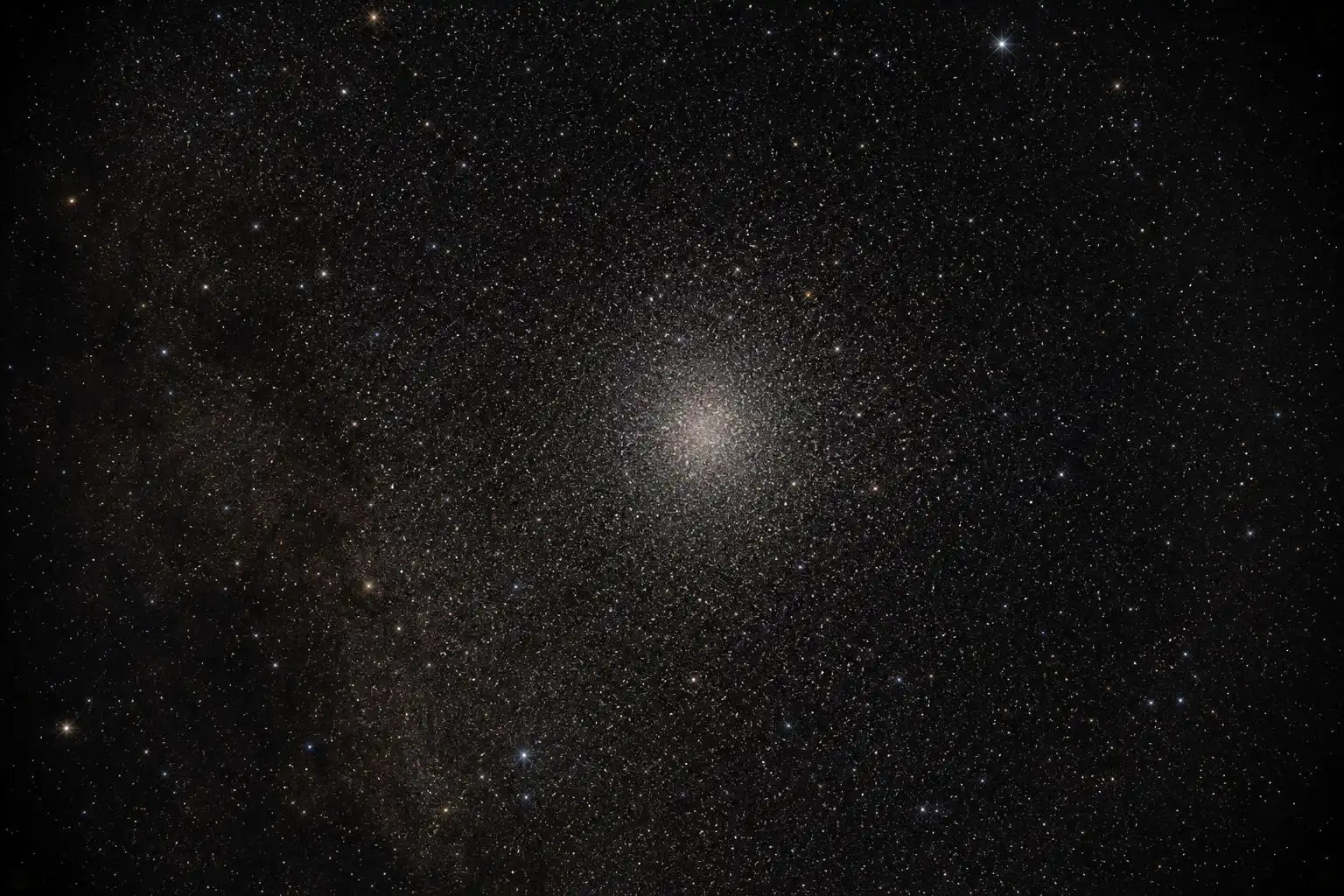
Now for something that gets criminally little attention. Around 10:30 P.M. local daylight time, Libra is highest in the south, and tucked nearly 12° below the constellation’s brightest star — Beta Librae, also called Zubeneschamali — is the globular cluster NGC 5897 [3].
I first hunted this one down years ago with a 10-inch f/4.7 Dobsonian from a Bortle 4 site in the foothills, and it stopped me cold. It’s large — around 12 arcminutes across — and genuinely bright enough to find easily, but it has this diffuse, unresolved quality at low power that gives it an almost spectral appearance. Hence the nickname: the Ghost Cluster. It lacks the dense, blazing core of something like M13 or M22. Instead it spreads out softly, like a handful of powdered sugar spilled on black velvet.
At 100× in a good 8-inch mirror, you’ll start to resolve the outer halo into individual stars, but the center remains stubbornly misty. That’s not a flaw — it’s a clue. NGC 5897 is a loosely concentrated globular (Shapley-Sawyer class XI, meaning very loose), and it sits roughly 24,000 light-years away. Crank up to 180× or 200× on a steady night and the resolution improves noticeably. I like a 6mm or 7mm Nagler-style eyepiece here — something with a wide apparent field so the cluster has room to breathe against the star background.
For a finder path: start at Zubeneschamali (Beta Librae, magnitude 2.6, slightly greenish — one of the few stars that genuinely looks green to many observers). Sweep about 12° due south. If you’re using a finder chart, look for a small triangle of 8th and 9th magnitude stars; NGC 5897 sits right in that neighborhood. In a 9×50 right-angle finder, it’s visible as a faint fuzz at the edge of detection. In a 6-inch or larger main scope, it’s unmistakable.
If you’ve already bagged M5 in Serpens and are looking for a globular with a different personality, NGC 5897 is your next stop.
21 Lutetia: An Asteroid You Can Track
Here’s an activity I love recommending to observers who want to engage with the solar system dynamically rather than just looking at static points of light: track an asteroid over several nights and watch it move against the background stars.
Right now, main-belt asteroid 21 Lutetia is shining at magnitude 10.6 in Scorpius [1]. That’s within reach of any 4-inch or larger telescope under reasonable skies. The best time to observe is in the late evening, in the hour or two around midnight when Scorpius is highest in the south.
What makes this week particularly satisfying is the geometry. On June 24, Lutetia slides just south of a 9th-magnitude field star. Come back the following night, and it has shifted to sit southwest of a second, fainter field star — all three objects (Lutetia plus the two field stars) briefly forming a nearly straight line [1]. That’s exactly the kind of before-and-after comparison that makes asteroid hunting click for people. You’re not just trusting a chart; you’re seeing with your own eyes that something has moved.
And there’s a bonus target nearby: about 0.6° north of Lutetia’s current position is Beta Scorpii, a 3rd-magnitude double star whose two components are separated by 14 arcseconds — easy to split in virtually any telescope [1]. It’s a lovely pairing, with a slight color contrast between the components. So in a single low-power field, you can have a double star and a moving asteroid. That’s a good night.
Lutetia itself has some scientific pedigree worth knowing. The European Space Agency’s Rosetta spacecraft flew past it in July 2010, revealing a battered, ancient surface covered in craters and a composition that appears to be among the most primitive in the main belt. When you’re looking at that 10.6-magnitude dot, you’re looking at a 100-kilometer-wide rock that dates back to the earliest days of the solar system. That knowledge always sharpens the view for me.
Late Night: The North America Nebula
If you’re a night owl and you’re still at the eyepiece after midnight, swing north and east toward Cygnus. NGC 7000, the North America Nebula, reaches nearly 70° altitude by 2 A.M. local daylight time, sitting just 3.2° east of Deneb [4].
This is one of those objects that scales dramatically with sky darkness. Under Bortle 8 suburban skies, it’s essentially invisible without a narrowband filter. Under Bortle 4 or better, it’s visible to the naked eye as a brightening in the Milky Way, and through a wide-field eyepiece with an OIII or H-beta filter, the “Gulf of Mexico” and the “Atlantic coast” of the North American outline snap into view with startling clarity. I’ve had nights at a dark site with a 2-inch Luminos at 24mm — giving a nearly 4° true field — where the whole nebula fit in the view and looked like a continent floating in stars.
For a finder: Deneb is unmistakable, the brightest star in Cygnus and the northeast corner of the Summer Triangle. NGC 7000 is a short star-hop of just over 3° due east. No star-hopping required if you have a wide-field finder or binoculars — just put Deneb at the western edge of your field and look east.
A Note on Saturn
Early risers get a bonus this week: Saturn’s moon Iapetus sits just 1.9 arcminutes due north of Saturn in the predawn sky on June 25 [1]. That’s an extremely close pairing — well within the same low-power telescopic field. Saturn is heading toward opposition in the coming weeks, so it’s getting brighter and better-placed with each passing night. The rings are currently tilted nicely toward us, and even a 60mm refractor will show them cleanly. If you’re up before dawn anyway, don’t miss the chance to spot Iapetus alongside Saturn.
What to Bring Outside
Here’s my quick checklist for this week’s observing sessions:
- Binoculars (10×50): Venus near M44, the planet trio at dusk, Saturn and Iapetus at dawn
- 4-inch or larger scope: 21 Lutetia and Beta Scorpii, NGC 5897 in Libra
- 6-inch or larger scope: NGC 5897 resolution, Saturn’s rings and Cassini Division
- 8-inch or larger scope: NGC 7000 with a narrowband filter, Lutetia field stars in context
The solstice nights are long in twilight but the darkness, once it arrives, is summer-rich with targets. Get out there.
References
- The Sky Today on Wednesday, June 24: Look for Lutetia’s light – Astronomy Magazine
- The Sky Today on Sunday, June 21: A summertime lineup – Astronomy Magazine
- The Sky Today on Saturday, June 20: Libra’s Ghost Cluster – Astronomy Magazine
- The Sky Today on Monday, June 22: Visit the North America Nebula – Astronomy Magazine
- The Sky This Week from June 19 to 26: The summer solstice – Astronomy Magazine



Leave a Reply