
Somewhere in the Large Magellanic Cloud, on February 23, 1987, a blue supergiant called Sanduleak −69° 202 ran out of options. In less than a quarter of a second, its iron core—roughly the mass of the Sun compressed into a sphere the size of Manhattan—collapsed so violently that it released more energy than our Sun will emit across its entire ten-billion-year lifetime. The resulting explosion, Supernova 1987A, was the brightest supernova visible from Earth in nearly four centuries. Neutrino detectors in Japan, the United States, and the Soviet Union recorded a pulse of 24 particles in a span of thirteen seconds. Twenty-four. From an event 168,000 light-years away. That’s how loud the universe screamed.
And here’s the part that should stop you mid-breath: the iron in your blood was forged in a stellar core not unlike Sanduleak’s. Core-collapse supernovae are not abstract astrophysical events. They are the foundational manufacturing process of the periodic table’s most biologically critical elements. You are, in a very precise and non-metaphorical sense, the ash of a dead star.
What “Core Collapse” Actually Means
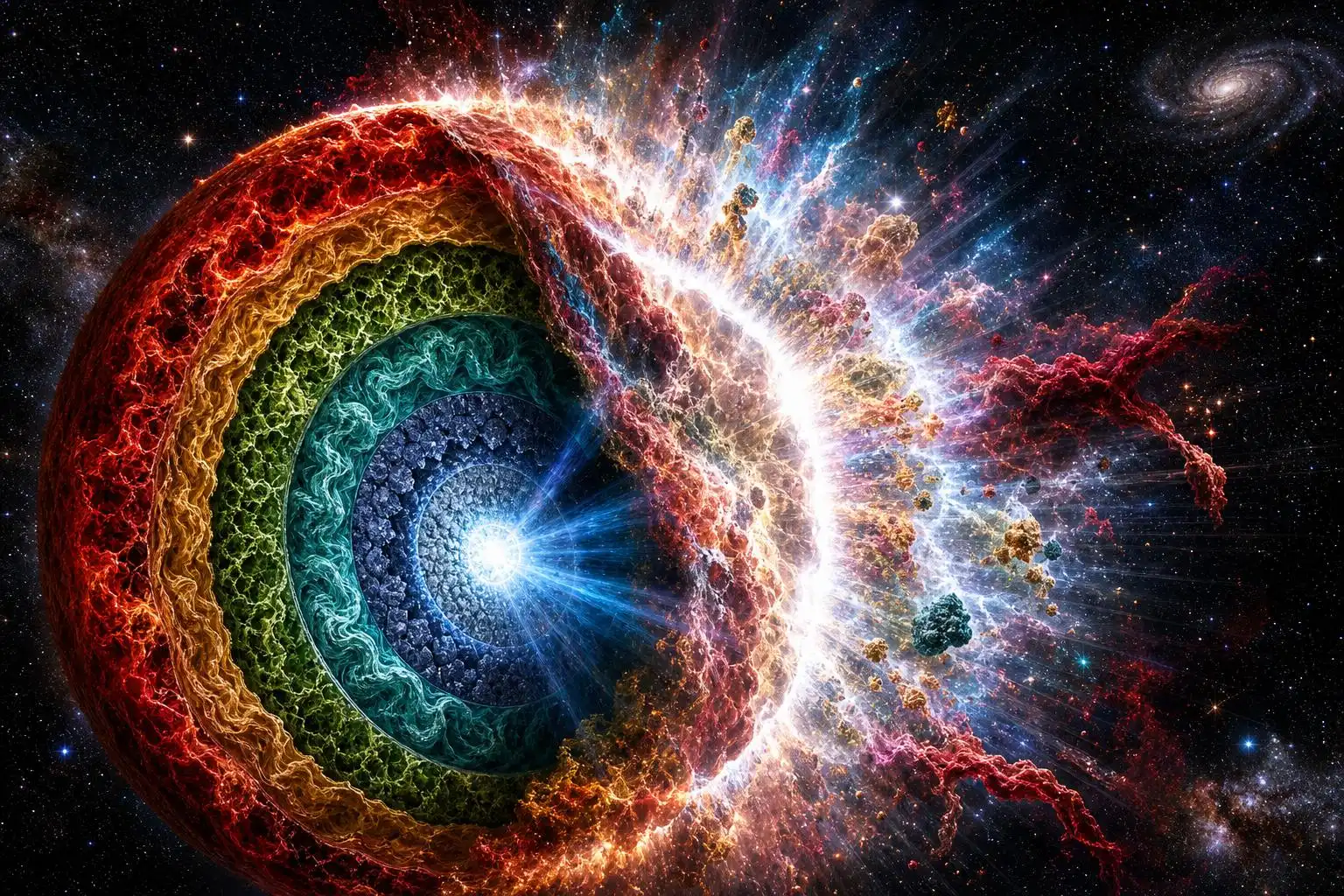
A massive star—anything above roughly eight solar masses—spends its life in a continuous negotiation between gravity and pressure. Nuclear fusion in the core generates an outward pressure that holds the star’s own weight at bay. For millions of years, this works. The star burns hydrogen into helium, then helium into carbon, then carbon into neon, oxygen, silicon, and finally iron, in a nested shell structure that looks, in cross-section, like a cosmic onion.
Iron is where the negotiation breaks down. Every fusion reaction up to iron releases energy—that’s what keeps the star inflated. But fusing iron absorbs energy. Iron is the thermodynamic dead end of stellar nucleosynthesis, the point at which the star has nothing left to burn. The iron core grows, slowly at first, then rapidly, as silicon burning in the shell above rains iron downward. When the core reaches approximately 1.4 solar masses—the Chandrasekhar limit—electron degeneracy pressure, the quantum mechanical force that had been holding it up, can no longer resist gravity.
What happens next is staggering in its speed and violence.
The Collapse: 0.25 Seconds to Change Everything
The iron core collapses from roughly the size of Earth to the size of a city—about 10 to 20 kilometers in radius—in approximately a quarter of a second. During this implosion, the density climbs to values that exceed nuclear density: around a few ×10¹⁴ grams per cubic centimeter. At that density, protons and electrons are forced together to form neutrons, releasing a torrent of electron neutrinos in a process called neutronization. The core briefly becomes opaque even to neutrinos, which is a sentence that deserves a moment of reflection—neutrinos interact so weakly with matter that they pass through a light-year of lead with only a 50% chance of being stopped. Making them bounce off a collapsing stellar core requires conditions that exist nowhere else in the observable universe.
The inner core stiffens as it reaches nuclear density, and the infalling outer core rebounds off it like a hammer hitting an anvil. This produces a shockwave. But here’s the problem that took astrophysicists decades to grapple with: the shockwave, on its own, is not energetic enough to blow the star apart. It stalls. Within milliseconds, it loses energy to the very process that created it—photodisintegration, in which the shock’s own energy is consumed breaking iron nuclei back into protons and neutrons.
So how does the supernova actually explode? The leading mechanism involves neutrinos. Of the roughly 3 × 10⁴⁶ joules released in the collapse—an almost meaningless number at human scales—about 99% is carried away by neutrinos. Even if just 1% of that neutrino energy is deposited back into the stalled shock, it is sufficient to revive it and drive the explosion. This is the neutrino-driven convection mechanism, and while it is the consensus model, simulating it in three dimensions with sufficient resolution remains one of the most computationally demanding problems in astrophysics. The first fully self-consistent 3D simulations capable of producing successful explosions only emerged in the last decade.
What Gets Left Behind
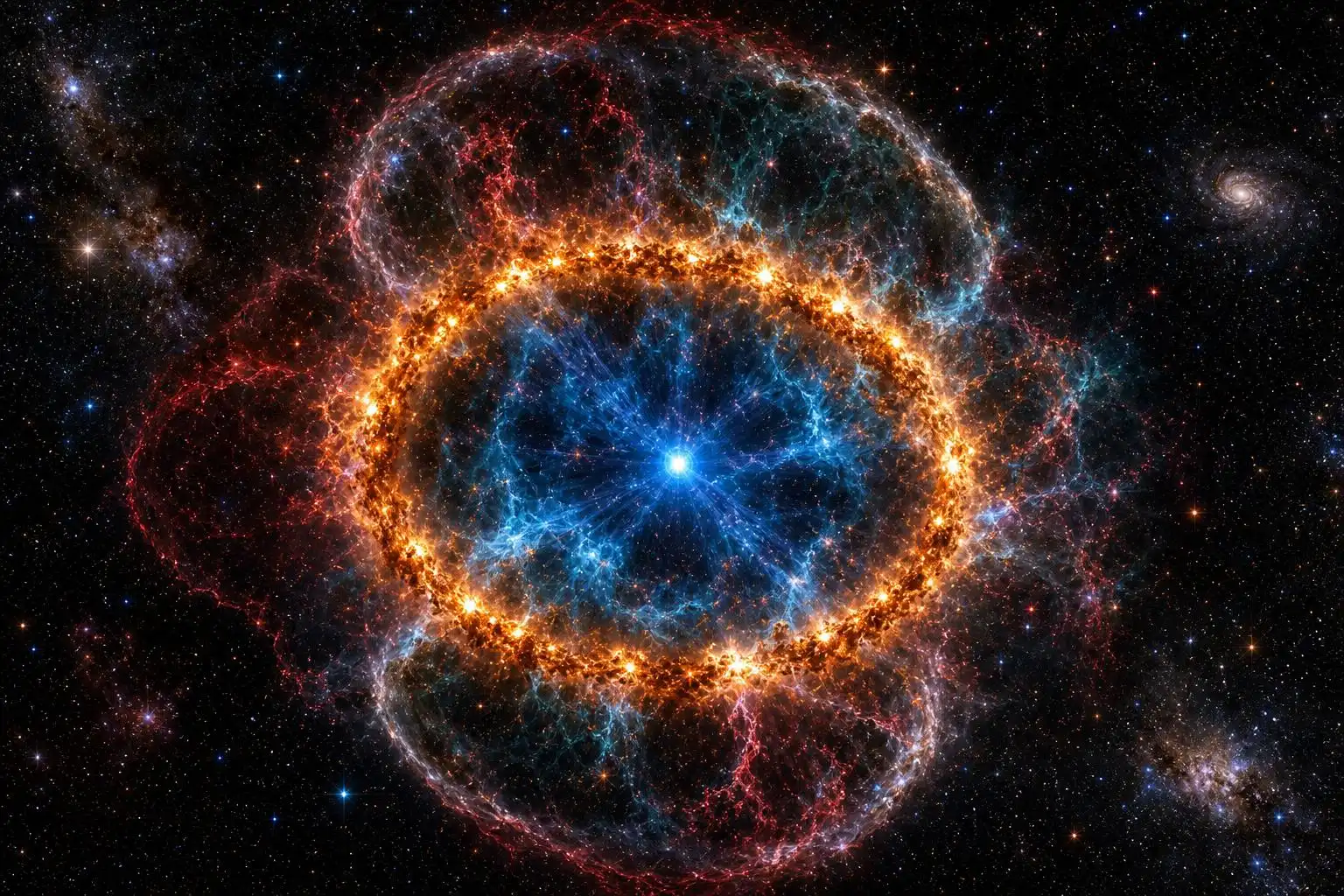
The remnant of a core-collapse supernova is one of two things: a neutron star or a black hole. Which one depends primarily on the mass of the collapsing core and the dynamics of the explosion. If the explosion is successful and the remaining core mass is below roughly two to three solar masses, you get a neutron star—an object of almost incomprehensible density, spinning potentially hundreds of times per second, threaded with magnetic fields a trillion times stronger than Earth’s. If the explosion fails, or the remnant accretes enough additional mass, the neutron star collapses further into a black hole.
Supernova 1987A almost certainly left a neutron star. The neutrino burst alone strongly indicated that a neutron star formed, and in 2024 the James Webb Space Telescope provided the clearest evidence yet of its presence, detecting emission consistent with a compact object at the center of the remnant—though the neutron star has not yet been unambiguously directly observed. Thirty-nine years of waiting, and the universe is finally letting us confirm what the physics always implied.
The Nucleosynthesis: Why the Periodic Table Owes Supernovae Everything
The explosion itself is a nucleosynthesis event of extraordinary productivity. As the shockwave tears through the star’s outer layers, it drives explosive nucleosynthesis—temperatures and densities spike high enough to forge elements that the star’s steady-state burning never could. Nickel-56 is produced in enormous quantities in the innermost ejecta; it decays to cobalt-56, then to stable iron-56, which is why the light curves of core-collapse supernovae follow a characteristic radioactive decay profile in the weeks and months after the explosion. The iron peak elements—iron, nickel, cobalt, chromium, manganese—are seeded into the interstellar medium with every such event.
But the story doesn’t stop at iron. The r-process—rapid neutron capture—was long suspected to occur in core-collapse supernovae, building elements heavier than iron by bombarding seed nuclei with neutrons faster than beta decay can occur. Barium, europium, gold, platinum, uranium—these are r-process products. The current consensus has shifted toward neutron star mergers as the dominant r-process site, following the gravitational wave detection of GW170817 and its associated kilonova, but core-collapse supernovae likely contribute to some portion of r-process production. The precise apportionment between these two channels is an active and contested area of research.
The Progenitor Problem
One of the most vexing open questions in supernova astrophysics is deceptively simple: which stars, exactly, produce core-collapse supernovae? The theoretical expectation is that stars above roughly eight solar masses should end their lives this way. But direct observational confirmation—identifying the progenitor star in archival images taken before the explosion—has produced a puzzle.
Red supergiants dominate the observed progenitor detections. That’s expected. But the most luminous red supergiants—those above about 17 to 18 solar masses—are conspicuously absent from the confirmed progenitor sample. This is the “red supergiant problem.” Either these stars collapse directly to black holes without producing a bright supernova, or they shed their envelopes and explode as different spectral types, or our theoretical understanding of massive star evolution in this mass range is incomplete. There is tentative evidence for “failed supernovae”—cases where a massive star simply disappears from a galaxy without a detectable explosion—but the sample sizes remain small.
Sanduleak −69° 202, the progenitor of 1987A, was itself a surprise: a blue supergiant rather than a red one, which forced a significant revision of the simple picture in which all core-collapse supernovae come from red supergiants. Thirty-nine years later, its remnant continues to be one of the most scientifically productive objects in the sky—a real-time laboratory for shock physics, dust formation, and neutron star cooling, observed across the full electromagnetic spectrum from radio to X-ray.
The Timescale That Puts Everything in Perspective
A massive star lives for a few million years. Its iron core collapses in a quarter of a second. The explosion propagates through the stellar envelope over hours. The ejecta expands and cools over years. The remnant interacts with the surrounding interstellar medium for tens of thousands of years. And the elements it dispersed—carbon, oxygen, silicon, iron, and dozens of others—will be incorporated into new molecular clouds, new protostellar disks, new planets, new oceans, new biology, over timescales of billions of years.
The iron in your hemoglobin was not forged in one event. It is a statistical aggregate of contributions from many supernovae, spanning billions of years of galactic chemical evolution, each one a quarter-second catastrophe that echoed across geological time. The calcium in your bones, the oxygen in every breath, the carbon backbone of every organic molecule in your body—all of it passed through the interior of at least one, and probably many, massive stars before it reached you.
Core collapse is not a footnote in stellar physics. It is the mechanism by which the universe recycles its heaviest elements, the process that makes rocky planets and biochemistry possible, the event that connects the life cycle of a star to the existence of everything that came after. The next time you hear that a supernova has been detected in a nearby galaxy—and one is statistically overdue in the Milky Way—understand that you are watching the universe do the most consequential thing it knows how to do.


Leave a Reply