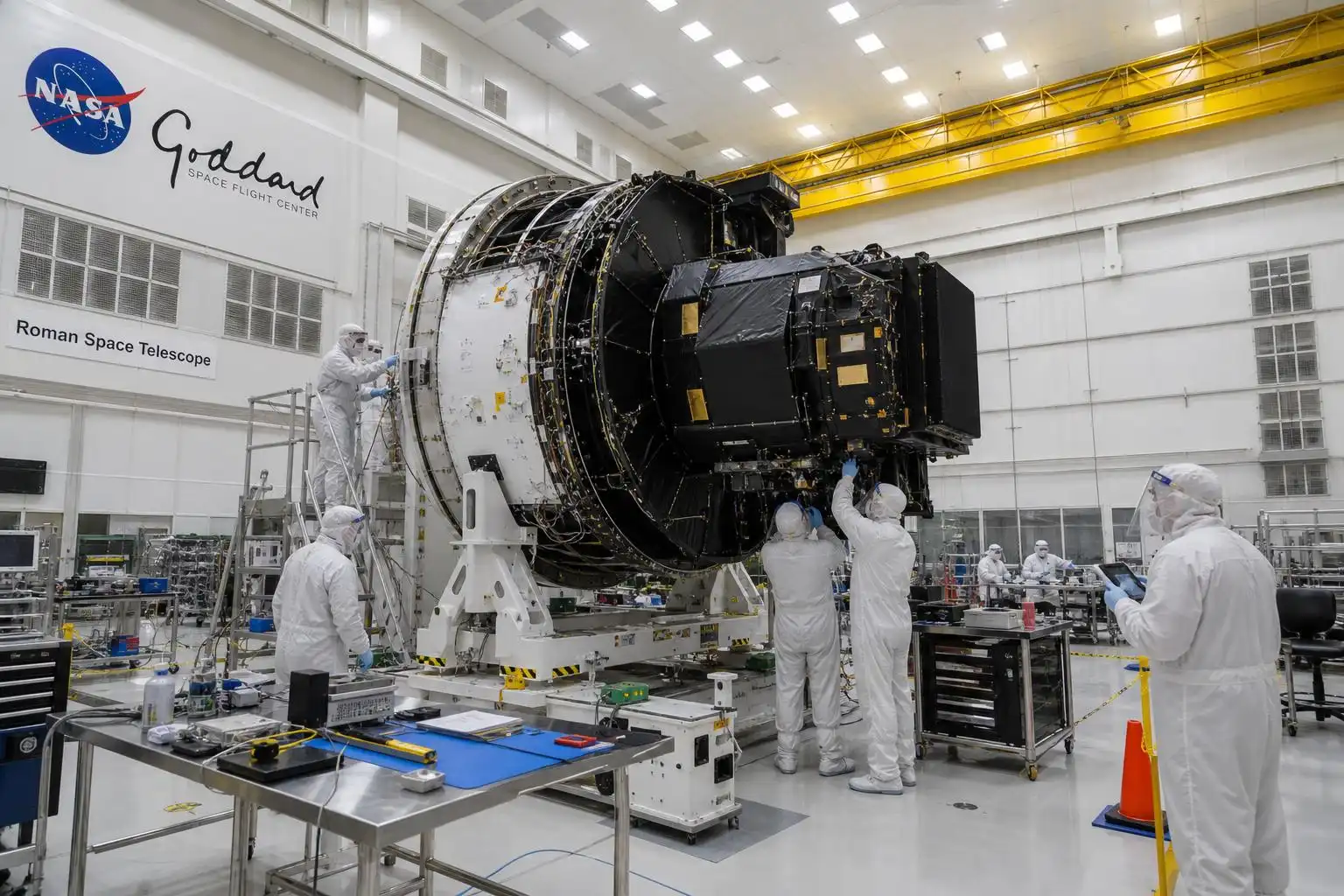

By 2023, the Nancy Grace Roman Space Telescope was no longer an abstract decadal-survey priority. It was a major NASA astrophysics mission in development at Goddard Space Flight Center, with hardware integration underway and a lifecycle cost measured in the billions. That made it both scientifically central and budgetarily exposed: Roman had survived multiple earlier cancellation proposals, and its costs were arriving at the same time NASA was operating Webb, Hubble, Chandra, and beginning planning for the next generation of flagship observatories.
Roman’s history reveals a great deal about how Big Science survives, or doesn’t, in an era of perpetual budget austerity.
The Telescope That Kept Getting Renamed
To understand the politics of Roman, you have to understand its history — which is, in essence, a history of near-death experiences.
The telescope was originally conceived in the early 2000s as the Joint Dark Energy Mission, a collaboration between NASA and the Department of Energy. It was later rebranded as the Wide-Field Infrared Survey Telescope, or WFIRST, and appeared in the 2010 Decadal Survey — New Worlds, New Horizons in Astronomy and Astrophysics — as the top large-mission priority for the coming decade. That endorsement should have been a golden ticket. It wasn’t.
During the Trump administration, WFIRST was proposed for termination in the fiscal year 2019, 2020, and 2021 presidential budget requests. Congress restored funding each time, a testament to the lobbying muscle of the astrophysics community and to the congressional support that major NASA centers and contractors can command.
In 2020, the telescope was renamed the Nancy Grace Roman Space Telescope, honoring NASA’s first Chief of Astronomy, who joined the agency in 1959, retired in 1979, and was instrumental in launching the Hubble Space Telescope program. The renaming was partly symbolic, partly strategic: giving the telescope a human name and a compelling backstory made it harder to cancel. It’s a trick the community had learned from Hubble itself.
What Roman Is Actually For — and Why That Made It a Target
Roman’s scientific case is genuinely broad, which is both its strength and its political vulnerability. The telescope is designed to survey the sky in near-infrared light with a field of view roughly 100 times larger than Hubble’s, enabling three flagship science programs: a dark energy survey using weak gravitational lensing and galaxy clustering, a microlensing survey to detect exoplanets (including free-floating planets with no host star), and a high-latitude wide-area survey that will serve as a legacy dataset for the entire community.
That breadth is scientifically powerful. But in budget fights, breadth reads as diffusion of purpose. When NASA’s Astrophysics Division Director Paul Hertz testified before the House Subcommittee on Space and Aeronautics in March 2018, Republican members pressed him repeatedly on what Roman would do that Webb couldn’t. “WFIRST and JWST are complementary, not competing,” Hertz said. “JWST goes deep. WFIRST goes wide.” The answer was accurate. It didn’t fully satisfy the questioners.
The more damaging critique came from within the scientific community itself. A 2017 report by an independent cost assessment team — the Independent Program Assessment Office, or IPAO — estimated that WFIRST’s cost had grown from an initial $1.6 billion estimate to somewhere between $3.2 billion and $3.9 billion, depending on the scope of the coronagraph instrument included on the mission. The coronagraph, a technology demonstration designed to directly image exoplanets, was added to the mission after the Decadal Survey recommendation and became a flashpoint. Critics argued it was scope creep that was inflating costs; supporters argued it was a transformative capability that justified the additional expense.
The National Academy of Sciences convened a midterm assessment in 2016 — an unusual step that reflected how anxious the community had become — and its report, New Worlds, New Horizons: A Midterm Assessment, reaffirmed Roman’s top priority status but urged NASA to “rigorously control costs and scope.” That’s the polite scientific equivalent of a warning shot.
The 2023 Crunch: Choosing Between Roman and Everything Else
The 2022 Decadal Survey, Pathways to Discovery in Astronomy and Astrophysics for the 2020s, released in November 2021 after a two-year process led by Fiona Harrison of Caltech and Robert Kennicutt of the University of Arizona, recommended completing Roman as NASA’s highest near-term priority in space astronomy. It also recommended technology maturation for a future large infrared/optical/ultraviolet space telescope, a concept that was later developed under the name Habitable Worlds Observatory. That recommendation set up an immediate budgetary tension: completing Roman while beginning the early work needed for a future flagship required NASA’s Astrophysics Division to simultaneously support operating missions, a mission in development, and a mission in planning, all within a budget that had not grown commensurately.
By fiscal year 2023, that tension had become acute. NASA’s science budget request was about $8.0 billion, while the astrophysics line — roughly $1.5 billion — was being squeezed from multiple directions. The Chandra X-ray Observatory, which had been operating since 1999, required a substantial annual operations budget that some budget analysts viewed as difficult to justify for an aging asset. The Hubble Space Telescope, despite its 1990 launch, still commanded roughly $100 million per year. Roman’s development costs were peaking — as they always do in the phase between completing hardware and launch — and the bills were coming due simultaneously.
NASA budget documents and public advisory discussions showed the basic problem clearly: Roman remained a decadal-survey priority, but it was competing for dollars inside a portfolio that also had to protect operating observatories and prepare for the next flagship. The question was not whether Roman had scientific support. It did. The question was how much stress the rest of astrophysics could absorb while Roman moved through the most expensive phase of development.
The astrophysics community continued to point back to the 2021 Decadal Survey’s explicit language: “The committee strongly recommends that NASA complete development of the Nancy Grace Roman Space Telescope as its highest near-term priority in space astronomy.” That sentence became the mission’s strongest institutional defense. It did not make Roman cheap, but it made cancellation or major descoping harder to justify.
The Coronagraph Fights Back
The coronagraph debate deserves its own chapter, because it illustrates how instrument politics can destabilize an entire mission.
The Roman Coronagraph Instrument, or CGI, was developed at the Jet Propulsion Laboratory in Pasadena under a team that included instrument scientist Vanessa Bailey. It was designed not as Roman’s primary science instrument but as a technology demonstration — a proof-of-concept for the starlight-suppression techniques that would eventually be needed for a future direct-imaging exoplanet observatory. In that sense, the coronagraph was doing double duty: contributing to Roman’s technology goals while also reducing risk for later missions.
But technology demonstrations are inherently difficult to defend in budget fights. They don’t produce the same clean scientific deliverables as a survey program. And the CGI added cost and complexity to a mission whose core decadal-survey rationale rested on wide-field infrared surveys.
NASA ultimately kept the coronagraph on Roman, but it remained formally a technology demonstration rather than the mission’s central survey instrument. That distinction mattered. In a constrained budget environment, the Wide Field Instrument and the survey programs carried the mission’s core scientific justification, while the coronagraph was treated as a high-value but secondary capability.
That compromise satisfied neither camp completely. Exoplanet researchers saw the coronagraph as a bridge to the next generation of direct-imaging missions. Budget officials and mission managers saw it as a limited demonstration that had to be contained so that Roman’s primary surveys could proceed.
Goddard, Congress, and the Geography of Survival
Roman has survived every budget threat for the same reason most big NASA missions survive: geography.
Goddard Space Flight Center, where Roman is being built and integrated, is the largest NASA installation on the East Coast. It employs thousands of civil servants and contractors, and Maryland’s congressional delegation has long been vocal in defending Goddard missions. Steny Hoyer, who served as House Majority Leader from 2019 to 2023 and remains one of the most senior Democrats in the House, has been an explicit advocate for Goddard-related work for decades.
That kind of response is not accidental. NASA’s contractors — Northrop Grumman, Ball Aerospace (now BAE Systems), Teledyne, and others — employ people in districts that matter to appropriators. The Roman supply chain spans many states. This is not a coincidence; it is a feature of how large NASA programs are structured, deliberately, to make cancellation politically costly.
The strategy has a name in the aerospace policy community: “political constituency building.” It was perfected during the Space Shuttle era and has been applied to every major NASA program since. Critics argue it distorts mission design by adding contractors and components to maximize geographic spread rather than technical efficiency. Defenders argue it’s the only realistic way to protect long-term science investments from short-term budget pressures.
Both are right.
Where Roman Stands Now
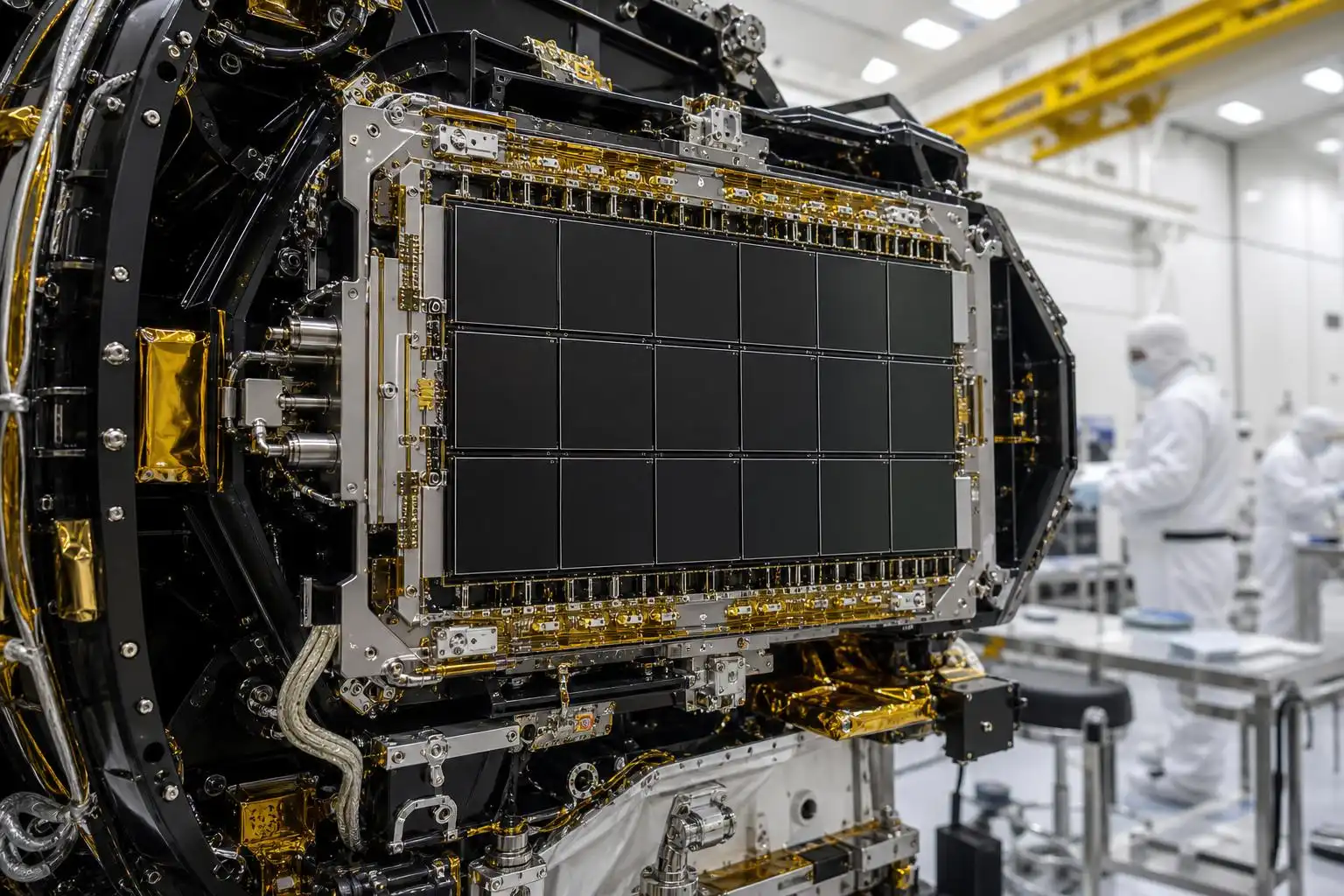
As of 2026, the Nancy Grace Roman Space Telescope is in the integration and testing phase at Goddard, with launch planned on a SpaceX Falcon Heavy rocket. The coronagraph instrument is part of the mission. The Wide Field Instrument — the 300-megapixel camera that will conduct the core survey programs — has completed major testing and integration milestones. The mission’s total lifecycle cost is now estimated at more than $4 billion, a figure that NASA’s budget documents present without apology.
The broader astrophysics portfolio remains under pressure. Chandra’s future beyond the mid-2020s has been the subject of repeated budget debate. The Hubble servicing program, ended with the retirement of the Space Shuttle in 2011, means that telescope is operating on borrowed time. And the Habitable Worlds Observatory — Roman’s intended scientific successor in the broader flagship sequence — has not yet received a full mission new-start authorization, meaning the 2021 Decadal’s top priority for a future large observatory remains in planning and technology maturation.
The Institutional Lesson
The Roman story teaches the same lesson as JWST, as LIGO, as every large-scale scientific instrument that has actually reached the sky: survival in Big Science is not primarily a function of scientific merit. It is a function of institutional durability — the ability to outlast administrations, absorb cost growth, maintain congressional relationships, and keep the coalition together across decades.
Roman was recommended by the 2010 Decadal Survey. It is scheduled to launch more than sixteen years after that priority endorsement — and the mission nearly died at least three times in between. The scientists who wrote the original white papers proposing the mission are, many of them, now senior enough to be writing the next Decadal Survey.
The question the Roman saga poses — and does not answer — is whether this is the best system we have for doing transformative science, or merely the only system we’ve built. The Decadal Survey process is genuinely democratic, genuinely rigorous, and genuinely slow. It produces excellent prioritization and then hands those priorities to an institutional machinery that was not designed for excellence. It was designed for survival.
Nancy Grace Roman herself understood this. In a 2017 interview with NASA’s history office, conducted when she was 91 years old, she was asked what she had learned from her years building the case for Hubble. “You have to be patient,” she said. “And you have to make friends in the right places.”
She died in December 2018, years before the telescope that bears her name is scheduled to open its eye on the sky.



Leave a Reply