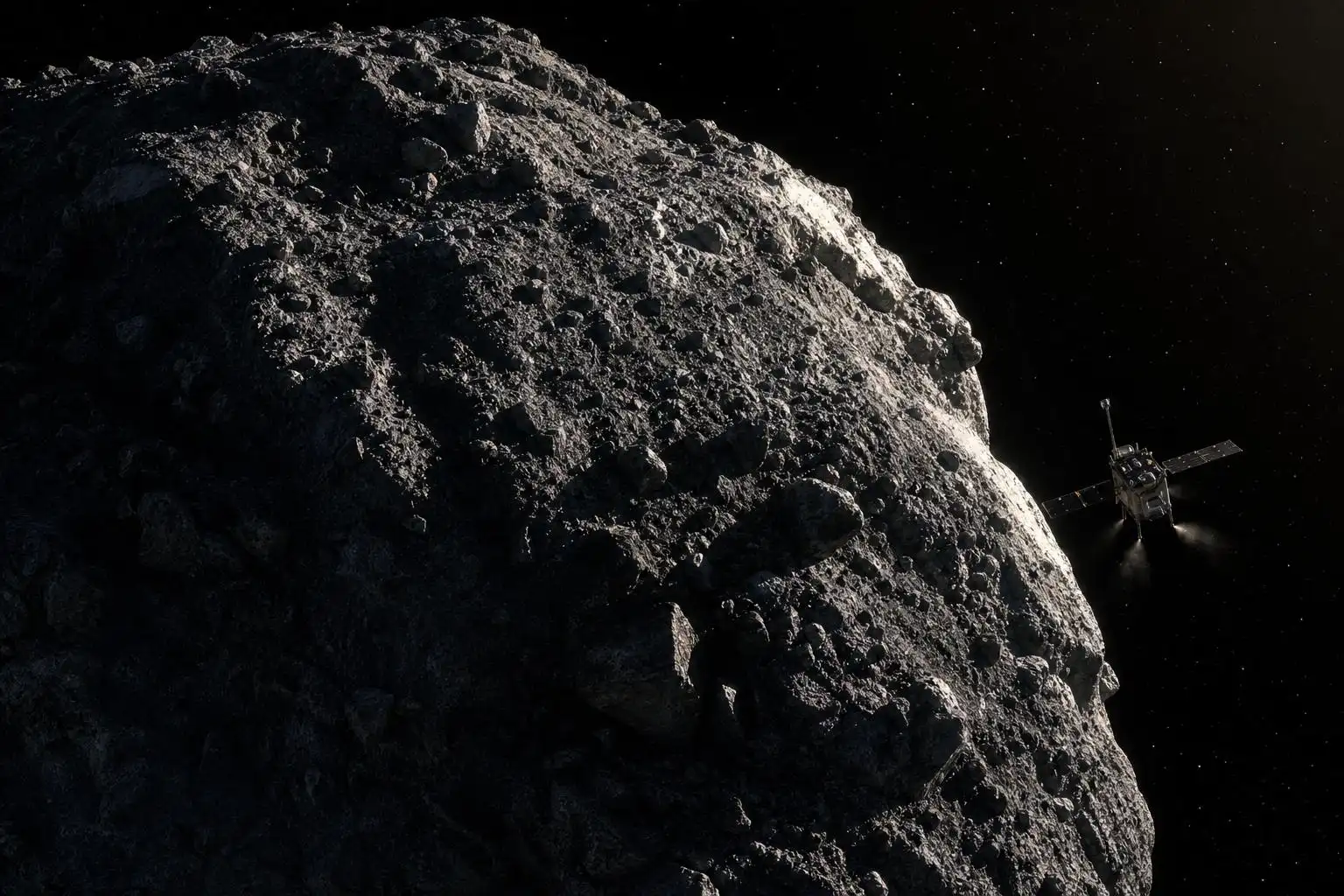

On July 5, 2026, JAXA’s Hayabusa2 spacecraft skimmed past the near-Earth asteroid Torifune at a distance of roughly 400 metres above its surface — just 744 metres from the object’s centre — setting a new record for the closest controlled flyby of any solar system body in history.[7] To put that in perspective: if you stood at one end of a standard running track and looked to the other, you’d be staring across roughly the same gap that separated a 600-kilogram spacecraft from an alien rock hurtling through interplanetary space. That is not a margin for error — it is a margin for precision, and it changes what we thought was possible in deep-space navigation.
From Ryugu to Torifune: A Spacecraft That Refuses to Retire
Hayabusa2 already has one of the most decorated CVs in planetary science. Launched in December 2014, it rendezvoused with the carbon-rich, rubble-pile asteroid Ryugu in June 2018, deployed three surface rovers and a lander, fired a copper impactor into the asteroid to excavate fresh subsurface material, and collected samples from both the surface and the newly created crater. In December 2020 it returned those samples to Earth — the first time humanity had retrieved subsurface material from a primitive asteroid. The Ryugu samples have since revealed amino acid precursors and hydrated minerals that speak directly to the question of how organic chemistry was distributed across the early solar system.
That would have been a complete mission for any spacecraft. JAXA had other ideas. Rather than parking Hayabusa2 in a graveyard orbit, engineers reprogrammed it for an extended mission. Its ultimate destination is the tiny, rapidly spinning asteroid 1998 KY26, an object barely 11 metres across, with a rendezvous scheduled for 2031.[7] Torifune was not the destination — it was an opportunistic target of convenience, a chance to stress-test navigation software against a real asteroid before the main event.
What “400 Metres” Actually Means in Deep Space
Deep-space navigation is fundamentally a problem of light-speed lag and accumulated uncertainty. At interplanetary distances, radio signals take minutes to travel each way, which means a spacecraft cannot be steered in real time the way a drone is. Instead, flight controllers build a trajectory model, upload a command sequence, and trust the onboard autonomy to execute it. Every gravitational perturbation, every solar-radiation-pressure nudge, every tiny thruster misfire accumulates into what navigators call the “position uncertainty ellipsoid” — the cloud of possible locations where the spacecraft might actually be at any given moment.
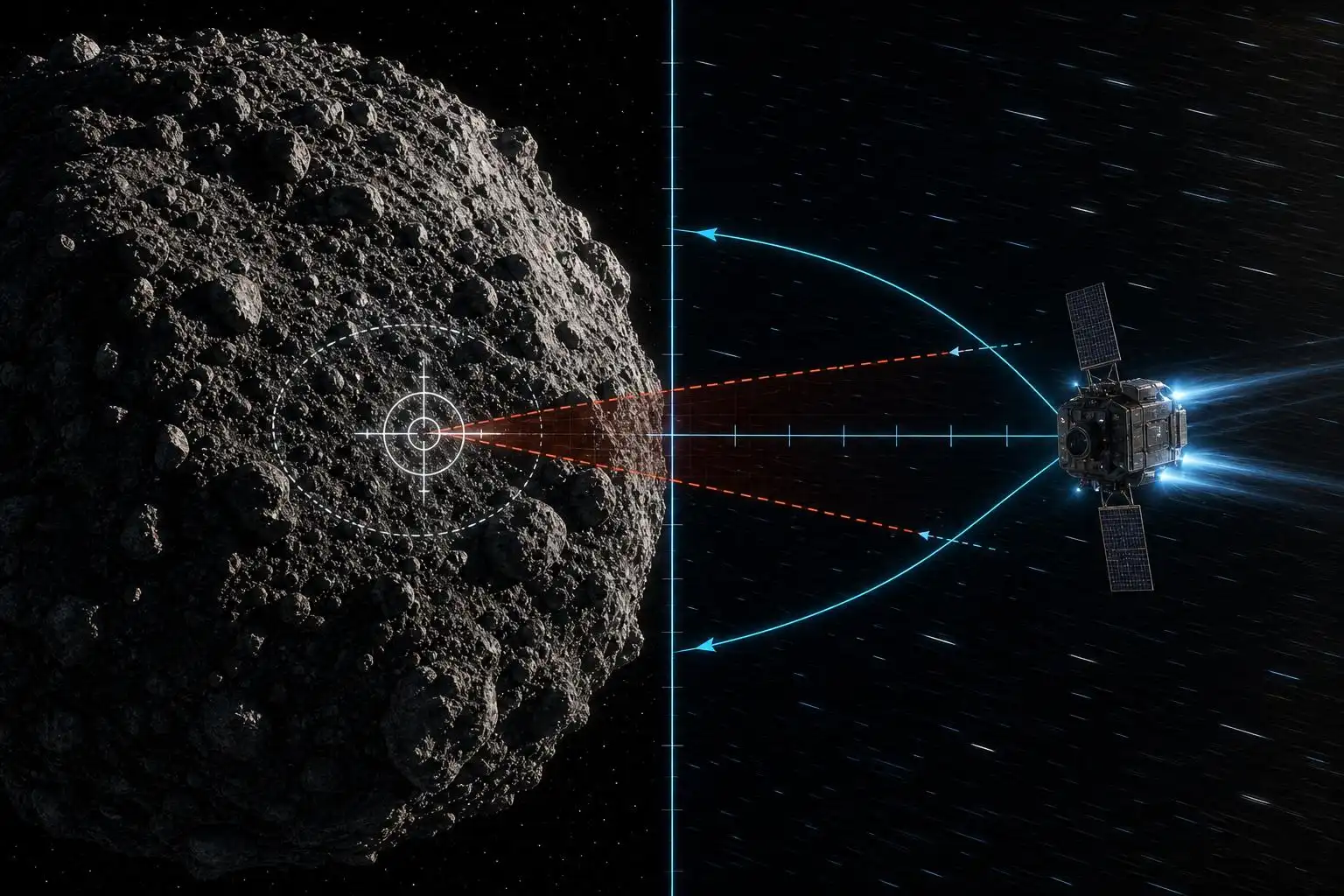
For the Torifune flyby, JAXA shrank that ellipsoid to a radius smaller than the asteroid itself. That required a combination of optical navigation — using the spacecraft’s cameras to triangulate its position relative to the asteroid in real time — and extremely precise trajectory corrections in the days before closest approach. The result was a pass so close that Hayabusa2’s instruments could resolve surface features at resolutions comparable to what a low-flying helicopter might see from a terrestrial hillside.
JAXA was explicit about why this matters beyond bragging rights. The navigation techniques demonstrated at Torifune are directly applicable to kinetic-impact missions — spacecraft designed to slam into an asteroid and nudge its orbit, exactly the strategy NASA’s DART mission validated at Didymos in September 2022.[2] A kinetic impactor that misses by even a few hundred metres has accomplished nothing. The ability to close to within 400 metres of a tumbling, irregular body under autonomous guidance is the same skill set, expressed differently.
The Planetary Defence Thread Running Through All of This
There is a satisfying narrative coherence to the sequence of missions now shaping planetary defence capability. DART demonstrated that a spacecraft can meaningfully alter an asteroid’s orbital period — the moonlet Dimorphos’s period around Didymos shortened by 33 minutes, far more than models predicted, largely because the ejecta plume from the impact acted as a secondary thruster. ESA’s Hera mission is now studying the Didymos system in detail, measuring the crater morphology, the mass distribution of Dimorphos, and the precise momentum transfer that occurred — data without which the DART result cannot be generalised to other scenarios.[2]
Hayabusa2’s Torifune flyby slots into this sequence as a navigation milestone. Knowing that you can deflect an asteroid is only half the problem; knowing that you can get a spacecraft precisely where it needs to be — at the right approach angle, at the right closing velocity, within the right impact corridor — is the other half. The flyby demonstrated that autonomous optical navigation can achieve sub-kilometre precision at an uncharted, irregularly shaped body with essentially no prior shape model. That is a harder problem than navigating to a well-mapped target, and solving it is exactly the kind of heritage that makes future planetary defence missions more credible.
Torifune as a Science Target
The flyby was not purely a technology demonstration. Hayabusa2 carries a suite of instruments that remained active during the close pass. Its Optical Navigation Camera (ONC) system — the same family of wide-angle and telephoto cameras that mapped Ryugu in extraordinary detail — would have captured images at resolutions impossible from any ground-based or space-based telescope. Near-Earth asteroids in Torifune’s size class are essentially invisible to Earth’s observatories except as point sources; we know their orbital parameters but almost nothing about their shapes, rotation states, or surface geology.
Even a single close-approach imaging sequence can answer foundational questions: Is the surface covered in fine regolith, or is it bare rock? Are there boulders? Does the shape suggest a monolithic fragment or a rubble pile held together by gravity and cohesion? These questions matter for planetary defence because a rubble pile responds to a kinetic impactor very differently than a solid rock — it can absorb energy by compressing and dispersing rather than transferring momentum cleanly. The Ryugu samples already confirmed that at least some carbon-rich near-Earth asteroids are loosely consolidated rubble piles. Torifune’s flyby data will help determine how common that structure is.
What This Means for 1998 KY26
Hayabusa2’s ultimate target, 1998 KY26, is in a class of its own. At roughly 11 metres in diameter, it is among the smallest solar system bodies ever targeted by a spacecraft — small enough that its surface gravity is essentially zero, meaning any attempt to land or anchor would require completely different engineering than anything attempted at Ryugu.[7] Objects this small spin rapidly — 1998 KY26 completes a rotation every 10.7 minutes — and their surfaces are poorly understood because no spacecraft has ever visited anything in this size range.
The Torifune flyby serves as a dress rehearsal for the navigation challenge that 1998 KY26 will present. A 744-metre closest-approach distance is still well outside the gravitational sphere of influence of an 11-metre object, but the optical navigation techniques, the autonomous hazard avoidance, and the trajectory correction manoeuvre sequencing are all directly transferable. Every lesson learned at Torifune is a lesson that does not need to be learned the hard way at 1998 KY26 in 2031.
A Broader Pattern: Missions That Keep Giving
What Hayabusa2 represents, beyond its individual achievements, is a philosophy of spacecraft utilisation that the planetary science community is increasingly embracing. New Horizons, after its Pluto flyby in July 2015, was redirected to the Kuiper Belt Object Arrokoth. Cassini’s final year at Saturn was structured as a series of ring-grazing orbits that collected data no earlier mission phase could have reached. JAXA’s approach with Hayabusa2 fits this pattern: once you have a functioning spacecraft with propellant remaining and instruments still operating, the marginal cost of an extended mission is a fraction of launching a new one.
The Torifune flyby record will not stand forever. Future missions — whether dedicated planetary defence demonstrators or sample-return spacecraft on extended tours — will push closer still, as navigation software improves and onboard autonomy becomes more capable. But for now, 400 metres above an alien rock, travelling at kilometres per second, guided by algorithms running on hardware launched in 2014, stands as a remarkable marker of how far deep-space navigation has come.
The solar system is full of small, dark, fast-spinning objects that we have never seen up close. Hayabusa2 just showed us how close we can get.
References
-
Japan’s Hayabusa2 spacecraft set a new record for the closest flyby of a Solar System body — National Space Society — https://www.facebook.com/NSS/posts/japans-hayabusa2-spacecraft-set-a-new-record-for-the-closest-flyby-of-a-solar-sy/1495707269267060
-
NASA intentionally crashed a spacecraft into an asteroid — Intrepid Museum / Instagram — https://www.instagram.com/p/DbG5hGniZxk



Leave a Reply