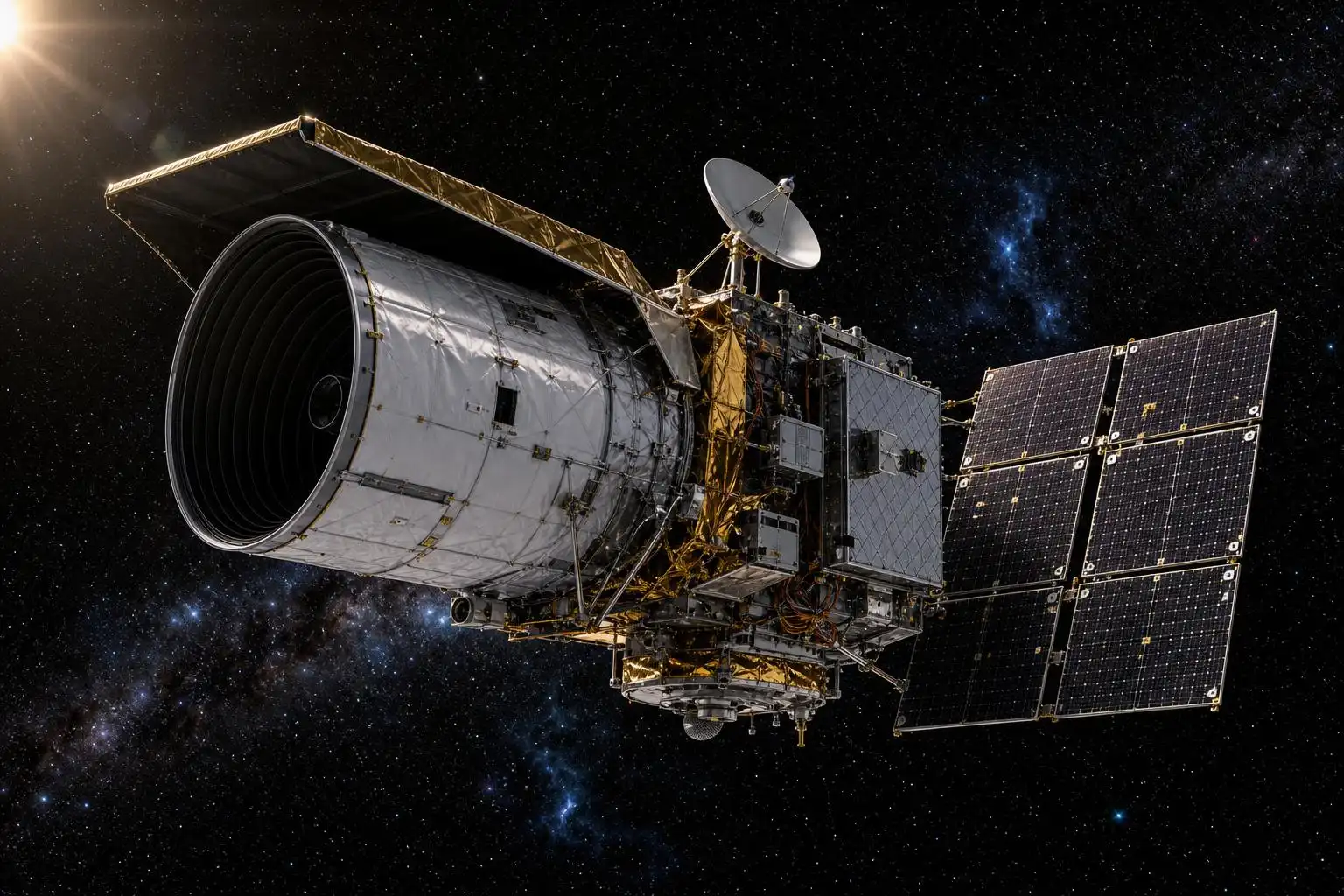

There is a 2.4-meter mirror sitting in a clean room at NASA’s Goddard Space Flight Center that once belonged to the National Reconnaissance Office. It arrived unannounced in 2012 — a gift from the intelligence community, still in its shipping container, optically superior to anything NASA had planned to purchase for its next flagship observatory. That mirror is now the heart of the Nancy Grace Roman Space Telescope, and it tells you something important about how this mission came to be: part inheritance, part ambition, and entirely the product of decades of hard-won lessons from every great observatory that came before it.
Roman — named for NASA’s first Chief of Astronomy, the woman who fought the bureaucratic battles that made Hubble possible — is scheduled to launch no earlier than late 2026 aboard a SpaceX Falcon Heavy. Its primary science goals are audacious: map the large-scale structure of the universe to constrain dark energy, conduct the most sensitive microlensing survey ever attempted to find thousands of exoplanets including free-floating worlds with no parent star, and image wide swaths of the sky at Hubble-quality resolution. To do all of that simultaneously, it needs a field of view that would make Hubble blush.
The Field of View Problem
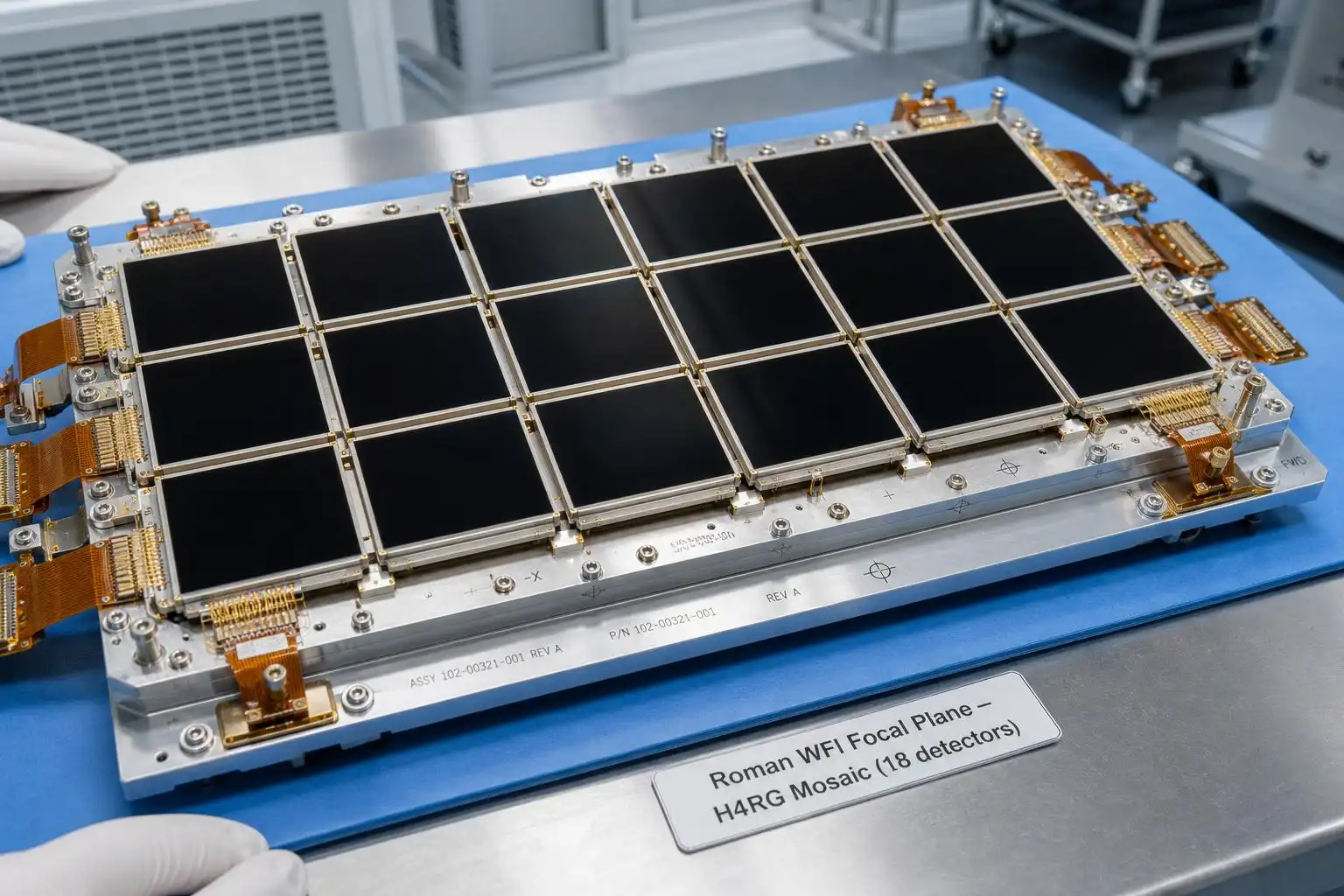
Hubble’s Wide Field Camera 3 covers roughly 7.4 square arcminutes per pointing. Roman’s Wide Field Instrument — a mosaic of 18 H4RG-10 infrared detectors, each 4096 × 4096 pixels — covers 0.281 square degrees total. That is approximately 100 times the area Hubble can image in a single exposure. The angular resolution is 0.11 arcseconds per pixel, comparable to Hubble’s optical performance, but Roman achieves it across a field that would take Hubble hundreds of individual pointings to tile.
This is not a small engineering detail. It is the entire mission architecture. The wide field is what enables the weak gravitational lensing surveys that probe dark energy — you need millions of galaxy shapes measured to the sub-percent level to extract the cosmological signal from the noise. It is what enables the microlensing survey toward the galactic bulge, where Roman will monitor hundreds of millions of stars simultaneously, watching for the characteristic brightening that signals a compact object crossing the line of sight. And it is what makes Roman’s guest observer program so compelling: any astronomer who has spent years mosaicking Hubble pointings together to cover a single nearby galaxy cluster will immediately understand what a 0.281-square-degree detector array means for their science.
The H4RG-10 detectors operate in the near-infrared, covering 0.48 to 2.3 microns. That wavelength range is deliberate. Infrared light cuts through the dust in the galactic plane, redshifted light from distant galaxies falls neatly into the band, and the detectors can be cooled passively to around 95 Kelvin — no expendable cryogen required, a lesson learned directly from Spitzer’s 360-liter helium budget and the hard deadline it imposed. Roman’s design lifetime is five years with a ten-year goal, and it will not be racing a dewar.
The Mirror That Fell From the Sky
The NRO mirror changed everything about Roman’s cost profile. When the Astro2010 decadal survey recommended what was then called the Wide Field Infrared Survey Telescope (WFIRST), the baseline design called for a 1.5-meter primary. The donated 2.4-meter mirror — the same diameter as Hubble’s primary, ground to comparable surface figure quality — arrived with a collecting area 2.56 times larger than the original plan, essentially for free. NASA accepted it.
But “free” in the aerospace sense means something specific. The mirror came without its original optical support structure, without coatings optimized for near-infrared, and without any of the surrounding hardware needed to turn a piece of glass into a functional telescope. Goddard engineers spent years characterizing its figure, designing a new optical system around it, and specifying the protected/enhanced silver coating that maximizes throughput in the 0.48–2.3 micron band. The total mission cost has grown to approximately $3.93 billion — not cheap, but substantially less than it would have been starting from a clean sheet.
The optical design that emerged is a three-mirror anastigmat, the same configuration used by JWST and, in modified form, by Gaia. Three-mirror anastigmats correct for spherical aberration, coma, and astigmatism simultaneously, which is how you achieve diffraction-limited performance across a wide field without the kind of off-axis degradation that plagued early wide-field designs. Roman’s system includes a fine steering mirror — a small, fast-actuating flat that can correct pointing jitter at the sub-pixel level, stabilizing the image during the long exposures needed for weak lensing measurements. Pointing stability requirements are in the range of 14 milliarcseconds over the course of a typical exposure. For context, Hubble’s fine guidance sensors hold the telescope to about 7 milliarcseconds, a standard Roman is designed to approach with a simpler mechanical system.
The Coronagraph: A Technology Demonstration with Enormous Stakes
Roman carries a second instrument that has nothing to do with its primary survey mission and everything to do with the future of astronomy: the Coronagraph Instrument, a high-contrast imaging system designed to directly image exoplanets and circumstellar debris disks.
Direct imaging of exoplanets is brutally hard. A Jupiter-analog reflects roughly one billionth the light of its parent star. An Earth-analog reflects about ten billion times less. Current ground-based coronagraphs, even with extreme adaptive optics, struggle to reach contrasts of 10⁻⁶ at small angular separations. Roman’s Coronagraph is designed to demonstrate contrasts approaching 10⁻⁹ in space, where there is no atmospheric turbulence to fight and the point spread function is stable over timescales of hours.
The instrument uses two deformable mirrors — both with 48×48 actuators — to actively suppress diffracted starlight. It includes multiple coronagraphic mask configurations: a hybrid Lyot coronagraph for broader separations and a shaped pupil coronagraph optimized for specific angular ranges. The wavefront sensing and control system measures residual speckles in the focal plane and feeds corrections back to the deformable mirrors in a closed loop, pushing the contrast floor down iteratively.
Roman’s Coronagraph is explicitly classified as a technology demonstration, not a primary science instrument. It will not spend the bulk of the mission’s observing time staring at nearby stars. But the data it returns — real on-sky performance numbers for 10⁻⁸ to 10⁻⁹ contrast in space — will directly inform the design of the Habitable Worlds Observatory, the mission the Astro2020 decadal survey identified as the community’s top priority for the 2040s. HWO’s entire scientific case rests on the ability to image Earth-like planets in the habitable zones of Sun-like stars. Roman’s Coronagraph is the proof-of-concept that either validates that path or forces a redesign before $10 billion is committed.
Orbit, Operations, and the Data Firehose
Roman will operate at the Sun-Earth L2 point, 1.5 million kilometers from Earth in the anti-sunlight direction — the same orbital neighborhood as JWST, Gaia, and the Planck and Herschel observatories before them. L2 is thermally stable, far from Earth’s radiation belts, and provides an unobstructed view of the sky for roughly half the year from any given pointing. The tradeoff is communication latency and the impossibility of servicing missions: unlike Hubble, Roman cannot be reached by astronauts.
The data rate is the operational challenge that keeps mission planners awake. Roman’s 18-detector mosaic generates approximately 302 megapixels per exposure. The Wide Field Survey is designed to image the sky repeatedly, building up the statistical samples needed for weak lensing and microlensing. Estimates suggest Roman will produce roughly 20 terabytes of raw data per month during survey operations — comparable to the data volume Gaia accumulated over its entire five-year primary mission, but compressed into monthly cadence. The downlink system uses Ka-band communications to NASA’s Deep Space Network, with a sustained downlink rate of approximately 500 megabits per second during contact windows.
The ground system is being built to handle this from day one, with automated pipeline processing at the Space Telescope Science Institute — the same organization that runs Hubble and supports JWST. STScI is developing a dedicated Roman Operations Center, and the science community is already building the data reduction pipelines needed to turn raw detector reads into calibrated sky images. The calibration requirements are formidable: to measure galaxy shapes at the sub-percent level for weak lensing, every source of systematic error — detector nonlinearity, persistence from bright sources, optical distortion, thermal drift in the point spread function — must be characterized and removed to parts-per-thousand precision.
What Roman Will Actually Find
The mission’s three core programs each attack a different frontier. The High Latitude Wide Area Survey will cover 2,000 square degrees of sky in multiple infrared bands, building a three-dimensional map of matter distribution through weak gravitational lensing and galaxy clustering. The goal is to constrain the dark energy equation of state parameter w to better than 1% — a measurement that distinguishes between a cosmological constant (w = −1) and dynamical dark energy models. Current constraints from Planck, DES, and Euclid are approaching this level; Roman’s combination of area, depth, and resolution is designed to break the degeneracies that remain.
The Galactic Bulge Time Domain Survey will point Roman repeatedly toward the dense stellar fields near the galactic center, monitoring roughly 200 million stars for microlensing events. Population models predict Roman will detect thousands of bound exoplanets — including cold gas giants, ice giants, and super-Earths at orbital separations beyond the snow line where current transit surveys are blind — and potentially hundreds of free-floating planetary-mass objects ejected from their birth systems. The sensitivity extends to objects as small as Mars, making Roman the first survey capable of measuring the abundance of free-floating Mars-mass objects across the galaxy.
The High Latitude Time Domain Survey will repeatedly image a smaller area to build a cosmological supernova sample — thousands of Type Ia supernovae reaching to around redshift z ~ 2, extending the distance ladder that originally revealed cosmic acceleration. Combining this with the weak lensing and clustering measurements provides multiple independent handles on the same cosmological parameters, allowing internal cross-checks that can reveal systematic errors in any single method.
The Weight of What Comes Next
Roman is not just a mission. It is a bridge. It carries Hubble’s resolution and mirror diameter into the wide-field infrared era. It carries Spitzer’s infrared sensitivity without Spitzer’s cryogen deadline. It carries JWST’s optical design philosophy — the three-mirror anastigmat, the L2 orbit, the passive cooling — into a survey-scale instrument. And it carries, in its Coronagraph, the first serious attempt to demonstrate in space the contrast performance that the Habitable Worlds Observatory will require to do its science.
When Roman launches on that Falcon Heavy and the solar panels deploy and the fine steering mirror takes its first calibration data, it will be inheriting the work of every engineer who ground Chandra’s mirrors to 0.5-arcsecond accuracy, every technician who folded JWST’s sunshield in a clean room for the hundredth time, every scientist who watched Kepler’s reaction wheels fail and figured out how to keep doing science anyway. The mirror in Roman’s optical tube was originally built to look down. Now it will spend its working life looking out — and what it finds will shape the questions we ask for the next half century.



Leave a Reply