
Press a solar mass of material into a sphere roughly 24 kilometers across and you have a neutron star — one of the densest stable configurations of matter in the universe. The central density exceeds 10¹⁸ kg/m³, several times the density of an atomic nucleus. At those conditions, the ordinary notion of “nuclear matter” dissolves. Protons and neutrons are no longer the right degrees of freedom. What replaces them is the central open question in neutron star physics: the equation of state (EOS) of cold, dense, strongly interacting matter.
The EOS is simply the relationship between pressure and density (or equivalently, energy density) inside the star. It sounds like a bookkeeping item, but it encodes everything about how matter behaves under conditions unreachable by any terrestrial experiment. Get the EOS right, and you can predict a neutron star’s radius, its maximum mass, how it vibrates, and how it responds to being torn apart by a companion. Get it wrong, and your models of gravitational-wave signals, X-ray pulse profiles, and even the r-process yields of neutron star mergers are all off.
From Crust to Core: A Layered Problem
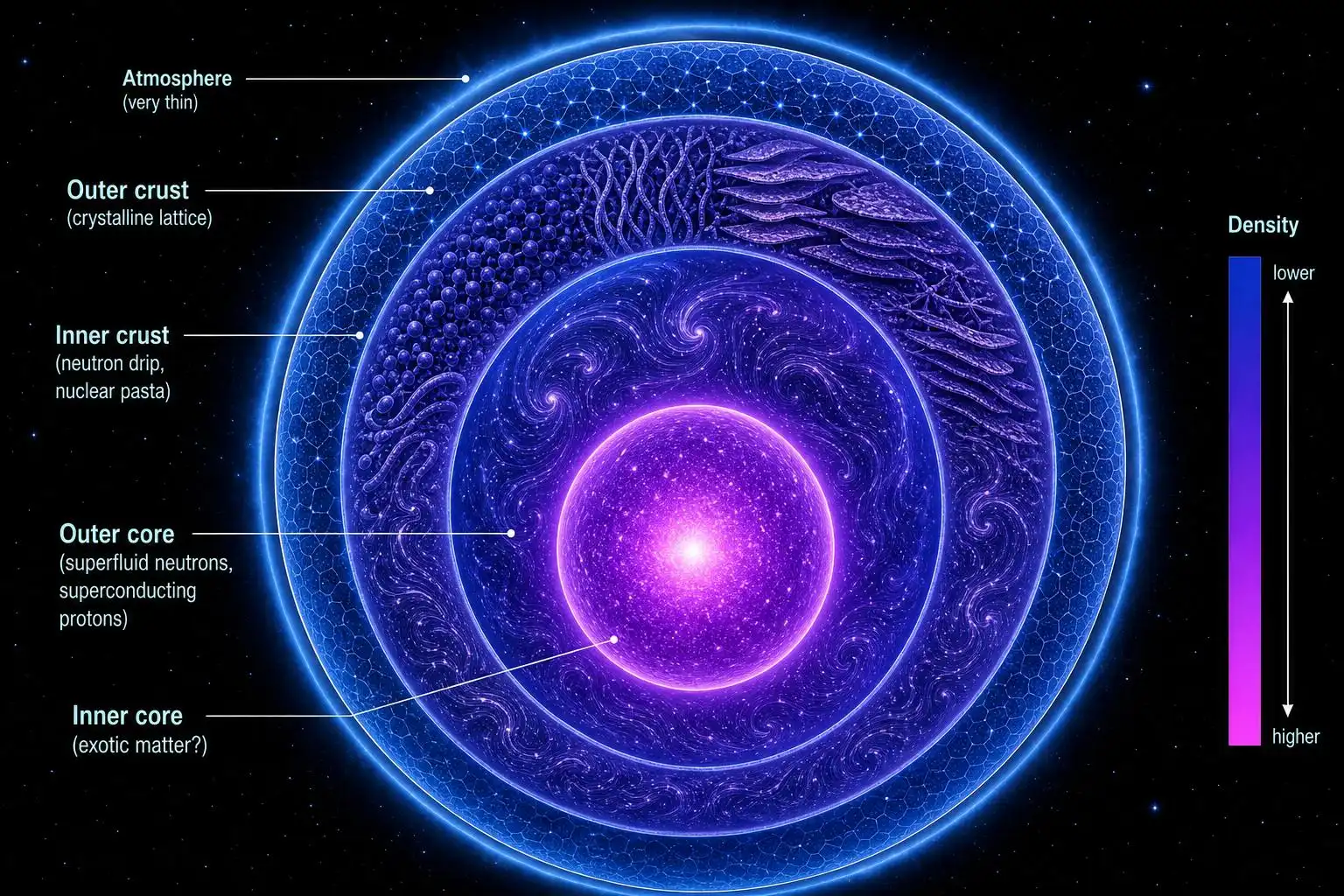
A neutron star is not uniform. Its interior stratifies into distinct regions, each governed by different physics.
The outer crust — from the surface down to roughly 300 meters depth — is a crystalline lattice of neutron-rich nuclei embedded in a relativistic electron gas. Densities here run from about 10⁹ kg/m³ at the surface up to the neutron drip point near 4 × 10¹⁴ kg/m³. Below neutron drip, free neutrons begin to leak out of nuclei and form a superfluid that coexists with the nuclear lattice. This is the inner crust, extending to roughly half nuclear saturation density (ρ₀ ≈ 2.3 × 10¹⁷ kg/m³).
Near the crust-core transition, at roughly half nuclear saturation density, nuclei dissolve entirely into a uniform fluid of neutrons, protons, and leptons. This is the outer core, and it is reasonably well constrained by nuclear experiments — chiefly measurements of nuclear binding energies, neutron skin thicknesses, and heavy-ion collision data. The symmetry energy and its slope parameter L, which describe how the energy of nuclear matter changes as you increase the neutron-to-proton ratio, are the key quantities here, and decades of nuclear physics have bracketed them to perhaps ±20%.
The trouble starts in the inner core, above roughly 2ρ₀. No terrestrial experiment reaches these densities. Three broad scenarios compete:
-
Nucleonic matter: Neutrons and protons remain the relevant degrees of freedom, interacting via a stiff repulsive potential at short range. This produces a hard EOS — high pressure for a given density — and correspondingly large neutron star radii (≳13 km for a 1.4 M☉ star).
-
Hyperonic matter: Above about 2–3ρ₀, it becomes energetically favorable for neutrons to convert into hyperons — strange baryons like Λ⁰, Σ⁻, and Ξ⁻. Adding these new particles softens the EOS because they provide additional pressure-relief channels. The problem is that softening the EOS tends to lower the maximum mass a neutron star can support, and observations have now firmly established neutron stars above 2 M☉. Reconciling hyperons with high maximum masses is known as the hyperon puzzle.
-
Quark matter: At sufficiently extreme densities, the quark substructure of baryons may become relevant. Quarks could deconfine from their hadronic bags and form cold dense quark matter, possibly in a color-superconducting phase. A hybrid star — hadronic outer layers over a quark core — or even a fully strange quark star are both viable if the strong interaction at these densities permits it.
The Observational Constraints
Astrophysical observations have become remarkably powerful EOS probes over the past decade.
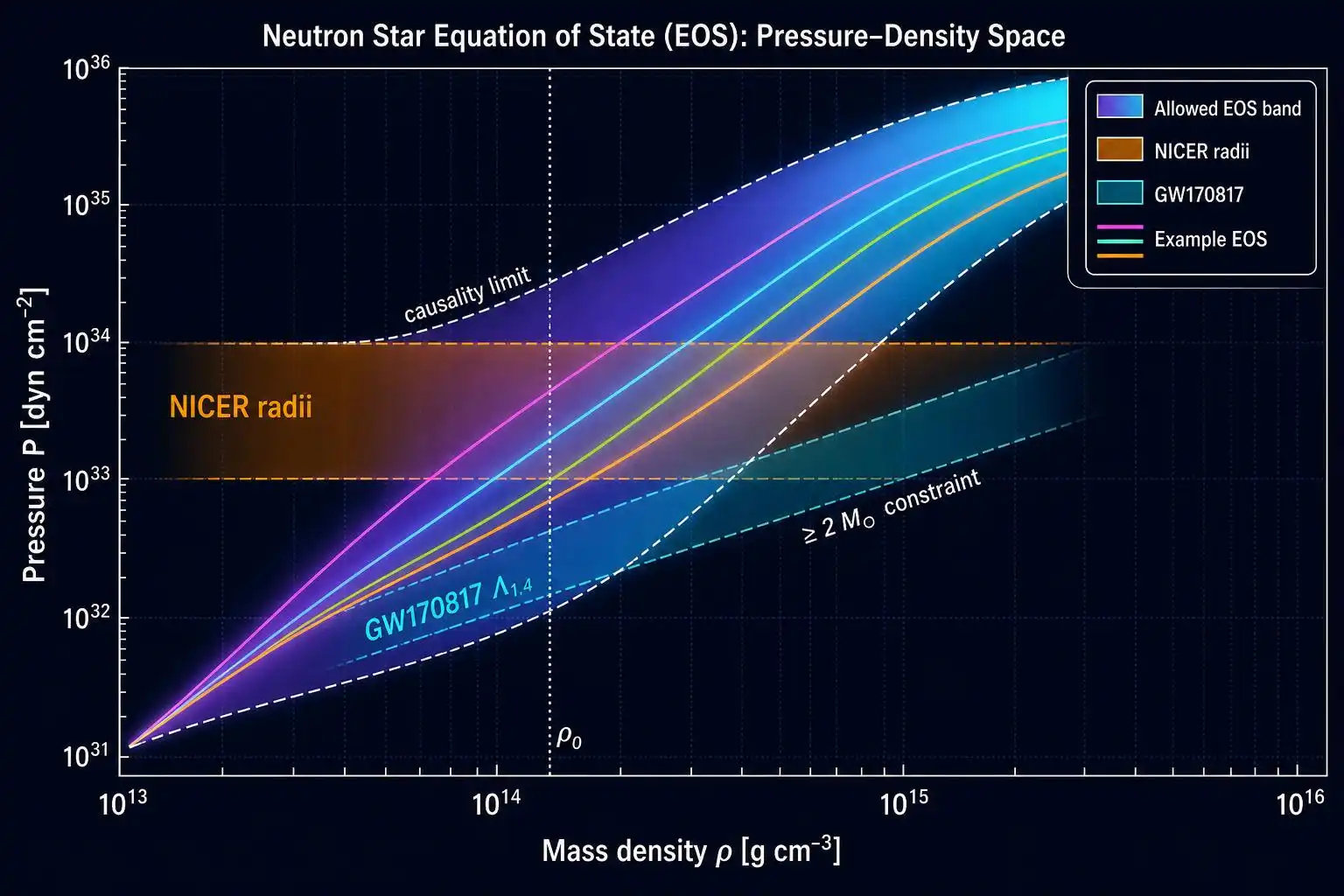
Maximum mass is the most decisive single constraint. If you observe a neutron star more massive than the maximum mass a given EOS predicts, that EOS is ruled out. The measurement of PSR J0740+6620 at 2.08 ± 0.07 M☉ (Fonseca et al. 2021, using Shapiro delay) immediately eliminates most soft equations of state. Many hyperonic and quark-matter models that predict M_max < 2 M☉ are already ruled out.
Radius measurements constrain the EOS at intermediate densities (~1–2ρ₀), where the pressure of matter sets the star’s size. The NICER (Neutron star Interior Composition Explorer) mission, mounted on the International Space Station, measures pulse profiles of rotation-powered millisecond pulsars. By modeling how hot spots on the stellar surface are obscured and revealed as the star rotates — accounting for light-bending in the star’s own gravitational field — NICER extracts the compactness ratio M/R with remarkable precision. For PSR J0030+0451 (1.34 M☉), NICER finds a radius of approximately 12.7 km. For PSR J0740+6620 (2.08 M☉), the radius is constrained to roughly 12–13 km. The fact that a much more massive star has nearly the same radius as a lighter one is a strong EOS signature — it favors equations of state that are stiff at moderate density but soften somewhat at higher density.
Tidal deformability entered the toolkit dramatically with GW170817, the first detected neutron star merger. As two neutron stars spiral together, each tidally distorts the other’s mass distribution, and this distortion imprints a phase shift on the gravitational waveform at late inspiral. The dimensionless tidal deformability Λ — which scales as (R/M)⁵ — was constrained by LIGO/Virgo to Λ₁.₄ ≤ 800 at 90% confidence (later analyses tightened this further, to roughly 70–580). This rules out the stiffest nucleonic EOSs, which predicted very large radii and correspondingly large Λ. Combined with the NICER radii, the allowed EOS band is now squeezed from both sides: not too stiff, not too soft.
The Speed of Sound as a Diagnostic
A powerful way to think about the EOS without committing to a specific microphysical model is through the speed of sound in dense matter, c_s. In ordinary nuclear matter near ρ₀, c_s ≈ 0.2c. Causality demands c_s ≤ c everywhere. In a free, non-interacting gas of quarks (the perturbative QCD limit at asymptotically high density), c_s² → c²/3.
Here is the puzzle: to support a 2 M☉ neutron star, the pressure at high density must be large — which means c_s must rise substantially above the free-quark limit of c/√3 somewhere inside the star. Several analyses of the combined observational constraints now find that c_s² must exceed c²/3 at densities around 2–4ρ₀, peaking somewhere in the range 0.5–0.7 c² before presumably returning toward the perturbative QCD value at extreme densities. This non-monotonic behavior — a peak in the speed of sound — is not easily explained by either purely nucleonic or purely quark-matter models. It may indicate a strongly correlated phase of matter that is neither conventional nuclear matter nor deconfined quarks: perhaps a quarkyonic phase, in which quarks form a Fermi sea but baryonic excitations near the Fermi surface remain confined.
What Future Observations Will Settle
The EOS landscape will sharpen considerably over the next decade.
NICER continues accumulating data on additional millisecond pulsars, and the next generation of X-ray telescopes (notably the proposed STROBE-X and eXTP missions) will measure pulse profiles with far smaller statistical uncertainties, potentially constraining radii to ±0.5 km. That precision is enough to discriminate between EOS families that currently overlap.
Advanced LIGO and Virgo at design sensitivity, plus the planned Einstein Telescope and Cosmic Explorer, will detect many more neutron star mergers. Each event adds a tidal deformability measurement, and the ensemble will build a statistical picture of the EOS across a range of masses. Post-merger gravitational wave emission — a kilohertz-frequency signal from the hot, oscillating remnant — encodes the EOS at densities above those probed by the inspiral phase, but detecting it requires sensitivity improvements beyond current instruments.
Heavy-ion colliders offer a complementary laboratory handle. RHIC and the LHC probe deconfinement at high temperature and low density — the opposite corner of the QCD phase diagram from neutron star interiors. The upcoming FAIR facility at GSI (Germany) and the NICA collider in Russia are designed to reach moderate temperatures and moderate densities, closer to the neutron star regime, by colliding heavy nuclei at intermediate energies.
Why It Matters Beyond Neutron Stars
The neutron star EOS is not an isolated puzzle. It connects directly to the origin of heavy elements: the r-process nucleosynthesis that produces gold, platinum, and uranium occurs in neutron-rich environments, especially neutron star merger ejecta and possibly rare massive-star collapse scenarios. The neutron-to-proton ratio in the ejecta, and the total mass ejected, depend on the EOS. The kilonova AT2017gfo, the electromagnetic counterpart to GW170817, showed clear signatures of r-process enrichment, but pinning down the yields requires knowing whether the merger produced a short-lived hypermassive neutron star, a long-lived supramassive one, or collapsed promptly to a black hole — and that outcome depends entirely on where the maximum mass falls, which is an EOS question.
There is also the question of neutron star cooling. A freshly born neutron star loses energy primarily through neutrino emission. The dominant cooling processes — modified Urca reactions, direct Urca reactions, and superfluidity-modified variants — depend on the proton fraction in the core, which is set by the EOS. The Cassiopeia A neutron star, born in a supernova observed around 1680 CE and now visible as a compact X-ray source at the center of a young Galactic supernova remnant, appears to be cooling faster than standard modified Urca predicts. One interpretation is that neutron superfluidity in the core just switched on, enhancing neutrino emission through Cooper pair formation and breaking — a transient signal of a phase transition that the EOS must account for.
About twenty-four kilometers across, twice the mass of the Sun, hotter than 10⁸ K in the interior, spinning hundreds of times per second, threaded by magnetic fields of 10⁸–10¹⁵ gauss: neutron stars are extreme by any measure. But what makes them irreplaceable as physics laboratories is precisely that their interiors are inaccessible to direct experiment. Every photon, every gravitational wave, every neutrino that escapes from or near a neutron star carries a coded message about the state of matter at densities we cannot otherwise probe. Decoding that message — settling whether the core is nucleonic, hyperonic, or quark matter, and what the speed of sound does between 2ρ₀ and 5ρ₀ — is one of the sharpest open problems at the intersection of nuclear physics, particle physics, and astrophysics. The answer, when it comes, will tell us something fundamental about the strong force itself.



Leave a Reply