
Light is fast. Embarrassingly, universe-breakingly fast by any human standard. In the time it takes you to blink — roughly 150 milliseconds — a photon of light could circle the entire Earth more than once. In one second, it travels 299,792 kilometers. If you drove a car at highway speed from the moment of your birth until the day you died, you would cover roughly the same distance light covers in about four minutes.
So yes: light is fast.
And yet, when you zoom out to the scale of the actual universe, light is almost comically, heartbreakingly slow. And that tension — between “faster than anything we can imagine” and “nowhere near fast enough” — is one of the most quietly profound facts in all of science. It changes what it means to see something. It changes what it means to know something. And if you sit with it long enough, it changes how you feel about being alive at this particular moment in cosmic history.
The Speed Limit That Isn’t Really About Speed
Most people know that 300,000 kilometers per second is the universe’s ultimate speed limit. Nothing with mass can reach it; nothing can exceed it. But here’s the part that doesn’t get said enough: the reason light speed matters isn’t just that it’s fast. It’s that it’s finite.
If light were instantaneous — if information traveled from one place to another in zero time — then looking at a distant galaxy would mean seeing it right now, exactly as it is. The universe would be a live photograph. Every star, every nebula, every swirling arm of every spiral galaxy would be showing you its present face.
But light isn’t instantaneous. It takes time to travel. And because it takes time, every single thing you see in the night sky is a message from the past.
When you look at the Moon, you’re seeing it as it was 1.3 seconds ago. Fine — not a big deal. The Moon is probably still there.
When you look at the Sun, you’re seeing it as it was about 8 minutes and 20 seconds ago. The light entering your eyes right now left the Sun’s surface before most of your morning was underway. If the Sun quietly winked out of existence at this exact moment, you wouldn’t know for over eight minutes. You’d be standing in sunshine that was already, technically, a lie.
When you look at Jupiter, depending on where it is in its orbit, you’re seeing it as it was anywhere from 33 to 53 minutes ago. When NASA’s Voyager 1 probe needed to receive a command from Earth, the signal — also traveling at light speed — took over 22 hours to arrive. Twenty-two hours, and Voyager is beyond the heliopause in interstellar space, yet still far inside the Sun’s broad gravitational domain. The solar system is, cosmically speaking, a rounding error.
Across the Galaxy: Time Becomes Geological
Step outside the solar system and the numbers start to feel less like measurements and more like poetry.
The nearest star to our Sun is Proxima Centauri, home to the exoplanet Proxima b — one of the most tantalizing candidates for a potentially habitable world beyond our solar system. Proxima Centauri is 4.24 light-years away. That means the light arriving in your eye from that star tonight left it in the year 2022. You’re not seeing Proxima Centauri. You’re seeing a memory of it from a year when many of us were still figuring out how to do everything remotely.
Travel further. The center of our own Milky Way galaxy sits about 26,000 light-years away. The light reaching us from there tonight began its journey roughly 26,000 years ago — when Homo sapiens were painting horses on cave walls in what is now France, when woolly mammoths still roamed, when the concept of a written word was still thousands of years in the future. We are watching the galactic core as it existed in the deep Stone Age.
And the Milky Way is just our galaxy. Our home. Our local neighborhood.
The Cosmic Scale: Where “Slow” Becomes Staggering
Here is where light speed stops being a curiosity and starts being an existential fact.
The Andromeda Galaxy — our nearest large galactic neighbor, the one I wrote about before as a smudge of light visible to the naked eye — is 2.537 million light-years away. The light you can see from it tonight departed before our species existed. Before Homo sapiens as a category existed. The ancestors walking the African savanna when that light left Andromeda were not yet us. They were something older, something on the long road toward becoming us, and they had no idea that the faint glow leaving their neighboring galaxy would one day be caught by the eyes of creatures who would build telescopes and name the galaxy and worry about their mortgage payments.
The most distant galaxies we’ve ever detected — some captured by the James Webb Space Telescope — are over 13 billion light-years away. Their light left when the universe was only a few hundred million years old. Those galaxies may not even exist anymore in the form we see them. They’ve had 13 billion years to evolve, merge, transform, or die. We’re watching a universe that is, in a very real sense, already gone.
This is the strangeness at the heart of astronomy: we can never see the universe as it is. We can only ever see the universe as it was, at varying depths of the past, all layered on top of each other like a geological cross-section of time itself.
Why This Matters to Someone Who Isn’t an Astronomer
You might reasonably ask: okay, interesting, but so what? The stars are still beautiful. The universe is still out there doing its thing. Why does it matter that I’m seeing old light?
It matters because it reframes what seeing means.
When you look at the night sky, you are not a passive observer of a static scene. You are a time traveler, receiving signals from different eras of cosmic history simultaneously. The star 100 light-years away and the galaxy 100 million light-years away are both visible to you right now, but they are not from the same “now.” You are holding multiple pasts in your field of vision at once.
It also matters because it puts a hard wall around what we can ever know. There is a concept called the observable universe — the bubble of space from which light has had time to reach us since the Big Bang, roughly 46 billion light-years in radius (larger than 13.8 billion light-years because the universe has been expanding the whole time). Beyond that bubble, there may be more universe — almost certainly is — but we cannot see it, cannot measure it, cannot know it. Not because our telescopes aren’t good enough, but because the light from those regions hasn’t had time to arrive yet. The universe has a horizon, and it’s made of time, not space.
And here’s the kicker: there is another horizon too. As the universe expands — and it’s expanding faster than light can cross some new distances, thanks to dark energy — some galaxies are receding from us so quickly that light they emit today will never reach us. They are beyond our cosmic event horizon, becoming forever unknowable in their present and future. The observable universe is not shrinking, but the set of galaxies whose new light can ever reach us is being walled off by expansion.
The Gift Hidden in the Slowness
There is something I find unexpectedly moving about all of this, and I want to try to put it into words.
The fact that light is slow — slow enough that it takes time to cross the cosmos — means that the universe has a kind of memory. Every photon is a message. Every ray of starlight is a record of something that happened, preserved in transit, waiting to be received. When a star explodes in a supernova in a distant galaxy and the light of that explosion reaches a human eye centuries later, there is something almost like communication happening across time. The universe, in its blind and beautiful way, is always sending us postcards from its own past.
The slowness of light also means that we are, right now, embedded in a specific moment of cosmic history that is genuinely unique. The universe is 13.8 billion years old. The stars are still shining. The galaxies are still visible. In the very far future — trillions of years from now — the expansion of the universe will have pushed all other galaxies beyond our horizon. A civilization arising then would look up at a night sky containing only their own galaxy, with no evidence that any other galaxy had ever existed. They would have no way of knowing about the Big Bang, no way of reconstructing cosmology as we understand it. The universe will have hidden its own origin story.
We live in the lucky window. The window when the light from the cosmic past is still arriving, when the evidence is still present, when the universe is still legible.
The speed of light is annoyingly slow. It means we can never see the universe as it truly is, right now, in real time. It means we are always receiving old news, always reading yesterday’s headlines from stars that may already be dead.
But it also means the sky is a library. And we are, right now, in the best possible moment to read it.
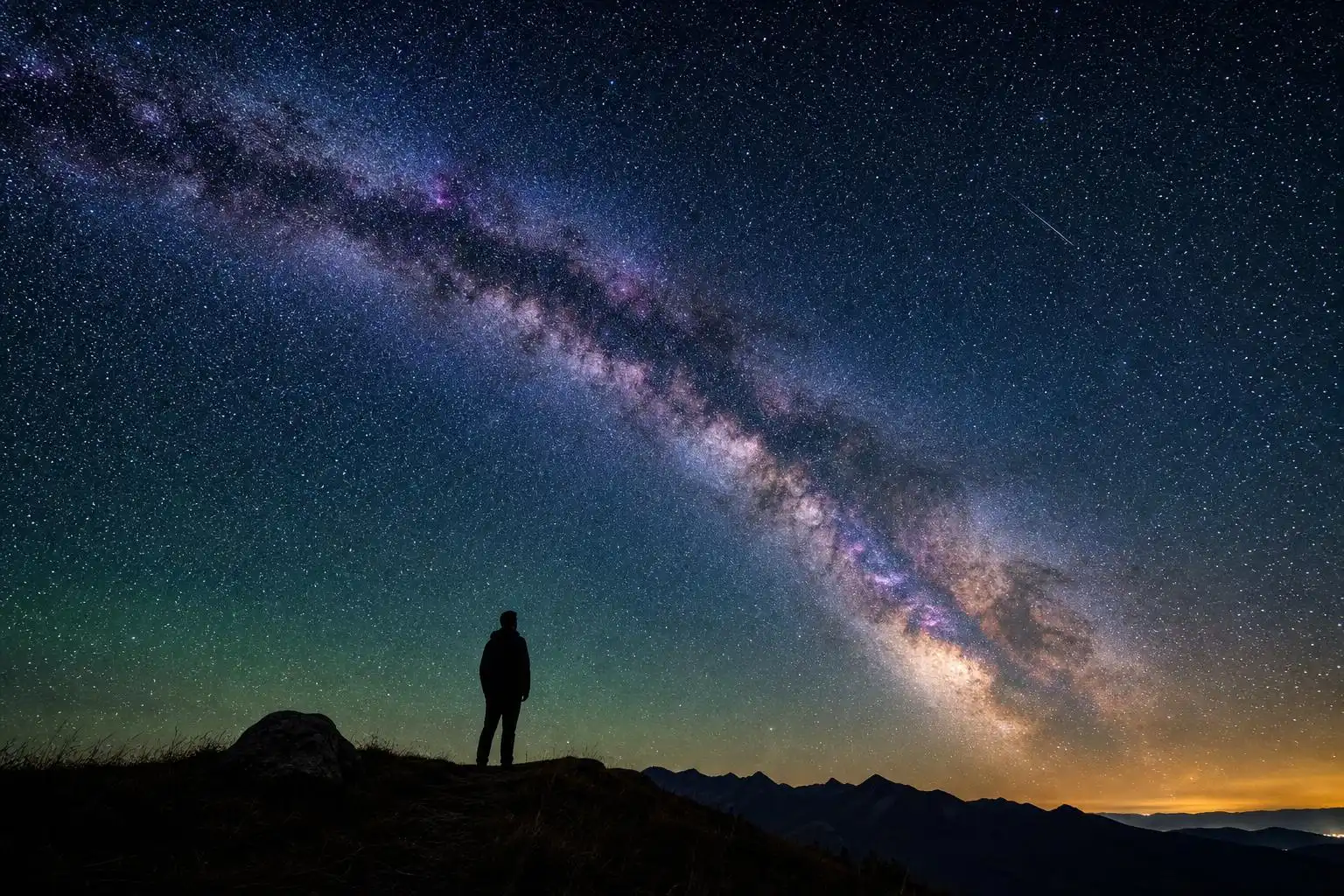
So next time you step outside on a clear night and look up — know that what you’re seeing is not the sky. It’s time, made visible. It’s the universe’s autobiography, written in light, arriving at your eyes from across the ages.
That’s not a limitation. That’s the whole miracle.



Leave a Reply