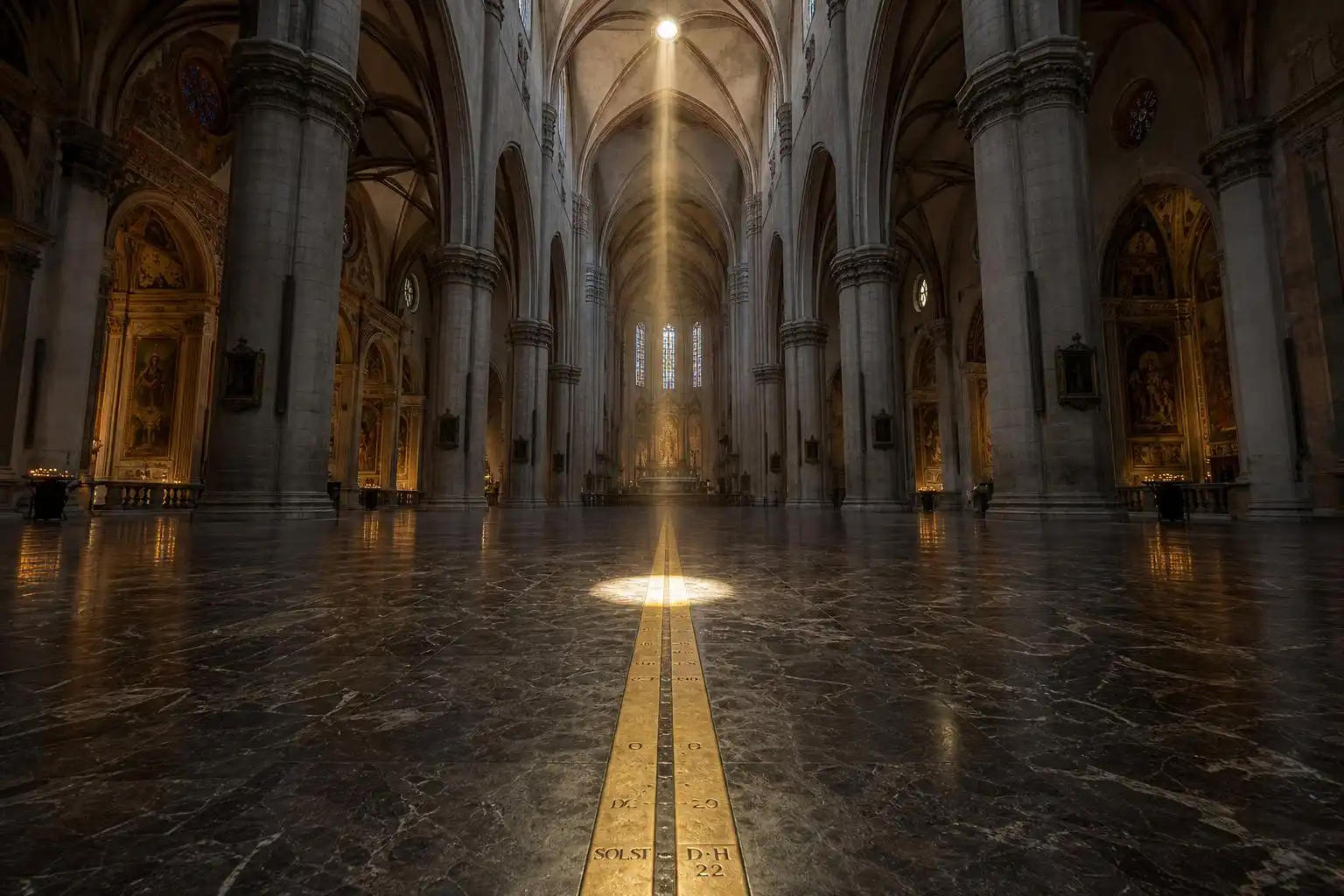

On the morning of June 21, 1655, a young professor of astronomy knelt on the cold marble floor of the Basilica of San Petronio in Bologna and watched the image cast by a pinhole no wider than a florin. Above him, near the vault of the left aisle, a small aperture had been cut into the roof — barely a thumb’s breadth across — and through it a shaft of sunlight fell about eighty-nine feet to the floor, where it cast a trembling ellipse of light onto a brass line inlaid in the stone. Giovanni Domenico Cassini was thirty years old. He was holding a notebook, a stick of chalk, and the conviction that the meridian line he was about to calibrate would test one of the strongest observational arguments in European astronomy for Kepler’s account of the Earth-Sun system.
The meridian line — a gnomone in Italian, a sundial laid flat — was not Cassini’s invention. The Dominican mathematician and cosmographer Egnazio Danti of Perugia had begun a similar instrument in the same basilica in 1575, and had worked on meridian lines in Florence. But Cassini’s version, completed between 1653 and 1655 and stretching nearly 67.7 meters from the aperture to the far end of the nave, was the longest and most precise in Europe. He had calculated the geometry himself, supervised the laying of the brass inlay, and spent weeks adjusting the aperture’s height to ensure that the solar image would fall cleanly on the line at every season. The basilica’s Gothic walls, which had been rising since 1390 and would never quite be finished, became his observatory — cold in winter, sweltering in summer, smelling always of incense and damp stone.
What Cassini was after was the Sun’s apparent diameter at different times of year. If the Earth-Sun distance remained constant, the Sun’s disk would appear the same size in January as in July. But if that distance varied over an elliptical orbit — as Kepler had argued in his Astronomia Nova of 1609 — the Sun would loom larger when the Earth was closest (perihelion, in early January) and shrink when it was farthest (aphelion, in early July). The meridian line made this measurable. When the solar image fell on the brass strip at noon, Cassini could measure its length along the floor with a brass ruler, compare it to the known focal length of the aperture, and calculate the Sun’s angular diameter to within a few arc-seconds. No telescope, with its mirrors and lenses and attendant distortions, was required. The geometry of light itself did the work.
The results, accumulated over three summers and winters, were unambiguous: the Sun’s apparent diameter varied by roughly three percent between January and July, in line with Keplerian geometry. Cassini published his findings in 1656 in a slim folio called Specimen Observationum Bononiensium, dedicating it to the Senate of Bologna with the careful language of a man who understood that Galileo had died under house arrest only seventeen years earlier and that the Inquisition still read dedications. He did not call himself a Copernican. He described the observations, stated the measurements, and let the ellipse speak for itself.
It is worth pausing on what kind of man Cassini was at this moment, because the later caricature — the imperious director of the Paris Observatory, the father who crushed his son’s career, the man who refused to believe in the finite speed of light — tends to swallow the younger one. In Bologna, Cassini was genuinely brilliant and genuinely open. He corresponded with the Jesuit polymath Athanasius Kircher in Rome, with the Florentine experimenters of the Accademia del Cimento, and with astronomers in Paris who were beginning to dream of a royal observatory. He was also, by all accounts, a magnificent teacher: his lectures at the University of Bologna drew students from across Italy and beyond. When he measured the rotation period of Mars in 1666 — watching a triangular feature later known as Syrtis Major wheel across the disk through a Campani refractor — he did it with the same patient accumulation of nightly notes that had characterized his meridian work. He found a period of 24 hours and 40 minutes, a figure within three minutes of the modern value, and he was quietly pleased with himself about it for the rest of his life.
The invitation to Paris arrived in 1668, carried by a letter from Jean-Baptiste Colbert, Louis XIV’s minister of finance and the effective patron of French science. The Académie Royale des Sciences had been founded two years earlier, and Colbert wanted the best astronomer in Europe to anchor the new observatory that was rising on a hill south of the city. Cassini negotiated — he was always a careful negotiator — and arrived in Paris in 1669 with a salary, lodgings, and the title of premier astronome du roi. He would not return to Italy for the remaining forty-three years of his life.
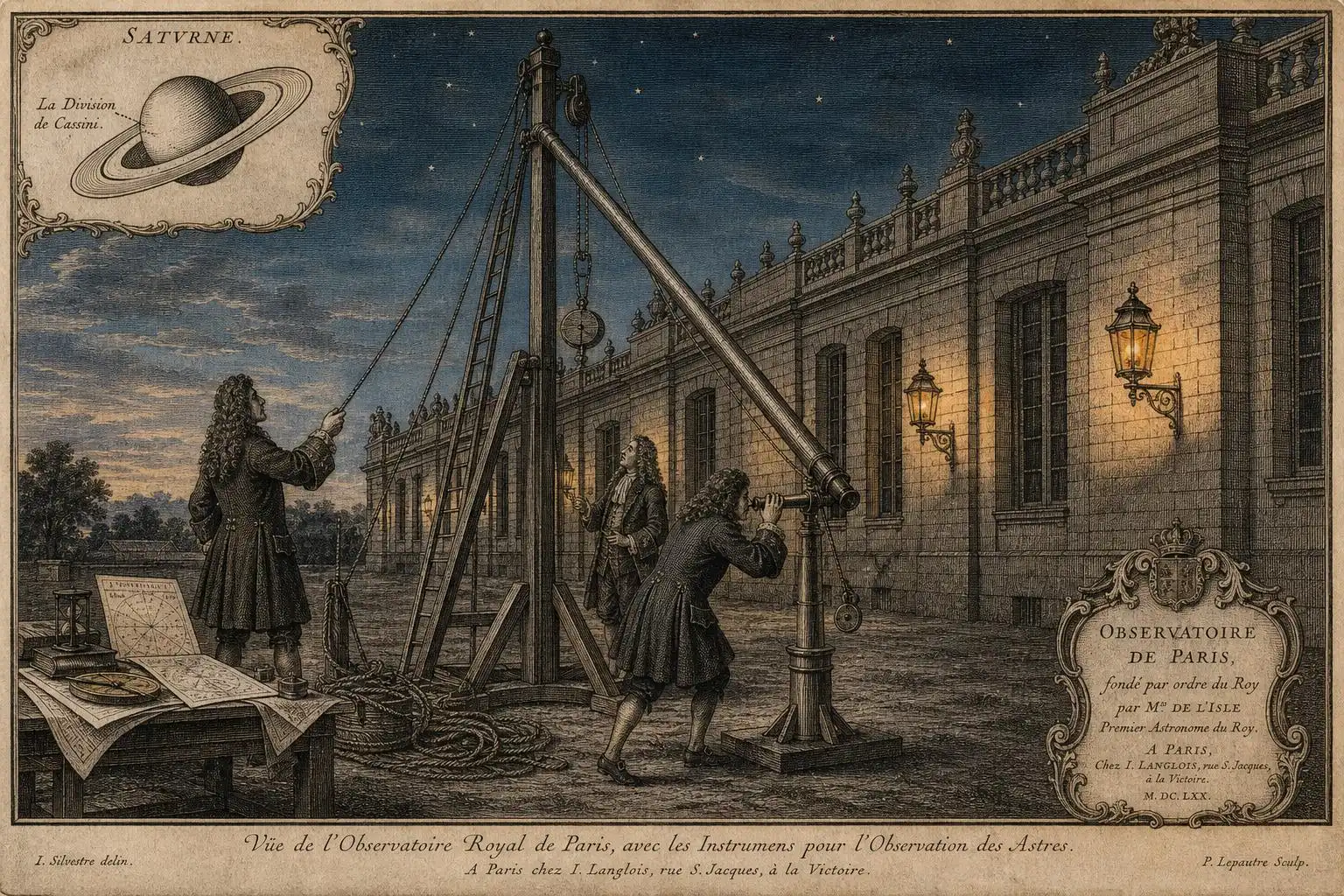
The Paris Observatory, designed by Claude Perrault (the architect better known for the Louvre’s east colonnade), was a magnificent folly from an astronomical standpoint. Its walls were too thick, its windows too few, and its orientation — aligned to the cardinal points for aesthetic reasons — made it awkward for mounting instruments along the meridian. Cassini complained about the building for decades. But he worked with what he had, hauling enormous aerial telescopes — some with focal lengths of over a hundred feet, their lenses mounted on tall masts in the observatory’s garden — into position on clear nights, and filling notebook after notebook with planetary observations. It was here, in 1675, peering through a 34-foot Campani refractor, that he noticed the dark gap dividing Saturn’s ring into two concentric bands. The Division de Cassini, as it is still called, was not merely a visual curiosity: it was evidence that the ring was not a solid disk but a structure of some complexity, a conclusion that would not be fully understood for another two centuries.
The episode that most reveals the texture of Cassini’s mind, however, is his response to Ole Rømer’s measurement of the speed of light in 1676. Rømer was a young Danish astronomer working at the Paris Observatory under Cassini’s supervision, and he had been assigned the unglamorous task of refining the tables of Jupiter’s moon Io — tables that were essential for the longitude problem, since Io’s eclipses behind Jupiter occurred like clockwork and could serve as a universal celestial clock. What Rømer noticed, poring over observations accumulated since 1671, was that Io’s eclipses arrived systematically late when the Earth was on the far side of its orbit from Jupiter, and early when the Earth was close. The discrepancy amounted to about twenty-two minutes across the full diameter of the Earth’s orbit. Rømer’s inference was audacious: light was not instantaneous. It took time to cross space, and the varying distance between Earth and Jupiter explained the varying delay.
Cassini had actually noticed the same discrepancy a few years earlier and had mentioned it in a brief note to the Académie in 1675. But he had drawn back from Rømer’s conclusion. His published response to Rømer’s 1676 paper was skeptical: the delays, he suggested, might be caused by irregularities in Io’s orbit rather than by the finite speed of light. It is tempting to read this as the conservatism of an old man protecting his turf — Cassini was fifty-one, Rømer twenty-seven — but the historical record is more complicated. Cassini’s objection was not unreasonable given the data available. Io’s orbit was irregular in ways that were not yet understood (tidal interactions with Europa and Ganymede, which would not be explained until the 1970s, cause genuine variations in eclipse timing). And the speed of light, once accepted, raised immediate questions about stellar aberration and the geometry of the solar system that Cassini was not equipped to answer. His caution was, in part, the caution of a man who had spent fifty years learning that premature conclusions in astronomy cost you your reputation.
Rømer left Paris in 1681 and returned to Denmark, where he eventually became a police chief and mayor of Copenhagen — the seventeenth century’s way of reminding us that careers rarely follow straight lines. His measurement of the speed of light was vindicated by James Bradley’s discovery of stellar aberration in 1728, sixteen years after Cassini’s death, and by then the argument had moved on without either man.
What endures from Cassini’s long career is something harder to name than a single discovery. It is a method: the patient, instrument-based accumulation of precise measurements over years and decades, the willingness to let data accumulate before drawing conclusions, the understanding that astronomy is not a science of inspiration but of repetition. The meridian line at San Petronio was still being used for solar observations in the eighteenth century. The Division de Cassini still bears his name on every diagram of Saturn. The tables of Jupiter’s satellites that Rømer corrected were Cassini’s tables. Even his errors — the rejection of Rømer’s light-speed measurement, his lifelong resistance to Newton’s theory of universal gravitation, his insistence that the Earth was elongated at the poles rather than flattened — were the errors of a man who demanded more evidence than his contemporaries thought necessary.
His son Jacques Cassini, his grandson César-François Cassini de Thury, and his great-grandson Jean-Dominique Cassini (Cassini IV) would all hold leading authority at the Paris Observatory — a dynastic tenure associated with the institution that lasted from 1671 to 1793, when the Revolution ended it. Whether this was a legacy or a stranglehold is a question the French scientific community debated bitterly in the 1780s, when the younger Cassinis resisted the reforms of Laplace and Méchain with the full weight of institutional inertia. But that argument belongs to another century.
In the Basilica of San Petronio, the meridian line is still there. Tourists walk across it without knowing what it is, their footsteps echoing in the Gothic nave. On the winter solstice, if the sky over Bologna is clear, a shaft of sunlight still falls through the aperture near the vault and strikes the brass strip at noon, casting an ellipse of light on the cold marble. The ellipse is a little larger in January than in July, just as Kepler’s mathematics predicted and Cassini’s measurements confirmed. The building smells of incense and damp stone, as it did in 1655, and the light falls the same way it always has.
What the episode of the meridian line reveals, finally, is something that the great debates of astronomy — Copernicus against Ptolemy, Newton against Leibniz, Shapley against Curtis — tend to obscure: that the displacement of one idea by another is rarely the work of a single heroic moment. It is the work of brass lines laid in church floors, of solar images measured with rulers on winter mornings, of notebooks filled with numbers that only become arguments years later. Cassini did not prove that the Earth moved around the Sun. He made it measurably harder to believe otherwise, and then he moved on to the next problem. That, in the end, is how science actually works: not in flashes of revelation, but in the slow accumulation of mornings when the light falls where the mathematics said it would.



Leave a Reply