
Long before European navigators learned to read the sky for longitude, Maya astronomers had already spent centuries tracking a single brilliant point of light with an accuracy that still astonishes modern researchers. That light was Venus — Chak Ek’, the Great Star — and the knowledge they built around it was not merely observational. It was calendrical, cosmological, theological, and deeply political.
The Dresden Codex and the Venus Tables
The most direct window into Maya Venus astronomy is the Dresden Codex, one of only four pre-Columbian Maya books to survive the widespread destruction of Maya manuscripts — including the systematic burning ordered by Bishop Diego de Landa in 1562, though the surviving codices are not all simply known survivors of that single event. Produced sometime between the eleventh and thirteenth centuries CE but drawing on far older observational records, the codex contains what scholars call the Venus Tables — an almanac spanning pages 24 and 46–50 that tracks Venus’s synodic cycle across a 104-year Venus Round with extraordinary precision.
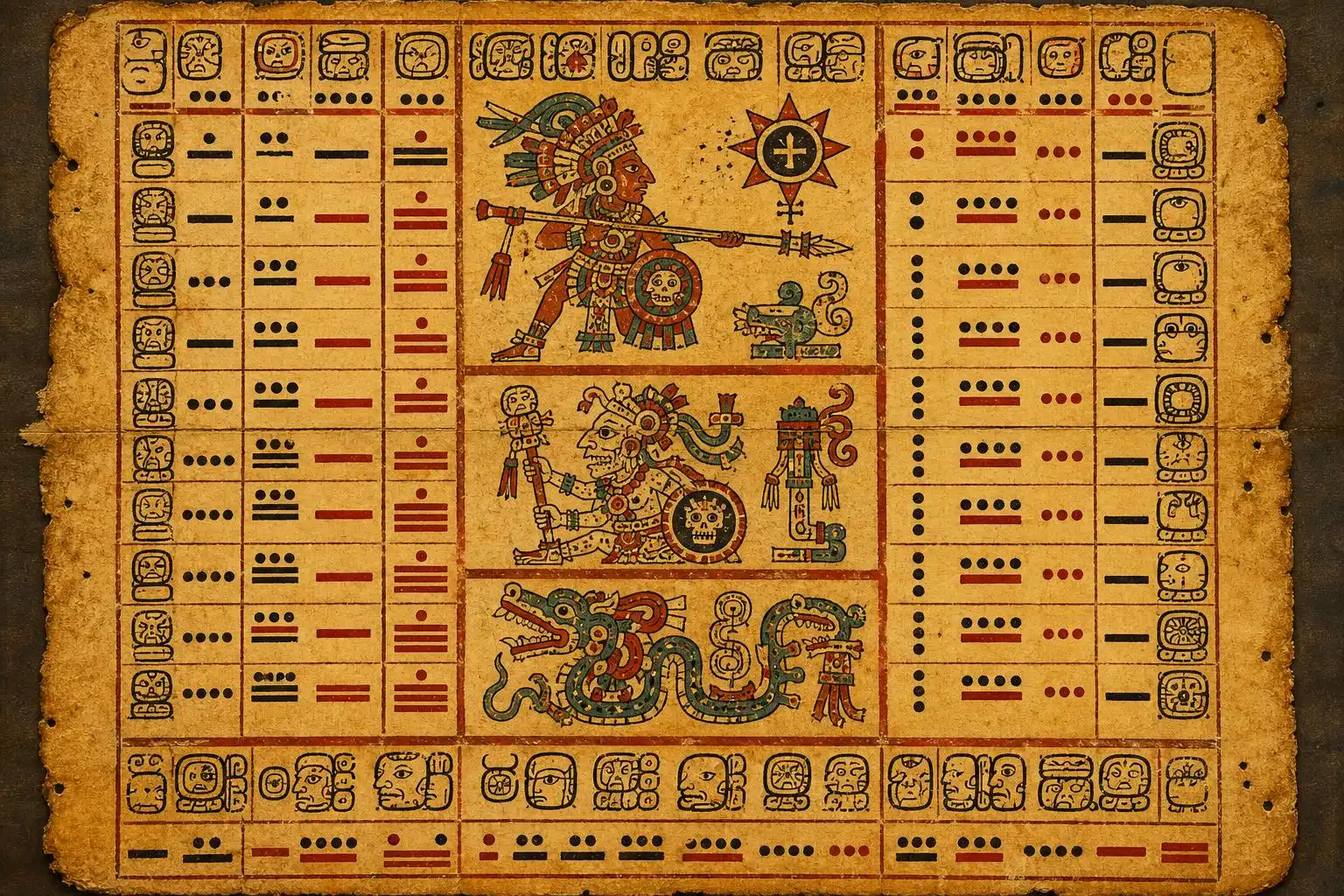
The Maya calculated Venus’s synodic period — the time it takes the planet to return to the same position relative to Earth and the Sun — at 584 days. The modern value is 583.92 days. That is an error of less than two hours over a nearly 20-month cycle. But the Maya didn’t stop there. They recognized that 5 Venus cycles (5 × 584 = 2,920 days) align almost perfectly with 8 solar years (8 × 365 = 2,920 days), and that 65 Venus cycles (65 × 584 = 37,960 days) align with 104 solar years and two full rounds of the 52-year Calendar Round — the interlocking cycle of the 365-day Haab’ and the 260-day Tzolk’in. This 104-year grand cycle, called the Venus Round, was the backbone of one of the most sophisticated timekeeping systems ever devised.
The Dresden Codex even includes correction tables — small numerical adjustments built directly into the almanac to compensate for the accumulated drift between the idealized 584-day period and the true synodic cycle. The Maya astronomers knew their model was an approximation. They built the correction in. That is not primitive stargazing; that is applied mathematical astronomy.
Chak Ek’ and the God of War
The Venus Tables were not neutral scientific records. Each phase of Venus’s cycle — heliacal rising as the Morning Star, superior conjunction, appearance as the Evening Star, inferior conjunction — was associated with specific deities, omens, and ritual prescriptions. The heliacal rising of Venus as the Morning Star was particularly charged. In Maya cosmology, this moment was linked to Kukulkan (the feathered serpent deity known to the Aztec as Quetzalcóatl) and to the descent of dangerous celestial forces.
The Venus pages of the Dresden Codex depict Venus deities hurling spears downward at various earthly victims — farmers, rulers, the rain god — depending on which day of the calendar the heliacal rising fell upon. This was not metaphor. Maya rulers consulted these tables before launching military campaigns, and the timing of warfare was explicitly coordinated with Venus’s appearance. Epigraphers Linda Schele and David Freidel documented in their landmark 1990 work A Forest of Kings how a glyph scholars call the “star war” sign in Classic-period inscriptions has been interpreted as correlating with Venus events, particularly its heliacal rising or inferior conjunction — though the precise reading of the glyph and the directness of that correlation remain subjects of scholarly debate.
The implications are staggering: Maya political history — the rise and fall of city-states, the timing of conquests — was partially choreographed around a planetary almanac refined over generations of careful observation.
Chichén Itzá and the Architecture of Venus
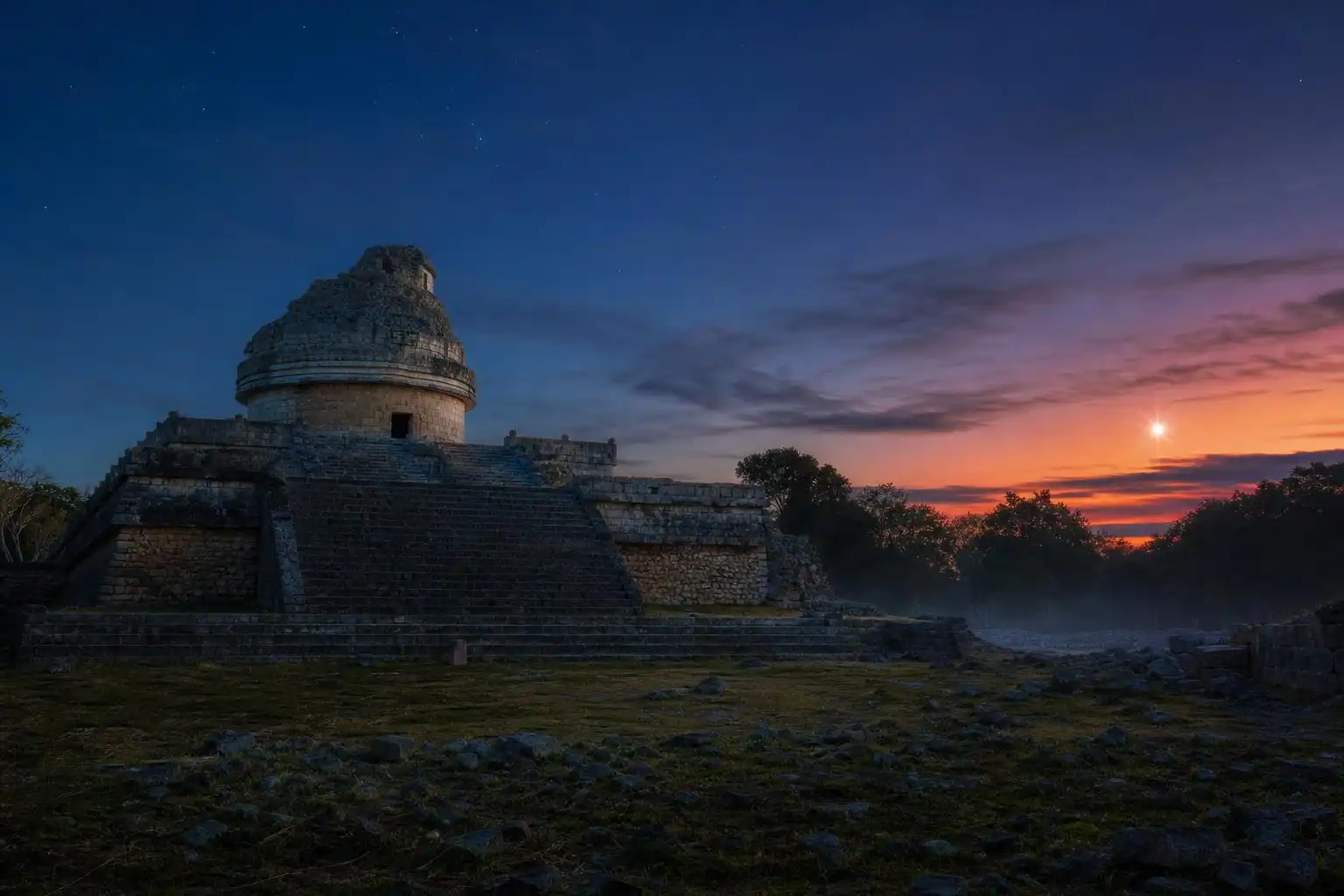
The Dresden Codex is the textual record. The architecture is the physical one. At Chichén Itzá in the Yucatán Peninsula, the structure known as El Caracol — “the snail,” named for its spiral interior staircase — is one of Mesoamerica’s most studied astronomical monuments. Built between approximately 900 and 1000 CE, El Caracol’s design encodes Venus alignments in stone.
Astronomer Anthony Aveni, a pioneer of archaeoastronomy, demonstrated that the diagonal of El Caracol’s base platform aligns with the northernmost setting point of Venus on the horizon. Several of the structure’s narrow window shafts — clearly intentional sightlines rather than decorative openings — frame key Venus events, including the planet’s maximum elongations north and south. The building functioned, at least in part, as a precision instrument for tracking the Great Star across its full range of horizon positions.
Further south, at Uxmal, the Governor’s Palace presents one of the most dramatic Venus alignments in the Maya world. Its central doorway points directly toward the southernmost rising point of Venus — an alignment so precise, and so deliberately skewed from the site’s general orientation, that it could only have been intentional. Over 350 Venus glyphs adorn the palace’s exterior frieze, as if the building itself is announcing its astronomical purpose.
The Popol Vuh and the Cosmic Narrative
Beyond tables and temples, Venus permeates Maya narrative cosmology. The Popol Vuh — the K’iche’ Maya creation epic recorded in the early colonial period but rooted in pre-Columbian tradition — contains the story of the Hero Twins, Hunahpu and Xbalanque, who descend into the underworld Xib’alb’a, defeat the lords of death, and ascend to become the Sun and the Moon. Many scholars, including Dennis Tedlock in his authoritative 1985 translation and commentary, have argued that the twins’ journey also encodes the phases of Venus: the disappearance into the underworld mirrors inferior conjunction, the resurrection mirrors heliacal rising.
If this reading is correct — and the structural parallels are compelling — then the Popol Vuh is simultaneously a myth, a ritual calendar, and a planetary almanac. The boundary between story and science, between theology and astronomy, simply did not exist in the same way it does in the modern Western tradition. The sky was not a separate domain to be studied from the outside; it was woven through every layer of Maya life.
What the Maya Tradition Teaches Us
It would be easy — and wrong — to frame Maya Venus astronomy as a curiosity, a parallel development that happened to produce accurate numbers before being eclipsed by the European scientific tradition. That framing misses the deeper point entirely.
The Maya Venus Tables demonstrate that long-term, systematic, multi-generational observation — conducted without telescopes, without clocks, without calculus — can yield results of genuine scientific precision. The correction tables in the Dresden Codex reflect an epistemological sophistication: an awareness that models are approximations, and that accumulated error must be periodically corrected against fresh observation. That is, in essence, the same intellectual move that underlies modern empirical science.
Moreover, the integration of Venus astronomy into architecture, political decision-making, and narrative cosmology reveals something that purely instrumentalist astronomy tends to obscure: the sky is not just a set of phenomena to be measured. It is a domain of meaning. The Maya did not choose to study Venus because it was scientifically interesting in the abstract; they studied it because it was powerful, because it governed time, because understanding it was a form of sovereignty over the world.
Scholars working with contemporary Maya communities — particularly through collaborative projects like the FAMSI (Foundation for the Advancement of Mesoamerican Studies) archives and the work of ethnographers like Barbara Tedlock in Time and the Highland Maya — have documented the survival of Venus-watching practices into the present day. In some K’iche’ and Ixil communities, specialized calendrical priests called ajq’ij (day-keepers) still mark Venus events as part of an unbroken tradition of sky observation.
The Dresden Codex, El Caracol, the Governor’s Palace at Uxmal, the Popol Vuh — these are not relics of a lost science. They are chapters in a living astronomical tradition, one that tracked the Morning Star across centuries with a precision that humbles easy assumptions about who counts as a scientist, and what science is for.



Leave a Reply