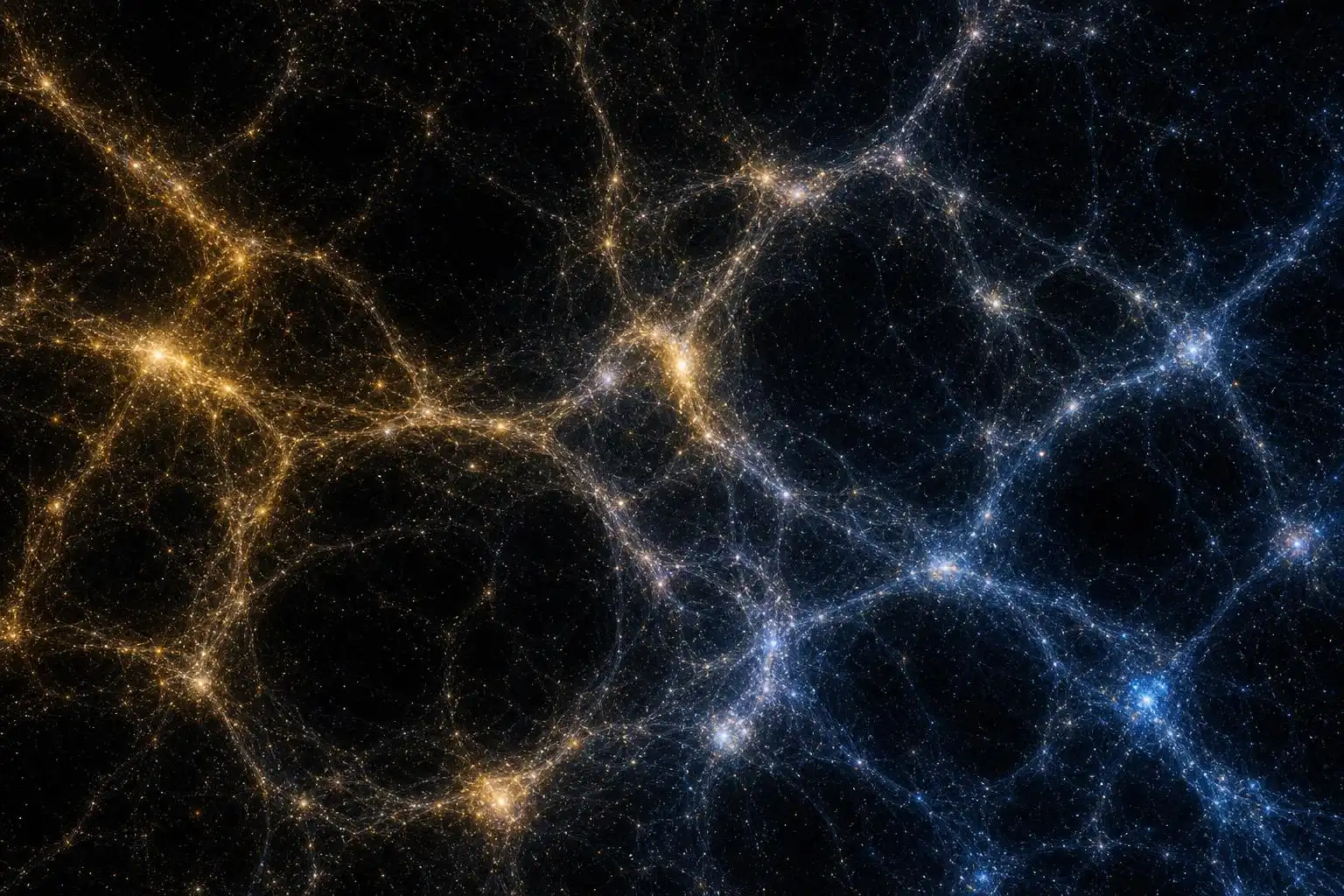

For nearly three decades, cosmologists have lived with a peculiar houseguest: dark energy. It accounts for roughly 68% of the universe’s total energy budget, it is driving the accelerating expansion of space, and we have almost no idea what it actually is. The simplest explanation — a cosmological constant, Λ, a fixed energy density woven into the fabric of spacetime itself — has held up remarkably well. But “held up” is not the same as “confirmed,” and new data from the Dark Energy Spectroscopic Instrument (DESI) is now rattling the furniture in ways that deserve serious attention.
The Standard Story, and Why It Might Be Wrong
In the Lambda-CDM model, dark energy is described by a single parameter: its equation-of-state ratio, w, defined as the ratio of pressure to energy density. For a true cosmological constant, w = −1, exactly, forever. This is the prediction Einstein’s equations make when you add Λ as a fixed term — it doesn’t dilute as the universe expands, it doesn’t clump, it doesn’t evolve. It just is.
The moment w deviates from −1, or — more provocatively — the moment w changes over time, we are no longer dealing with a cosmological constant. We are dealing with something dynamical: a field, perhaps, or a modification to gravity, or something stranger still. Cosmologists parametrize this possibility using the Chevallier-Polarski-Linder (CPL) form: w(a) = w₀ + wₐ(1 − a), where a is the cosmic scale factor. At the present epoch, a = 1, so w₀ is today’s value. As you wind the clock back toward the Big Bang, wₐ captures how much the equation of state has drifted.
Lambda-CDM predicts w₀ = −1 and wₐ = 0. Clean. Simple. Possibly wrong.
What DESI Found
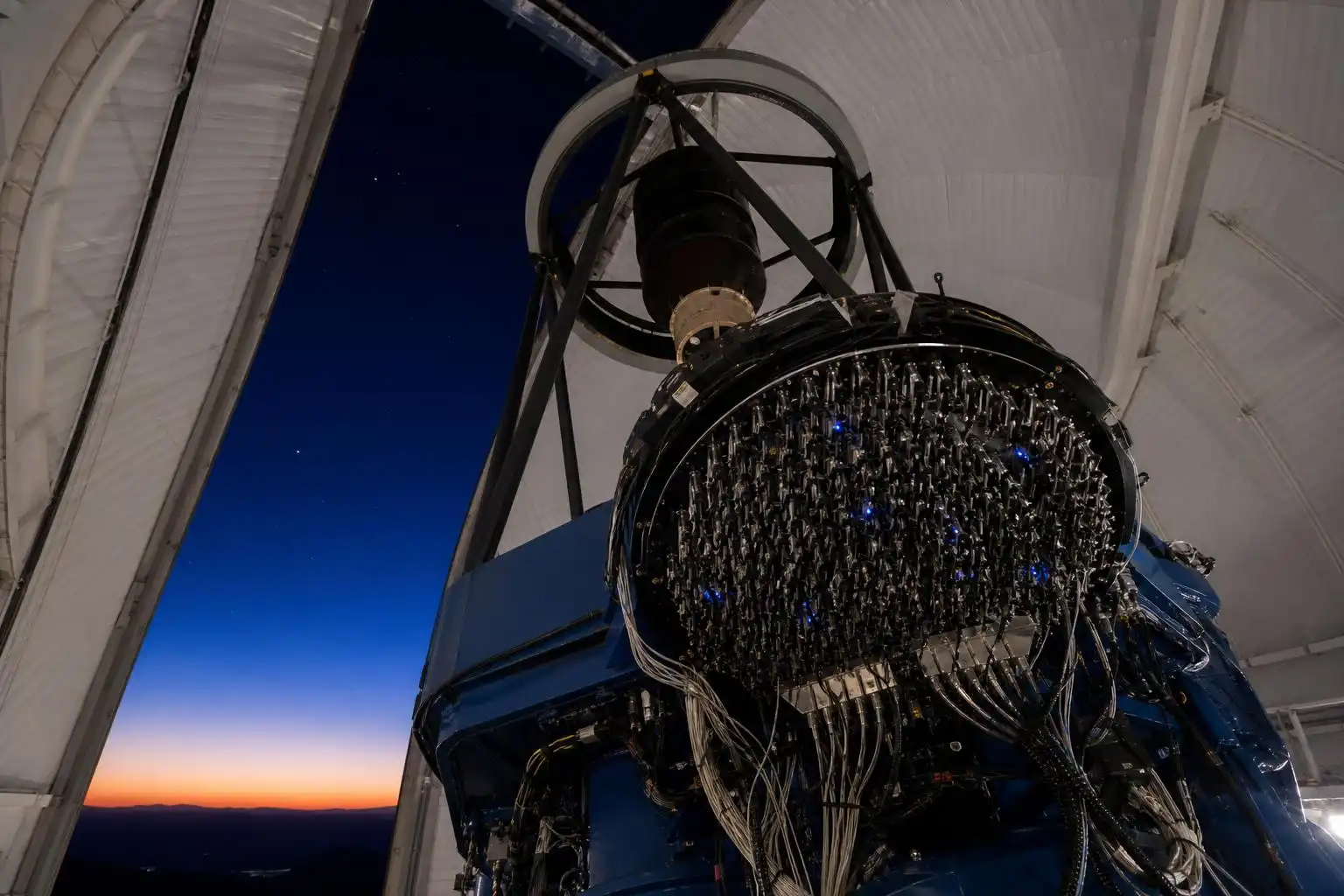
DESI is a fiber-fed spectrograph mounted on the 4-meter Mayall Telescope at Kitt Peak National Observatory in Arizona. It can observe up to 5,000 galaxies simultaneously, measuring their redshifts with extraordinary precision. Its primary tool for probing dark energy is baryon acoustic oscillations (BAOs) — the fossilized imprint of sound waves that rippled through the early universe’s plasma before the baryon drag epoch. Those ripples left a characteristic scale (~147 Mpc, comoving) stamped into the distribution of galaxies, and by measuring how that scale appears to change with redshift, we can map the expansion history of the universe with a kind of cosmic ruler.
In April 2024, DESI released its first-year BAO results, covering over 6 million galaxies and quasars spanning redshifts from roughly 0.1 to 4.2. The headline finding was striking: when DESI’s BAO measurements were combined with Planck CMB data and Type Ia supernova compilations, including the Pantheon+, Union3, and DES Year 5 datasets, the best-fit values for the CPL parameters shifted away from the cosmological-constant prediction. Across these combined analyses, the best fits typically placed w₀ noticeably above −1 with a negative wₐ, with the strongest departure appearing when the DES Year 5 supernova sample was included — a hint that dark energy may have been weaker in the past and is growing stronger, or alternatively that it is evolving in some other non-trivial way.
The statistical significance hovered around 2.5–3.9σ, depending on dataset combination, with the largest quoted tension associated especially with combinations including the DES Year 5 supernova sample. That is not a discovery by particle physics standards (5σ), but it is not noise either. It is precisely the kind of signal that keeps cosmologists awake at night.
Reading the Tea Leaves Carefully
Before declaring the cosmological constant dead, intellectual honesty demands we sit with the caveats.
Supernova systematics matter enormously. The tension between DESI+Planck and w = −1 in ΛCDM is sharpest when using the DES Year 5 supernova sample. When Pantheon+ is used instead, the deviation is milder. Type Ia supernovae are extraordinary standard candles, but their calibration — particularly the “mass step” correction and the treatment of host-galaxy dust — introduces systematic uncertainties that are genuinely difficult to fully characterize. Different choices lead to meaningfully different answers.
BAO measurements themselves require assumptions. Extracting a BAO scale requires knowing the sound horizon at the baryon drag epoch, rₛ, which is set by early-universe physics. If there is new physics before the drag epoch — early dark energy, extra relativistic species, or modified recombination history — the inferred rₛ shifts, and so does everything downstream. The Hubble tension (H₀ ≈ 67–68 km/s/Mpc from CMB versus ~73 km/s/Mpc from distance-ladder measurements) already hints that something may be off in this regime.
The CPL parametrization is a model, not a measurement. Fitting w₀ and wₐ to data assumes dark energy’s evolution follows a specific functional form. Nature is not obligated to cooperate. A signal in this parameter space might reflect genuine dark energy dynamics, or it might be an artifact of fitting an oversimplified model to a universe that is doing something more complicated.
None of this is to dismiss the DESI results — quite the opposite. These are exactly the tensions that make the data scientifically valuable. The point is to hold the inference lightly while demanding more.
What Could Explain It?
If the DESI hint hardens into a genuine detection of evolving dark energy, the theoretical landscape opens up dramatically.
Quintessence is perhaps the most studied alternative: a scalar field rolling slowly down a potential, much like the inflaton field hypothesized to drive cosmic inflation. Depending on the shape of the potential, quintessence can produce w values close to −1 that drift slowly over cosmic time. The challenge is that no known particle physics mechanism naturally produces a field with the extraordinarily low mass (~10⁻³³ eV) required to be cosmologically relevant today without fine-tuning.
Phantom dark energy — models where w < −1 — is mathematically consistent but theoretically uncomfortable, as it typically implies violations of the null energy condition and can lead to a “Big Rip” future in which the expansion eventually tears apart galaxies, then stars, then atoms. Current DESI results do not strongly favor the phantom regime, but they do not rule it out.
Interacting dark energy, in which dark energy exchanges energy with dark matter, can mimic an evolving equation of state while potentially also addressing the H₀ tension. These models are constrained by the CMB power spectrum and large-scale structure, but they remain viable.
Modified gravity offers a different framing entirely: perhaps dark energy is not a substance at all, but a signal that General Relativity breaks down on cosmological scales. Theories like f(R) gravity or scalar-tensor theories can produce effective dark energy behavior without invoking a new field. DESI’s growth-of-structure measurements — how fast matter clusters over time — will be a critical discriminator here in future data releases.
The Road Ahead
DESI’s first-year results represent roughly one-fifth of its planned survey volume. By the time the full five-year dataset is assembled, statistical uncertainties will shrink dramatically. More importantly, DESI will be joined by a suite of complementary experiments: the Euclid satellite, launched in July 2023, is now delivering its first wide-field weak-lensing and galaxy-clustering maps; the Rubin Observatory’s Legacy Survey of Space and Time (LSST) will begin full science operations and map billions of galaxies with photometric redshifts; and the Nancy Grace Roman Space Telescope will add high-precision supernova cosmology from space.
The combination of these datasets — BAOs, weak lensing, supernovae, CMB lensing, and redshift-space distortions — will either sharpen the DESI hint into something undeniable or wash it away as a statistical fluctuation. Either outcome is scientifically valuable. A confirmed detection of dynamical dark energy would be among the most consequential discoveries in the history of physics. A null result would tighten the constraints on Λ to the point where theorists would need to explain, with renewed urgency, why the vacuum energy is not only small but exactly constant.
The Question We’re Really Asking
There is something philosophically vertiginous about dark energy that I find myself returning to again and again. The cosmological constant problem — why the quantum vacuum energy is at least 60 orders of magnitude smaller than naive field-theory estimates predict — is arguably the worst fine-tuning problem in all of physics. Lambda-CDM “solves” it by simply measuring the value and moving on. But if dark energy is dynamical, if it has a history and a trajectory, then perhaps it is telling us something about the mechanism that suppresses the vacuum energy, or about new physics at energy scales we have never probed.
The DESI results are not yet a revolution. But they are a genuine question mark, written in the distribution of six million galaxies across billions of light-years of cosmic history. The universe is under no obligation to be simple. And the fact that our best instruments are now sensitive enough to hear it equivocate — that is, in itself, something worth sitting with.



Leave a Reply