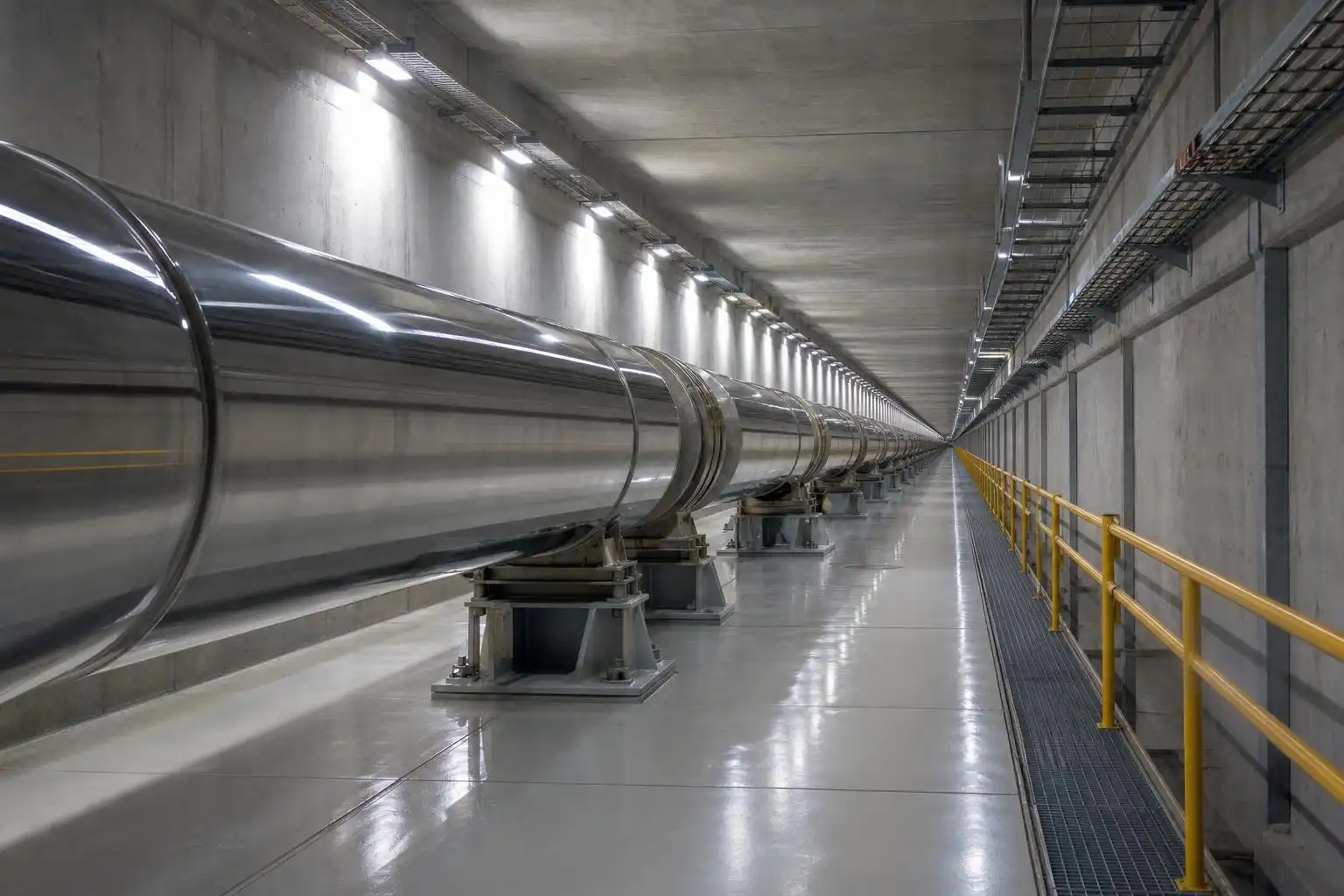

At its core, the Laser Interferometer Gravitational-Wave Observatory is a length measurement. Two arms, each 4 kilometers long, are monitored so precisely that a passing gravitational wave — stretching and squeezing spacetime by a fraction smaller than a proton — shifts the relative arm length by roughly 10⁻¹⁸ meters. That is one-thousandth the diameter of a proton. The photodetectors at the end of LIGO’s optical chain must register that shift reliably, in real time, against a background of every noise source the universe and human civilization can throw at it. The engineering story of how they do that — and where quantum mechanics itself becomes the limiting wall — is one of the most remarkable measurement tales in modern physics.
The Interferometer in One Paragraph
LIGO operates as a Michelson interferometer with Fabry-Pérot arm cavities. A 1064 nm Nd:YAG laser injects roughly 125 watts of light into the beamsplitter. Each arm cavity bounces that light back and forth about 280 times before it exits, effectively multiplying the arm length to around 1,120 km of optical path. When the arms are equal length, the light returning from both arms interferes destructively at the output port — almost no light reaches the detector. A gravitational wave breaks that symmetry. The arms stretch and squeeze differentially, the destructive interference becomes slightly imperfect, and a tiny flicker of light leaks to the output. The photodetector’s job is to measure that flicker.
InGaAs Photodiodes: The Detector of Choice
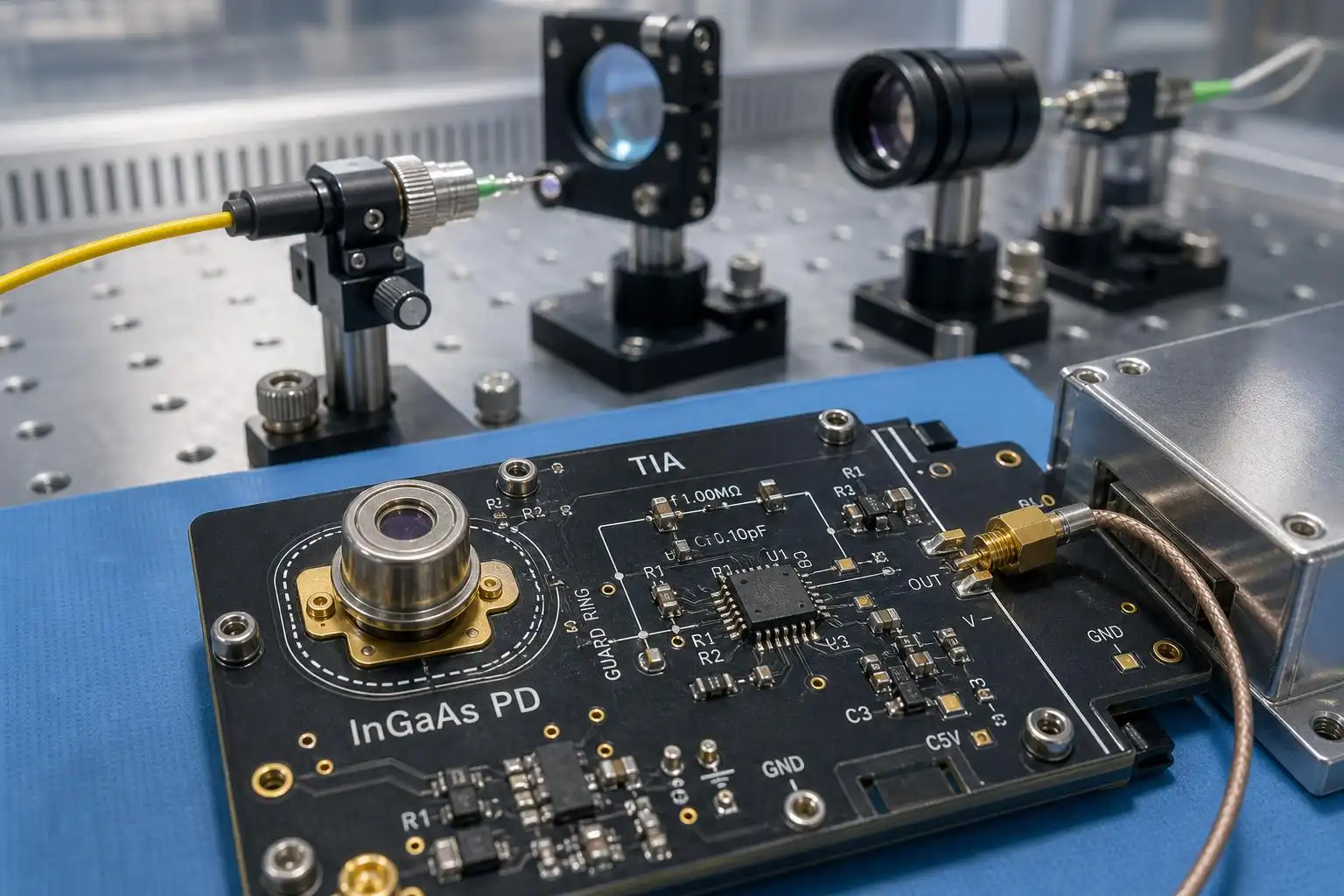
LIGO’s output photodetectors are indium gallium arsenide (InGaAs) photodiodes, not CCDs or CMOS imagers. The distinction matters. A CCD integrates charge over many pixels and reads out slowly — useful for imaging faint galaxies, useless for a signal that arrives as a transient ripple lasting a fraction of a second at frequencies between 10 Hz and 10 kHz. What LIGO needs is a single-element, high-bandwidth, high-quantum-efficiency photodiode that can respond to intensity fluctuations in that audio-frequency band without adding noise.
InGaAs is the material of choice at 1064 nm because silicon’s bandgap is too wide — silicon photodiodes have falling quantum efficiency above about 900 nm and are essentially blind by 1100 nm. InGaAs, with a bandgap tunable by composition, achieves quantum efficiencies above 95% at 1064 nm. The Advanced LIGO (aLIGO) output mode cleaner feeds a few milliwatts of carrier light onto InGaAs photodiodes in a DC readout scheme. Each diode must handle that power without saturating or generating excess thermal noise, while still resolving the tiny modulation imposed by a gravitational wave.
Shot Noise: The Quantum Wall
Here is where quantum mechanics enters, not as a background detail but as the dominant obstacle. Light is quantized into photons, and photons arrive at the detector randomly, following Poisson statistics. Even with a perfectly stable laser, the number of photons hitting the detector in any short time interval fluctuates. Those fluctuations produce a noise current in the photodiode — shot noise — with a spectral density that scales as the square root of the photon flux.
The shot-noise-limited strain sensitivity goes as:
h_shot ~ (1/L) × √(ħω / P)
where L is the arm length, ħω is the photon energy, and P is the circulating power. More power means more photons per second, smaller relative fluctuations, lower shot noise. This is why LIGO pushes circulating arm power to roughly 200–300 kilowatts — not because the mirrors need heating, but because every factor-of-four increase in power halves the shot noise floor.
At the frequencies most relevant for binary black hole mergers (100–300 Hz), Advanced LIGO’s design sensitivity is shot-noise dominated above about 200 Hz. Below that, radiation pressure noise and seismic noise take over. The shot noise floor in strain units sits around 10⁻²³ per root hertz in the most sensitive band — a number that only makes sense when you remember that the arm length is 4,000 meters and the measurement is of a differential length change.
Radiation Pressure Noise: The Other Face of the Same Coin
Shot noise and radiation pressure noise are not independent problems — they are two faces of the same quantum uncertainty. Higher laser power reduces shot noise but increases radiation pressure noise, because random photon momentum kicks shake the mirror surfaces. The mirror test masses at LIGO weigh 40 kilograms precisely to suppress this effect; heavier mirrors are harder to kick. Even so, radiation pressure noise dominates below roughly 30–40 Hz in Advanced LIGO, creating a noise floor that rises steeply toward low frequencies.
The product of shot noise and radiation pressure noise is bounded by the Heisenberg uncertainty principle. This is the Standard Quantum Limit (SQL) — the point at which you cannot reduce both simultaneously by simply adjusting laser power. The SQL for LIGO’s 40 kg mirrors at 100 Hz corresponds to a strain sensitivity of roughly 10⁻²³ per root hertz. Advanced LIGO approaches but does not breach this limit with conventional optics alone.
Squeezed Light: Borrowing from the Vacuum
The way to beat the SQL — or more precisely, to operate below it in one quadrature at the cost of increased noise in the conjugate quadrature — is squeezed light injection. Since 2019, Advanced LIGO has injected squeezed vacuum states into the dark port of the interferometer. This is not science fiction; it is a working part of the instrument.
Squeezed states are generated using optical parametric oscillators (OPOs) — nonlinear optical cavities containing periodically poled potassium titanyl phosphate (PPKTP) crystals pumped at 532 nm. The nonlinear interaction produces pairs of photons with correlated quantum fluctuations. By choosing the squeezing angle, you can reduce fluctuations in the phase quadrature (which sets shot noise) at the expense of increased fluctuations in the amplitude quadrature (which sets radiation pressure noise). At high frequencies, you want phase squeezing; at low frequencies, you want amplitude squeezing. Frequency-dependent squeezing — implemented after O3 by reflecting the squeezed beam off a 300-meter filter cavity before injection — rotates the squeezing angle as a function of frequency, providing the right trade-off across the detection band.
The practical result in O3 (the third observing run) was a factor of ~1.4 improvement in shot-noise-limited sensitivity, equivalent to increasing the laser power by a factor of two without touching the laser. In strain units, the improvement at 1 kHz is roughly 15–20%. That translates directly into detection range: a 15% sensitivity improvement means a 15% larger detection volume radius, or about 50% more volume of universe surveyed.
The Output Mode Cleaner and DC Readout
Before the squeezed or unsqueezed light reaches the photodiodes, it passes through the output mode cleaner (OMC) — a four-mirror bow-tie cavity roughly 1.1 m in round-trip length, with a free spectral range of about 264 MHz. The OMC serves two purposes. First, it strips away higher-order spatial modes and radio-frequency control sidebands, passing only the carrier TEM₀₀ mode that carries the gravitational-wave signal. Second, it defines the mode that the photodiodes actually see.
Advanced LIGO uses DC readout rather than the RF heterodyne scheme used by initial LIGO. In DC readout, a small offset is applied to the differential arm length, allowing a controlled amount of carrier light — a few milliwatts — to leak to the output even in the absence of a signal. The gravitational-wave signal then appears as a modulation of this DC carrier. DC readout has lower noise because it avoids the excess noise associated with RF oscillators and avoids the need to demodulate at radio frequencies, where electronic noise can be significant. The OMC is essential to DC readout: without it, scattered light and higher-order modes would overwhelm the few milliwatts of signal carrier.
Quantum Efficiency and the Cost of Optical Loss
Every photon lost between the interferometer and the photodiode is a wasted measurement. Optical loss reconstitutes vacuum fluctuations — the worst possible noise — in proportion to the fraction of light lost. If 10% of the light is lost in the output optics, the effective squeezing level is degraded by roughly 10% in power, which limits the achievable noise reduction regardless of how well the OPO performs.
This is why the output chain — OMC, Faraday isolators, steering mirrors, and photodiodes — is designed with obsessive attention to loss. The InGaAs photodiodes used in aLIGO achieve quantum efficiencies of 97–99% at 1064 nm. The OMC has measured round-trip losses below 100 parts per million. Faraday isolators contribute a few tenths of a percent each. Total output optical loss in Advanced LIGO is targeted below a few percent. Achieving that specification requires custom anti-reflection coatings, ultra-low-scatter mirror substrates, and careful alignment to avoid clipping losses.
Electronics: Keeping the Signal Clean from 10 Hz to 10 kHz
The photodiode current must be converted to a voltage and amplified without adding electronic noise that competes with the shot-noise floor. The transimpedance amplifier (TIA) following each photodiode is a custom low-noise design. The relevant figure of merit is the current noise of the amplifier referred to its input: this must be well below the shot-noise current of the photocurrent, which at 5 mW of detected power and 1064 nm is roughly 40 pA/√Hz. Commercial op-amp TIAs can achieve this, but only with careful component selection, shielding, and thermal management.
At low frequencies (10–100 Hz), 1/f noise in the electronics and in the photodiode itself can become significant. LIGO mitigates this partly by design — the DC readout scheme puts the gravitational-wave signal on a carrier, so the signal band sits at audio frequencies where 1/f noise is manageable — and partly by careful choice of InGaAs diode lots with low dark current.
Photodiode DC Readout
The aLIGO output uses InGaAs photodiodes after the output mode cleaner to measure the transmitted DC readout beam. The photodiode signals are combined to recover the gravitational-wave readout while preserving shot-noise-limited performance, but Advanced LIGO does not use the balanced-homodyne subtraction scheme described for some other precision optical measurements. The essential requirements are high quantum efficiency, low electronic noise, adequate power handling, and stable calibration of the photodiode response.
What the Numbers Mean
To make all of this concrete: a gravitational wave from a binary neutron star merger at 40 Mpc (roughly the distance of GW170817) produces a peak strain of roughly 10⁻²¹. LIGO’s 4 km arms respond with a differential length change of 4 × 10⁻¹⁸ meters — far smaller than the diameter of a proton. At the output, with 5 mW of carrier on the photodiodes, that length change produces a photocurrent modulation of order 10⁻¹³ amperes. The shot noise current at 5 mW is about 40 pA/√Hz. The signal-to-noise ratio in a 1 Hz bandwidth at the merger frequency (~150 Hz) is therefore on the order of 10⁻¹³ / (4 × 10⁻¹¹) ≈ 2.5 × 10⁻³. Detection requires matched filtering over the full bandwidth of the signal — typically a few seconds of inspiral — which integrates up the SNR to detectable levels above 8.
That matched filter is only possible because the waveform is predicted precisely by general relativity. The photodetector’s job is to preserve the phase coherence of the optical signal faithfully enough that the matched filter can do its work. Every excess noise source — shot noise, radiation pressure, electronic noise, optical loss — degrades that coherence. Squeezing, high circulating power, high quantum efficiency, and low-loss output optics all exist to protect it.
The Engineering Behind the Discovery
It is easy to look at the announcement of GW150914 — the first gravitational-wave detection, in September 2015 — and see a triumph of general relativity. It was. But it was equally a triumph of photodetector engineering, quantum optics, and noise budgeting carried out over decades. The InGaAs diodes, the output mode cleaner, the transimpedance amplifiers, and the DC readout system were essential to that first detection; squeezed-light injection later became an important upgrade for improving Advanced LIGO’s sensitivity. Without each part of the readout chain performing at or near its theoretical limit, the signal would have been buried in noise, and the universe’s most violent events would have passed by in silence.
That is the discipline of observational astronomy at its most demanding: not pointing a telescope, but coaxing a measurement out of quantum mechanics itself, one carefully engineered decibel at a time.



Leave a Reply