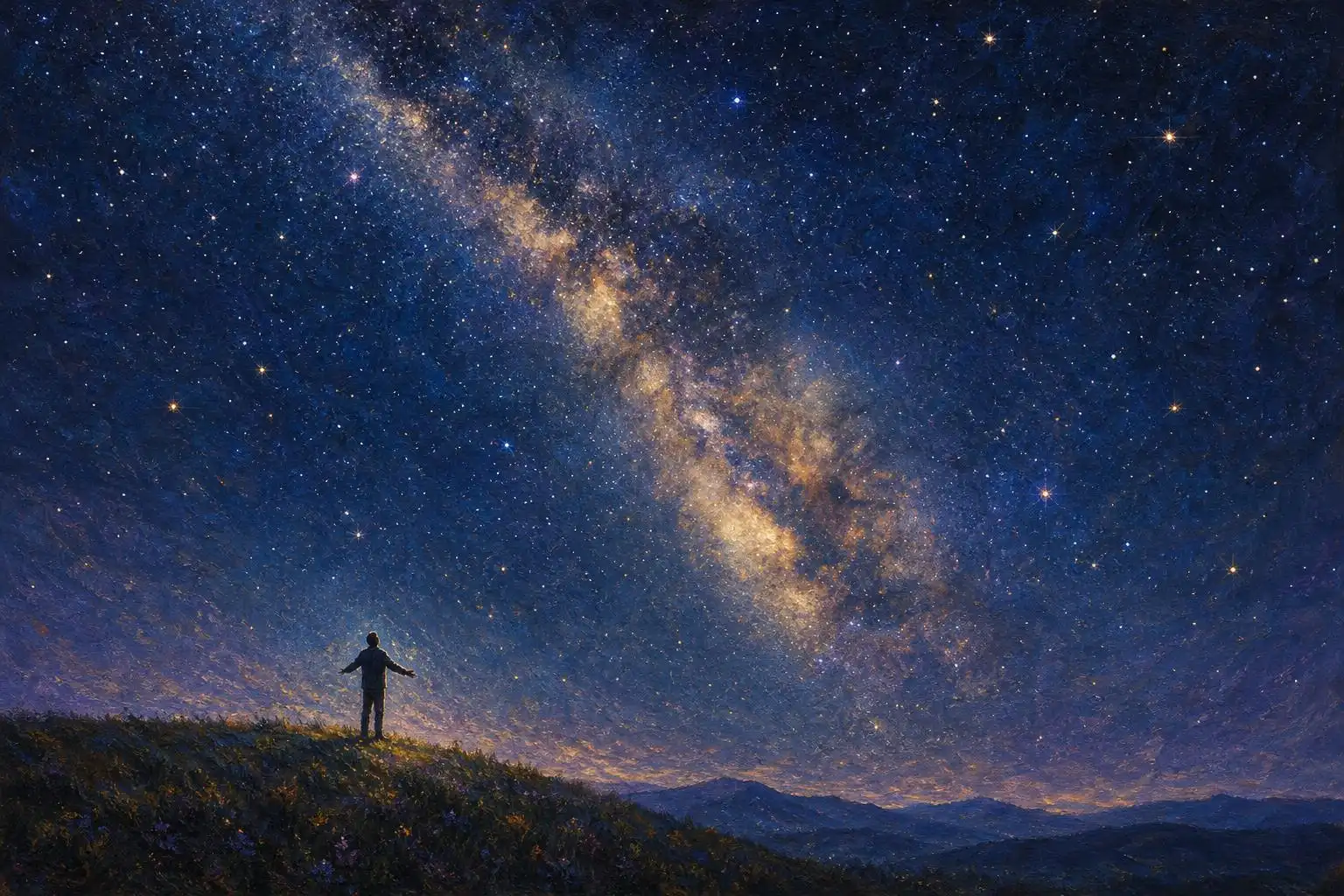

Let’s start with a number so large it should feel comforting, but somehow doesn’t: there are roughly 400 billion stars in the Milky Way alone. The observable universe contains an estimated two trillion galaxies. Do the math — or rather, don’t, because the result is a number so absurd your brain will simply file it under “very big” and move on.
Now here’s the question that should keep you up at night: given all of that, where is everybody?
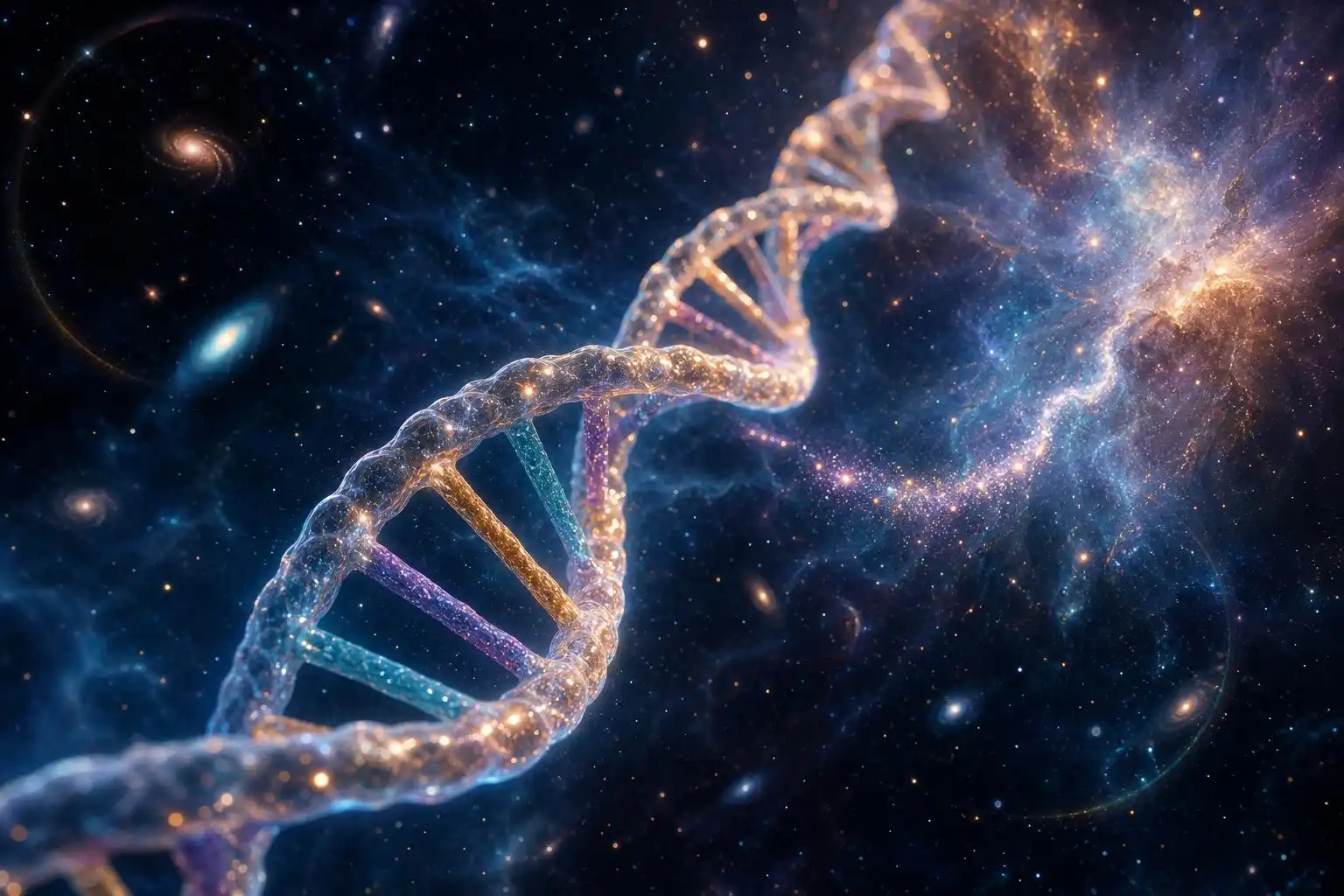
We’ve talked about the Fermi Paradox before — the eerie silence of a universe that, statistically, should be teeming with voices. And we’ve walked through the Drake Equation, that famous mirror that reflects our assumptions about life back at us. But today I want to zoom the lens in rather than out. Because there’s a version of the “where is everybody?” question that is far more personal, far more vertiginous, and somehow almost never gets asked.
The question is this: What are the odds that you, specifically, are here at all?
A Brief, Dizzying Probability Lesson
One popular estimate of the odds of any specific person existing — given the particular sperm and egg that had to meet, across all the generations of ancestors who had to survive, meet, and reproduce — puts it at roughly one in ten to the power of two-and-a-half million. That’s not one in a million. That’s one followed by 2,500,000 zeroes.
For context: the number of atoms in the observable universe is only about ten to the power of eighty. Your existence is, mathematically speaking, more improbable than the universe itself has atoms to represent.
Now hold that thought, because it gets stranger.
The Cosmic Prerequisite List
Before a single cell of you could exist, the universe had to do an enormous amount of prep work — and almost none of it was guaranteed.
The constants had to be just right. The strength of gravity, the charge of the electron, the ratio of matter to antimatter after the Big Bang — if any of these had been nudged by even a fraction of a percent in the wrong direction, the universe would have either collapsed back on itself in seconds or expanded so fast that no matter ever clumped together into stars. There would be no carbon. No water. No chemistry. No you.
This is the territory of the anthropic principle, which we’ve explored before: the universe appears fine-tuned for complexity, and we’re here to notice because if it weren’t, we wouldn’t be. That’s either deeply reassuring or deeply unsatisfying, depending on your mood.
Stars had to live and die in just the right sequence. Every atom of carbon in your body was forged in the nuclear furnace of a star that no longer exists. That star had to be born, burn for millions of years, and then explode — scattering its guts across space — before the cloud that eventually became our solar system could even begin to form. You are, quite literally, downstream of stellar death. In our case, the universe was about nine billion years old before the cloud that formed the solar system inherited the chemistry needed for something like you to be possible.
Earth had to thread an extraordinary needle. Not too close to the Sun, not too far. A large moon to stabilize the axial tilt (without which our seasons would swing wildly, making complex life far harder to sustain). A Jupiter-sized planet in the outer solar system whose role is complicated: it can deflect some comets and asteroids away, but it can also perturb other objects inward. Plate tectonics to recycle carbon and regulate temperature over geological time. An oxygen-rich atmosphere that took two billion years of cyanobacteria to produce.
Any one of these could have gone differently. All of them had to go the way they did.
The Ancestor Lottery
Now we get personal.
Every one of your direct ancestors — going back not just to the first humans, but to the first mammals, the first vertebrates, the first multicellular organisms — had to survive long enough to reproduce. A single one of them failing to do so, for any reason, at any point in the last 3.8 billion years of life on Earth, and you don’t exist.
Think about the asteroid that killed the non-avian dinosaurs 66 million years ago. The small, shrew-like mammals that survived that catastrophe are your ancestors. If that asteroid had missed — or hit somewhere slightly different, with slightly different consequences — the dinosaurs might still be here, and mammals might never have gotten their evolutionary moment in the sun. There would be no primates. No humans. No you.
Or consider the Toba supervolcanic eruption, roughly 74,000 years ago. Some hypotheses have proposed that it sharply reduced the human population, though the severity and global impact of any Toba-related bottleneck remain contested. If your particular ancestral line had been on the wrong side of a catastrophe like that, the chain breaks.
And that’s before we even get to the ordinary, everyday improbabilities: the chance meeting of two people who became your parents, the specific night you were conceived, the one sperm cell — out of the 250 million released — that happened to be the one.
So What Does This Mean?
I want to be careful here, because this kind of reasoning can slide into two very different places.
One place is a kind of cosmic narcissism: I was meant to be here. The universe conspired to produce me. This is a seductive story, but it’s not really what the numbers say. The numbers say that someone was going to exist, and they were going to be equally improbable. If your ancestral chain had broken anywhere along the way, some other improbable person would be sitting here reading some other article about their own improbable existence.
The other place — the one I find more honest and more interesting — is a kind of radical gratitude. Not the greeting-card kind, but the bone-deep, slightly terrifying kind that comes from really sitting with the numbers. You are a temporary arrangement of atoms that were forged in stars, that survived a 13.8-billion-year obstacle course of cosmic, geological, biological, and personal contingency, and that somehow ended up conscious enough to wonder about all of it.
The philosopher Derek Parfit argued, in debates about personal identity, that there need not be a separate “further fact” beyond the physical and psychological continuities that make you this person and not some other. There may be no deep metaphysical explanation for it. It just is. And somehow, that makes it more astonishing, not less.
The Universe Noticing Itself
Carl Sagan famously said that we are a way for the cosmos to know itself. I’ve always loved that line, but I think it undersells the weirdness of what’s actually happening.
It’s not just that humans, in general, are the universe’s self-awareness. It’s that you, with your specific memories and fears and the particular way you make your coffee, are a completely unrepeatable configuration of the universe reflecting on itself. When you look up at the night sky and feel that shiver of smallness and wonder, that’s not a small thing happening in a large universe. That’s the universe having a very specific, very personal experience that it has never had before and will never have again.
The Drake Equation asks how many civilizations might exist across the cosmos. It’s a beautiful question. But it doesn’t ask about the improbability of any particular mind within any particular civilization. It doesn’t count the asteroid that missed, the ancestor who survived, the specific Tuesday night that led to you.
The silence of the cosmos may be strange. But the fact that you’re here to notice the silence — that’s the strangest thing of all.
And maybe the most important thing to do with that strangeness is exactly what you’re doing right now: paying attention.



Leave a Reply