

In the sandstone cliffs of the Bandiagara Escarpment in Mali, the Dogon people have long maintained one of the most debated bodies of astronomical knowledge in the ethnographic record. Since the 1930s, French anthropologists Marcel Griaule and Germaine Dieterlen recorded Dogon accounts describing a companion star to Sirius — invisible to the naked eye, immensely dense, and orbiting the bright star on a roughly fifty-year cycle. That companion, Sirius B, is a real white dwarf, confirmed by telescopic observation only in 1862 and not photographed until 1970. The apparent match between Dogon oral tradition and modern astrophysics has fueled decades of argument about what indigenous sky-watchers in West Africa actually knew, and how.
The Testimony Griaule Recorded
Griaule’s fieldwork culminated in the 1965 publication, co-authored with Dieterlen, of “Le Renard Pâle” (“The Pale Fox”), a dense compendium of Dogon cosmological narrative gathered over decades of initiation-based interviews. In it, elders described Sirius as “sigi tolo” and its unseen companion as “po tolo,” named after the fonio grain, said to be the smallest and heaviest thing in creation — an image startlingly resonant with the extreme density of white dwarf matter. The Dogon reportedly associated po tolo’s orbit with the Sigui ceremony, a ritual cycle held roughly every sixty years, and described a third star, “emme ya,” that later observation has not confirmed.
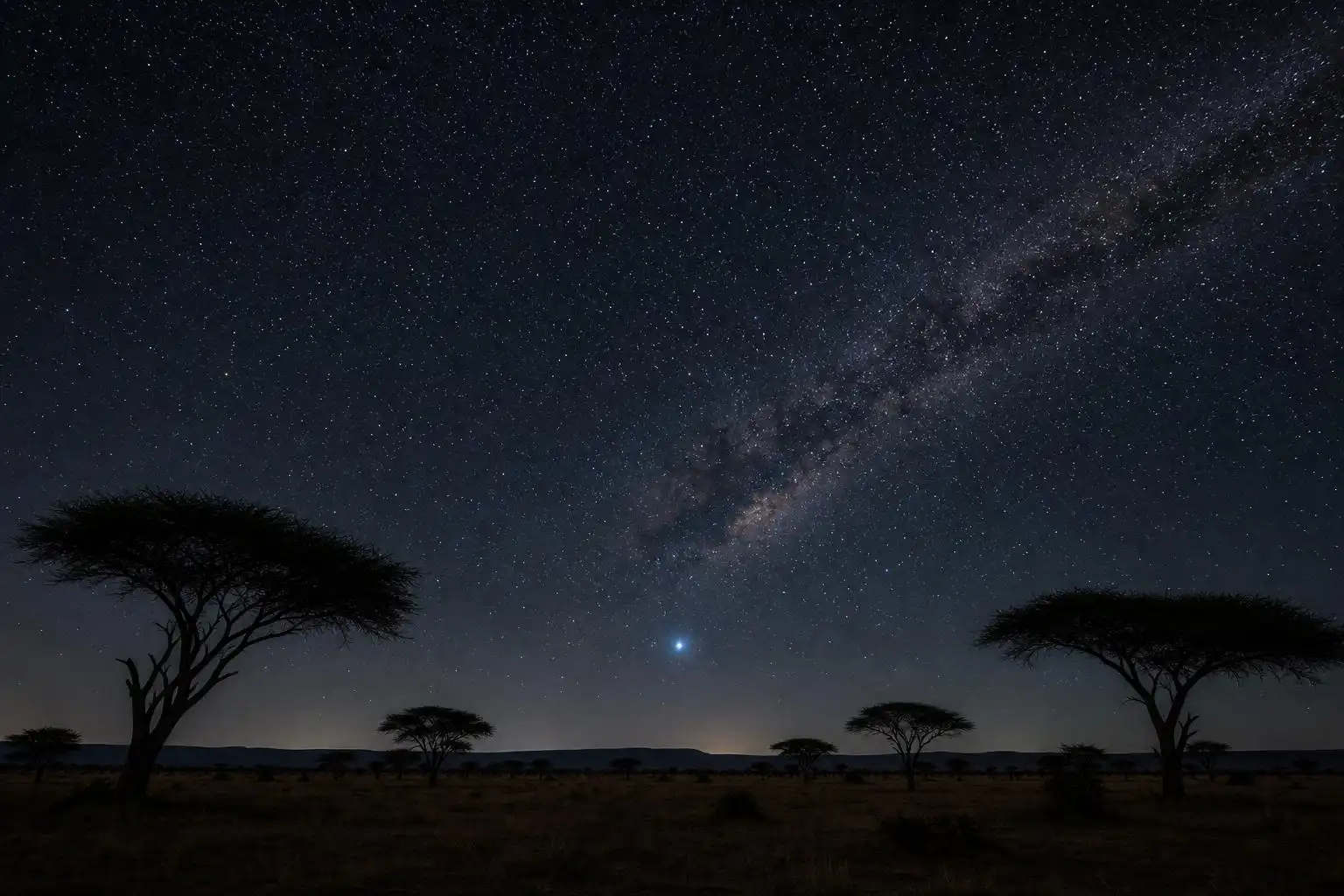
This is the crux of the puzzle: the sixty-year Sigui cycle does not cleanly map onto Sirius B’s actual fifty-year orbital period, and no third stellar body accompanies Sirius in any catalog. Anthropologist Walter van Beek, who began his own extended fieldwork among the Dogon in 1979, could not independently elicit the Sirius B narrative from Dogon informants outside those who had worked directly with Griaule’s team, raising serious questions about whether the material reflected pre-existing tradition or an artifact of the interview process itself, possibly introduced through European visitors, missionaries, or earlier colonial-era literature circulating in the region.
The Reported Sky Calendar
Griaule and Dieterlen described an intricate Dogon agricultural and ritual calendar built on stellar and solar observation, though van Beek did not corroborate Sirius’s prominence within it. In their account, Sigi tolo’s heliacal rising — its first reappearance in the dawn sky after a period of invisibility — served as a marker for the agricultural year, much as it did for the Egyptians along the Nile, where Sirius’s return signaled the coming flood.
Dogon cosmology, as recorded by Griaule and Dieterlen, also embeds astronomical reasoning inside a broader creation narrative involving Amma, the creator deity, and Nommo, an ancestral being associated with water, fertility, and the ordering of the cosmos. The granary of the Dogon world-system, a symbolic structure repeated in shrine architecture and divination practice, is described with proportions and compartments said to mirror celestial order. This is a cosmology in which sky-watching, agriculture, kinship, and ritual timekeeping are inseparable — a pattern echoed in Maya, Polynesian, and Aboriginal Australian traditions I have written about previously, where astronomy is never a detached science but a thread woven through the whole fabric of a society’s understanding of itself.
Rethinking the “Ancient Astronaut” Detour
The Sirius mystery took on a life of its own in the 1970s when writer Robert Temple published “The Sirius Mystery,” arguing that Dogon knowledge of an invisible dwarf star could only be explained by contact with an advanced extraterrestrial civilization. This claim, though popular in fringe literature, collapsed under scrutiny. Astronomer Carl Sagan and Ian Ridpath both published detailed rebuttals in the late 1970s, noting that European astronomical information about Sirius B — reinforced in the 1920s by Walter Adams’s reported gravitational-redshift measurements at Mount Wilson — had ample opportunity to reach Mali through French colonial contact, missionary schools, and the circulation of popular science almanacs, decades before Griaule’s fieldwork began.
The extraterrestrial hypothesis, in other words, required elaborate and unfalsifiable speculation while a far more mundane explanation — cultural transmission through colonial-era contact, filtered through Griaule’s own priming questions and the notorious difficulty of translating esoteric initiatory knowledge across languages — sat available all along. Van Beek’s fieldwork additionally raised the possibility that some of what Griaule published reflected his own synthesis and interpretive overlay on fragmentary testimony, a known hazard in mid-twentieth-century salvage ethnography conducted under the assumption that “authentic” tradition needed to be reconstructed by the outside scholar.
What the Debate Obscures
Treating the Dogon primarily as a puzzle to be solved — did they know or didn’t they? — flattens a rich cosmological system into a single yes-or-no trivia question, and it does a disservice comparable to reducing Chaco Canyon to a solstice-alignment checklist or the Antikythera Mechanism to a party trick. The more historically responsible reading treats “Le Renard Pâle” as a document of mid-century ethnographic method as much as a record of Dogon belief: a text shaped jointly by Griaule’s persistent questioning across repeated initiatory sessions and by Dogon interlocutors who may have elaborated, reframed, or incorporated new information within an existing narrative structure that already prized fonio grain, granaries, and cyclical time as central symbols.
This does not mean Dogon sky-watching lacks genuine astronomical sophistication. The heliacal rising of Sirius as a calendrical marker, the elaborate ritual calibration of the Sigui cycle, and claims of tracking celestial bodies for agricultural timing derive heavily from Griaule’s disputed ethnography rather than independent attestation. What is uncertain is specifically the claim of pre-contact knowledge of Sirius B’s existence, mass, and orbital period — a much narrower and more extraordinary assertion than “the Dogon watch the sky carefully,” which is simply true, as it is true of nearly every agricultural society in history.
Reading Indigenous Astronomy Without Distortion
The Dogon Sirius controversy offers a cautionary lesson for anyone studying non-Western astronomical traditions, myself included. Two opposite errors are equally tempting: dismissing indigenous knowledge as primitive superstition unworthy of serious study, or inflating it into evidence of impossible ancient science or alien contact because that story is more sensational than the truth. Both errors share a root cause — they refuse to sit with indigenous knowledge on its own terms, as a coherent, internally reasoned system adapted to its own purposes, whether that purpose is predicting the flood of the Nile, timing the planting of millet, or steering a canoe by the rising point of Arcturus across the open Pacific.
What the Dogon record ultimately preserves, stripped of the Sirius B controversy, is Griaule and Dieterlen’s description of an elaborate ritual calendar sustained across generations without writing, embedded in architecture, masked dance, and initiatory knowledge transmitted only to those who earned it through age-grade progression. That is itself a remarkable achievement of human observation and memory, no less impressive for not including a white dwarf. The proper task of ethnoastronomy is not to hunt for hidden proofs that indigenous peoples anticipated modern physics, but to recover, on their own terms, the observational care and cosmological imagination that let a community on the edge of the Sahara turn the motion of the stars into the rhythm of its entire life.


Leave a Reply