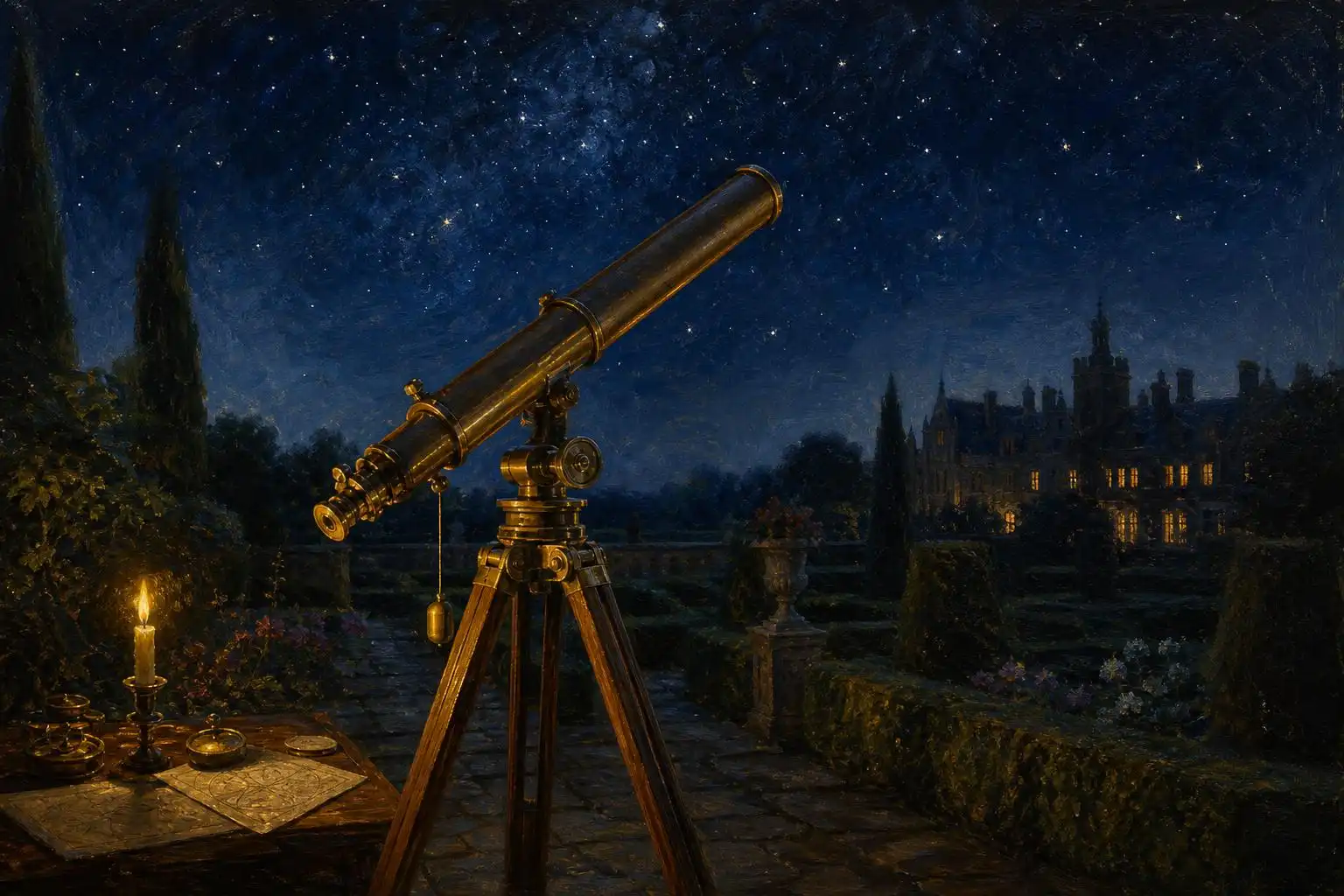

On the night of 17 October 1779, William Herschel stood in the garden of his house on New King Street in Bath, one eye pressed to a seven-foot reflector he had ground and polished himself, the other watering in the cold. He was not yet the man who had discovered a planet — that would come two years later, on 13 March 1781, when a faint disk in Gemini refused to sharpen into a point; he first reported it as a comet, and only subsequent observations and orbit calculations revealed it to be a new planet. In 1779 he was still a working musician, giving oboe lessons and playing organ at the Octagon Chapel by day, and by night turning his homemade mirrors on every star bright enough to hold his attention. He had begun a project that seemed, on its face, almost bureaucratic: a systematic review of double stars, pairs of points of light that appeared close together in the sky. He wanted to use them to measure the annual parallax of the fixed stars, the tiny yearly wobble that Copernican theory demanded and that no one had yet been able to detect.
The logic was elegant and, as it turned out, almost entirely wrong. If two stars appeared close together by sheer chance, one might be much farther away than the other. As Earth orbited the sun, the nearer star should appear to shift very slightly against the farther one, which would act as a fixed reference point — a trick suggested decades earlier by Galileo himself in a letter to Elia Diodati, and later urged more systematically by the Reverend John Michell. Herschel adopted the method with the same dogged patience he brought to lens-grinding, and by the late 1770s he had begun cataloguing hundreds of these star pairs, measuring the angles and distances between them with a filar micrometer he had built by hand, thread by thread, screw by screw.
A Catalogue in Search of a Parallax
Herschel’s double-star project ran for decades and eventually filled three major catalogues, the first read to the Royal Society in 1782, listing 269 pairs, with two further catalogues following in 1784 and 1821 that pushed the total past 800. He measured with an obsessiveness that alarmed even his sister Caroline, who kept his observing books and fed him at odd hours so he would not have to leave the eyepiece. He was hunting for the shift that would prove the Earth moved — a shift so small that it would not actually be detected by anyone until 1838, when Friedrich Bessel finally caught the parallax of 61 Cygni using a heliometer at Königsberg, nearly sixty years after Herschel began looking.
But something strange kept happening in Herschel’s measurements. Pairs of stars that should have held their relative positions fixed, or at most crept slowly apart as the Earth’s orbital motion carried the observer’s vantage point around the sun, were instead visibly rotating around each other. Castor, the northern star of the twins, showed its two components sliding around one another year by year. Herschel had been measuring double stars since the 1770s, and by the 1790s, comparing his own numbers against older measurements by James Bradley and by the German astronomer Christian Mayer, he could see the pattern was not noise. It was motion, and it was motion of the wrong kind for parallax.
The Paper of 1803
He announced his conclusion to the Royal Society in a paper read on 9 June 1803, “Account of the Changes That Have Happened, during the Last Twenty-Five Years, in the Relative Situation of Double-Stars.” The title is dry, almost apologetic, but the content was a quiet revolution. Herschel had compared his measurements of about fifty double stars across a quarter century and found that several pairs — Castor foremost among them, along with Gamma Virginis and 70 Ophiuchi — showed changes in position angle that could not be explained by any combination of proper motion or parallax. The only remaining explanation, he wrote, was that the stars were physically connected, “attracting each other” and revolving in orbits, exactly as a planet orbits the sun.
This was not a small claim. It meant that Newton’s law of gravitation, established for the solar system and confirmed spectacularly by Halley’s comet returning on schedule, sighted in late 1758 and reaching perihelion in 1759, extended all the way out to the fixed stars — bodies so remote that their light took years to reach Earth, bodies Newton himself had assumed were fixed reference points precisely because they showed no motion detectable with the instruments of his era. Herschel followed up with a second paper in 1804, “Continuation of an Account of the Changes,” adding more systems and describing the orbital motion in more detail, though a rigorous calculation of a binary orbit would not come until Félix Savary’s work in 1827, and stating the conclusion even more plainly: these were not chance alignments of a near star and a far star along the same line of sight, what he called “optical” doubles, but true “binary sidereal systems,” a phrase that stuck.
The irony of the discovery is one Herschel himself seems to have appreciated with wry good humor. He had set out to prove one thing — the Earth’s annual motion, via parallax — and instead demonstrated something else almost as important, that gravity appeared to govern the stars as it governed the planets, and that many of the double stars he had spent twenty-five years cataloguing for an entirely different purpose were genuine physical pairs locked in mutual orbit. In a letter-like passage in the 1803 paper he noted that some of these systems must complete a full revolution “in a period of time much within the compass of a moderate life,” which was itself a startling idea: that a human observer, patient enough, might watch two suns complete an entire orbital circuit within a single career.
Instruments Built by Hand
None of this would have been possible without the instruments Herschel built himself, often at his own expense and against the advice of professional opticians who thought his methods eccentric. His seven-foot reflector of the Bath years gave way to larger mirrors — a twenty-foot telescope built after his 1781 discovery of Uranus brought him a royal pension and freed him from teaching oboe scales to Bath society, and eventually the enormous forty-foot telescope erected at Slough in 1789, funded by George III, whose tube was famously large enough that the king, touring it before it was mounted, is said to have led the Archbishop of Canterbury through it by the hand, joking that this was surely the way to heaven.
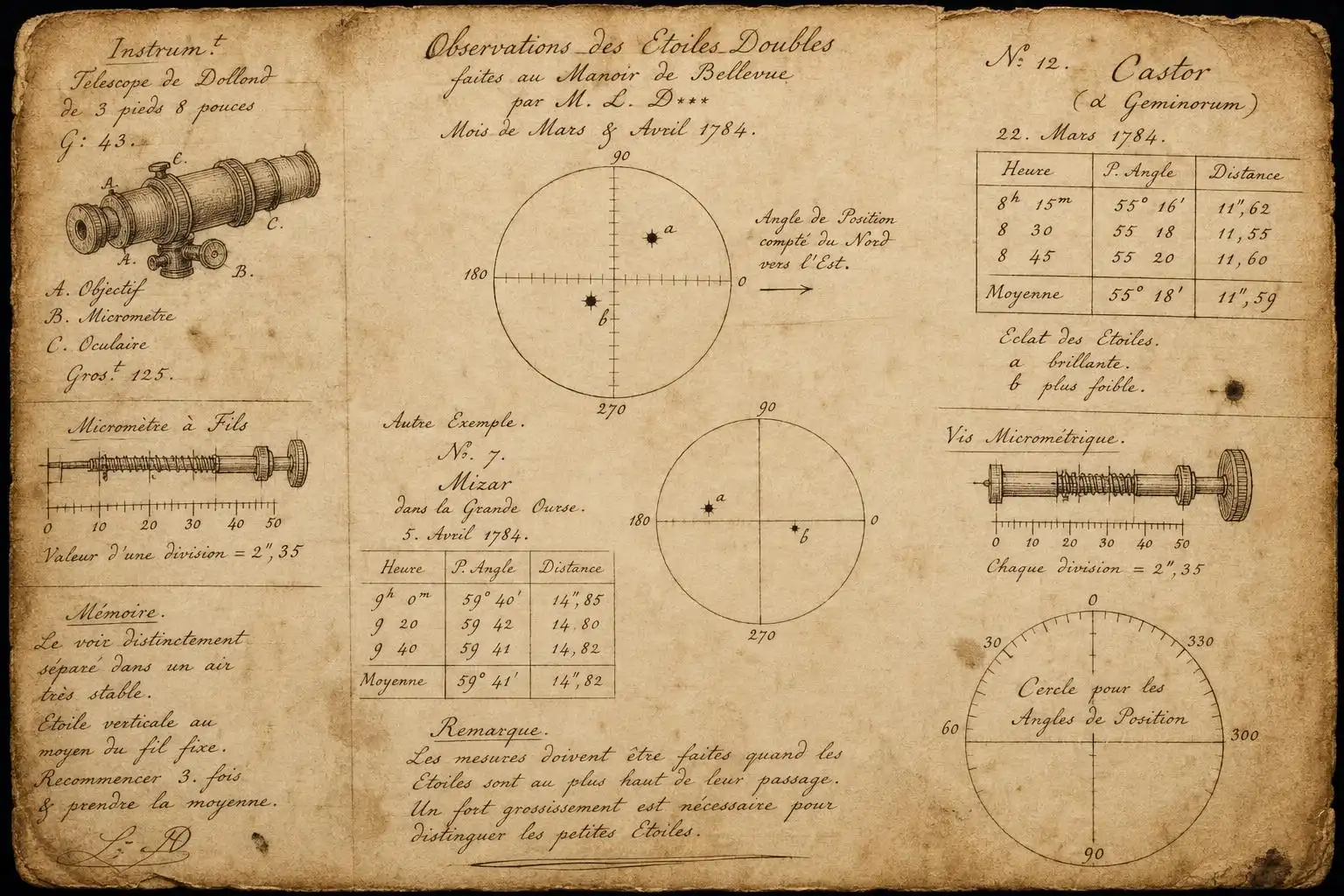
The forty-foot instrument was more spectacle than working tool — its speculum mirrors tarnished quickly in England’s damp air and it was difficult to point with precision — but the smaller reflectors, especially a refined twenty-foot, did the real work of the double-star catalogues. Herschel’s filar micrometer, a fine spider-thread or wire stretched across the eyepiece and moved by a calibrated screw, let him measure separations of a few arcseconds with a precision that rivaled instruments many times more expensive. Notebooks from this era of double-star observing, some using instruments like a Dollond refractor, record night after night of readings called out from the eyepiece and written down by candlelight, a testament to the shared, painstaking culture of measurement Herschel’s own observing depended on.
What the Losers Got Right
It would be easy, in hindsight, to make this story about a mistaken hypothesis rescued by a lucky accident, but that undersells both the method and the men who came before Herschel. Galileo’s suggestion of using double stars for parallax was sound in principle; it simply required precision no seventeenth or eighteenth-century instrument could deliver, and Herschel’s failure to find parallax by this route was not a personal failing but an honest report of the technology’s limits. John Michell, the same clergyman-scientist who in 1783 first speculated about bodies so dense that light could not escape them — objects later ages would call black holes — had already argued on statistical grounds that many double stars were likely to be physically associated rather than chance alignments, reasoning from the sheer improbability of so many close pairings occurring by random scatter across the sky. Herschel’s twenty-five years of careful, repeated measurement turned Michell’s probabilistic argument into direct observational proof, which is a different and harder thing.
The stars Herschel watched kept moving after he died in 1822. Castor’s components, cataloged as Castor A and B, continued their slow orbital dance, and by the twentieth century astronomers had calculated periods for many of the systems Herschel first flagged — Castor’s pair orbit each other roughly every 460 years, well beyond a human lifetime, though some of the tighter pairs Herschel and his contemporaries measured really did complete visible arcs within a few decades, exactly as he had guessed. His son John Herschel, continuing the family trade of patient measurement, extended the double-star catalogues through the 1820s and 1830s, and the field Herschel senior effectively founded became one of the principal tools nineteenth-century astronomers used to determine stellar masses, since an orbiting pair, once its period and the physical size of its orbit are known from the angular separation and the system’s distance, yields the combined mass of the two stars through the same Newtonian mathematics that gives the mass of the sun from the orbit of the Earth.
What the Sky Refused to Confirm
There is a particular kind of scientific honesty in Herschel’s papers of 1803 and 1804 that is worth sitting with. He does not pretend the parallax project succeeded. He reports, plainly, that after a quarter century of measurement, the shift he had hoped to find in these double stars was not there, or was too small and too tangled up with other motions to isolate — and then he pivots, without defensiveness, to explain what he found instead. Bessel would not vindicate the parallax method for another thirty-four years, using 61 Cygni, itself a double star, though by then measured with instruments and statistical techniques Herschel could not have imagined.
What the episode reveals about the practice of astronomy is something more interesting than a simple story of failure redeemed. Herschel’s twenty-five years of double-star measurements were designed to answer one question about the architecture of the solar system’s relationship to the fixed stars, and they ended up answering a different and in some ways larger question about the architecture of the stars themselves — that gravity is not a local rule confined to the sun and its planets but a universal law binding pairs of suns light-years from Earth into orbits as lawful and as calculable as the orbit of a moon. The tool built for one measurement, faithfully and rigorously applied over decades, disclosed a truth its builder had not been looking for. Herschel kept the micrometer thread taut and the eyepiece steady not because he knew what he would find, but because he trusted that patient, repeated observation would eventually tell him something true, whether or not it was the something he had set out to learn.



Leave a Reply