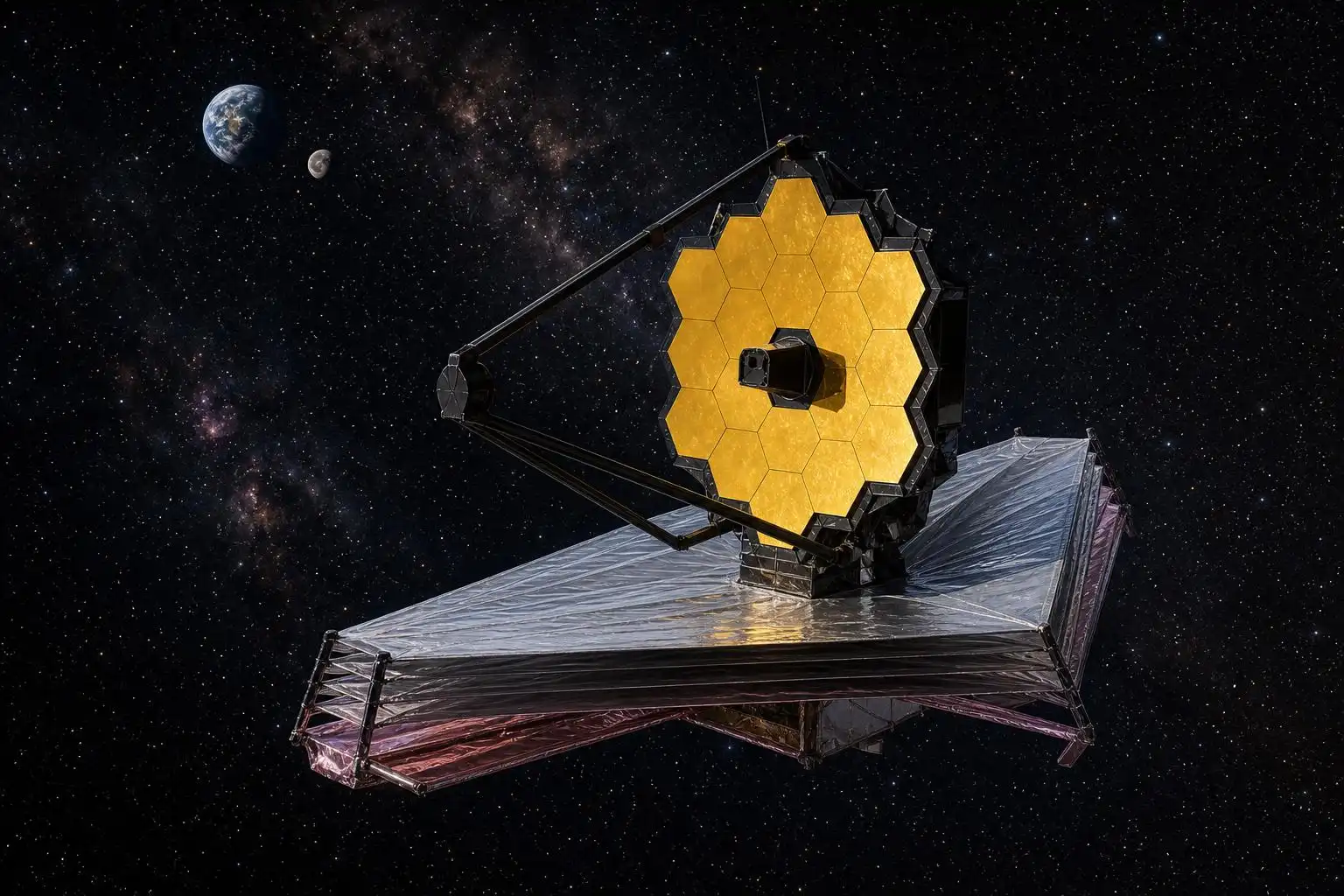

Before 2021, many telescopes sat on the ground or orbited a planet the way the Moon orbits Earth: a body pulling on a body, a simple gravitational handshake. Others, including Herschel, Planck, and Gaia, operated around Sun–Earth L2. The James Webb Space Telescope follows that pattern. It orbits the Sun while looping around a location in space defined entirely by the balance of forces between two other bodies, a place with no mass, no surface, and no reason to exist except that the mathematics of gravity happens to leave a parking spot there. That spot is called Lagrange point 2, or L2, and understanding why Webb lives there tells you something genuinely strange about how gravity behaves when you have more than one thing pulling on you at once.
The Problem With Two-Body Physics
Newton solved the two-body problem completely. Give him the Earth and the Moon, or the Sun and a planet, and he will hand you an exact orbit, stable and predictable for as long as nothing else interferes. The trouble starts the moment you add a third body. The “three-body problem,” as it is known, has no general closed-form solution — a result established through work by Heinrich Bruns and Henri Poincaré in the late 1800s. In prize work for the King of Sweden, Poincaré showed that the orbits of three mutually gravitating bodies can become chaotic, sensitively dependent on starting conditions in a way that makes long-term prediction impossible.
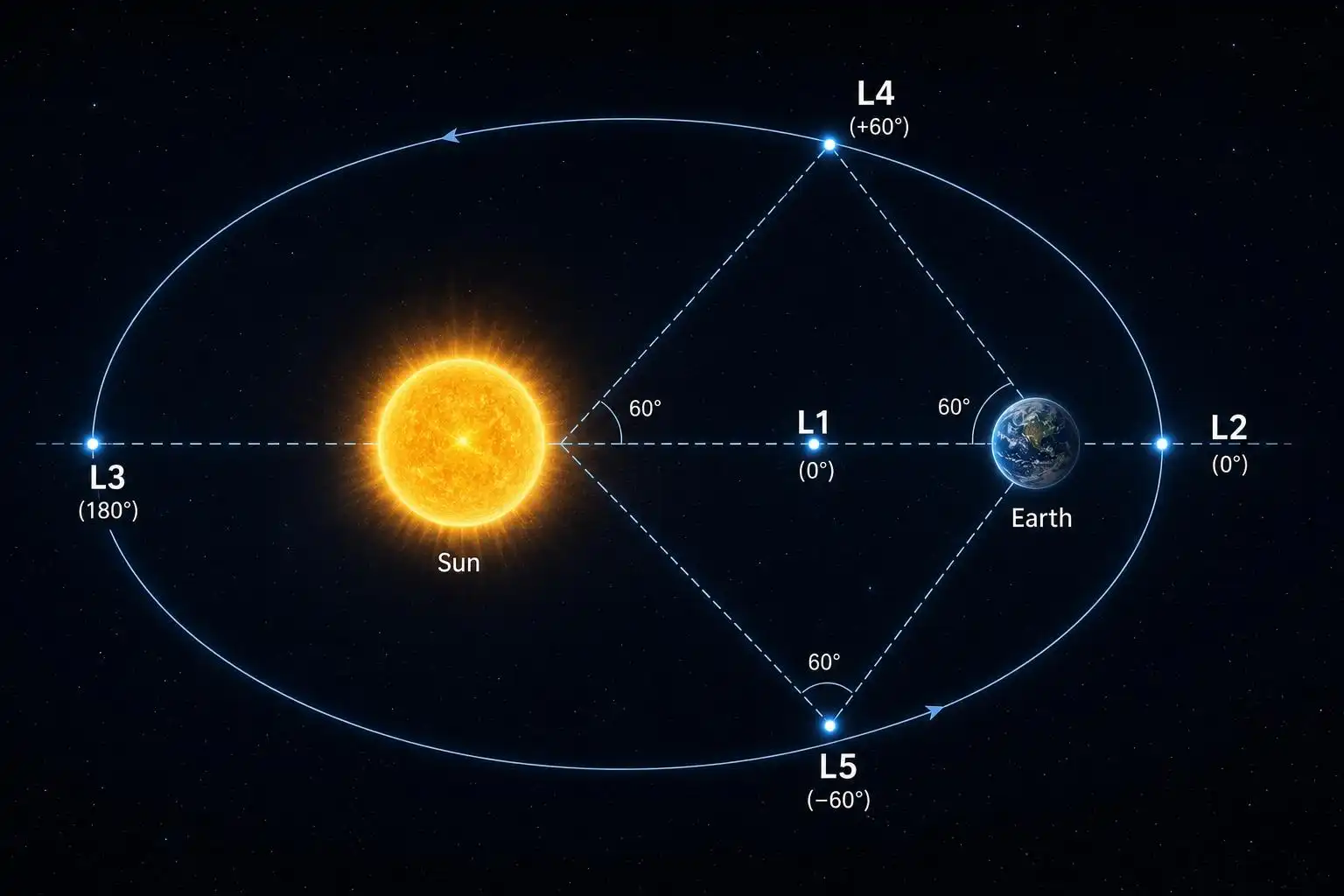
But in 1772, decades before Poincaré’s discovery, the mathematician Joseph-Louis Lagrange found something remarkable hiding inside a simplified version of that problem. If you have two massive bodies — say, the Sun and the Earth — locked in orbit around their common center of mass, there exist exactly five points in the surrounding space where a third, much smaller object can sit and have the combined gravitational pull of the two large bodies, plus the centrifugal effect of moving along with them, cancel out into equilibrium. Five points where a spacecraft can effectively hover, relative to the Sun and Earth, without needing constant thrust to hold position.
Why L2 and Not Just “Farther Out”
L2 sits about 1.5 million kilometers from Earth, on the side facing away from the Sun — roughly four times the distance to the Moon. That distance is not arbitrary; it is the point where Earth’s gravity adds just enough extra pull to the Sun’s gravity that an object there orbits the Sun at the same angular rate Earth does, even though it is farther from the Sun than Earth is and would, on its own, orbit more slowly at that distance. Earth’s gravity supplies the additional inward acceleration needed to match, so from Earth’s perspective, the object stays parked in the same direction indefinitely.
That geometry is exactly what an infrared telescope wants. Webb was built to detect the faint heat signatures of galaxies from the first few hundred million years after the Big Bang, light so stretched by cosmic expansion that it has shifted entirely out of the visible spectrum and into the infrared. To do that, the telescope itself must be cold enough that its own thermal emission does not overwhelm the infrared light it is trying to see — around 50 kelvin, or roughly minus 370 degrees Fahrenheit. At L2, Webb can orient its iconic tennis-court-sized sunshield so that the Sun, Earth, and Moon all stay on one side, permanently blocking their combined heat and light while the telescope’s mirrors face the cold dark on the other side, uninterrupted by day-night cycles or Earth’s shadow.
Compare that to the Hubble Space Telescope, which orbits Earth at about 540 kilometers up, crossing into and out of sunlight every 95 minutes and periodically having Earth itself blot out large patches of sky. Hubble also sits close enough that Earth’s own infrared glow — the planet is, after all, a warm object radiating heat — would have swamped Webb’s instruments. L2 solves both problems in a single stroke: constant shielding geometry and enough distance that Earth stops being a nuisance and becomes just another point of light behind the shield.
An Equilibrium You Have to Fight For
Here is the part that surprises people: Lagrange point 2 is not actually a stable parking spot. Of the five Lagrange points, L4 and L5 — sitting 60 degrees ahead of and behind Earth in its orbit — are stable, the kind of equilibrium where a small nudge causes an object to oscillate gently back rather than drift away, which is why swarms of asteroids called Trojans collect at those points around Jupiter and other planets. L1, L2, and L3, all lying along the direct Sun-Earth line, are saddle points instead: stable in some directions, unstable in others, like a ball balanced on a mountain pass that will roll away if it drifts even slightly off the ridge.
Webb doesn’t sit exactly at the mathematical L2 point anyway; it flies a loose, six-month loop around it called a halo orbit, chosen specifically so that Earth never blocks the Sun from the spacecraft’s solar panels. But halo orbits around an unstable saddle point require upkeep. Webb performs small station-keeping burns roughly every three weeks, tiny thruster firings that nudge it back onto its intended path before instability can carry it away. NASA calculated that Webb carries enough propellant for at least twenty years of these corrections — a number that, thanks to a remarkably precise launch by Ariane 5 in December 2021, may end up being closer to twenty-five, since less fuel than expected had to be spent correcting the initial trajectory.
The Trade You Make for Going There
The stability trade-off comes with a permanence problem too. Unlike Hubble, which orbits close enough that space shuttle astronauts could visit it for servicing missions — swapping instruments, replacing gyroscopes, famously correcting its blurry vision in 1993 — Webb is 1.5 million kilometers away, roughly four times farther than anyone has ever traveled from Earth. No spacecraft currently in existence is designed to reach it, dock with it, and bring astronauts home. Every mirror segment, every instrument, every sunshield layer had to work essentially the first time, unfolding through over 300 single-point failure mechanisms during a multi-week deployment sequence that engineers watched with what can only be described as controlled dread.
That is the price of choosing an equilibrium point over an orbit around Earth: you gain a permanently cold, permanently shielded observing environment, and you give up any chance of fixing your mistakes by hand. It worked. Webb deployed flawlessly, reached its halo orbit around L2 in late January 2022, and has spent the years since returning images of galaxies as they looked within a few hundred million years of the Big Bang — light that left its source before the Sun or Earth existed, focused by a mirror sitting in a spot of space that, in the strictest sense, isn’t really there at all.
The next time someone shows you one of Webb’s impossibly deep, impossibly old galaxy images, remember that the telescope taking that picture is holding its position through a very deliberate, very temporary act of gravitational balancing — one Lagrange worked out with pen and paper two and a half centuries before anyone had a spacecraft to send there.



Leave a Reply