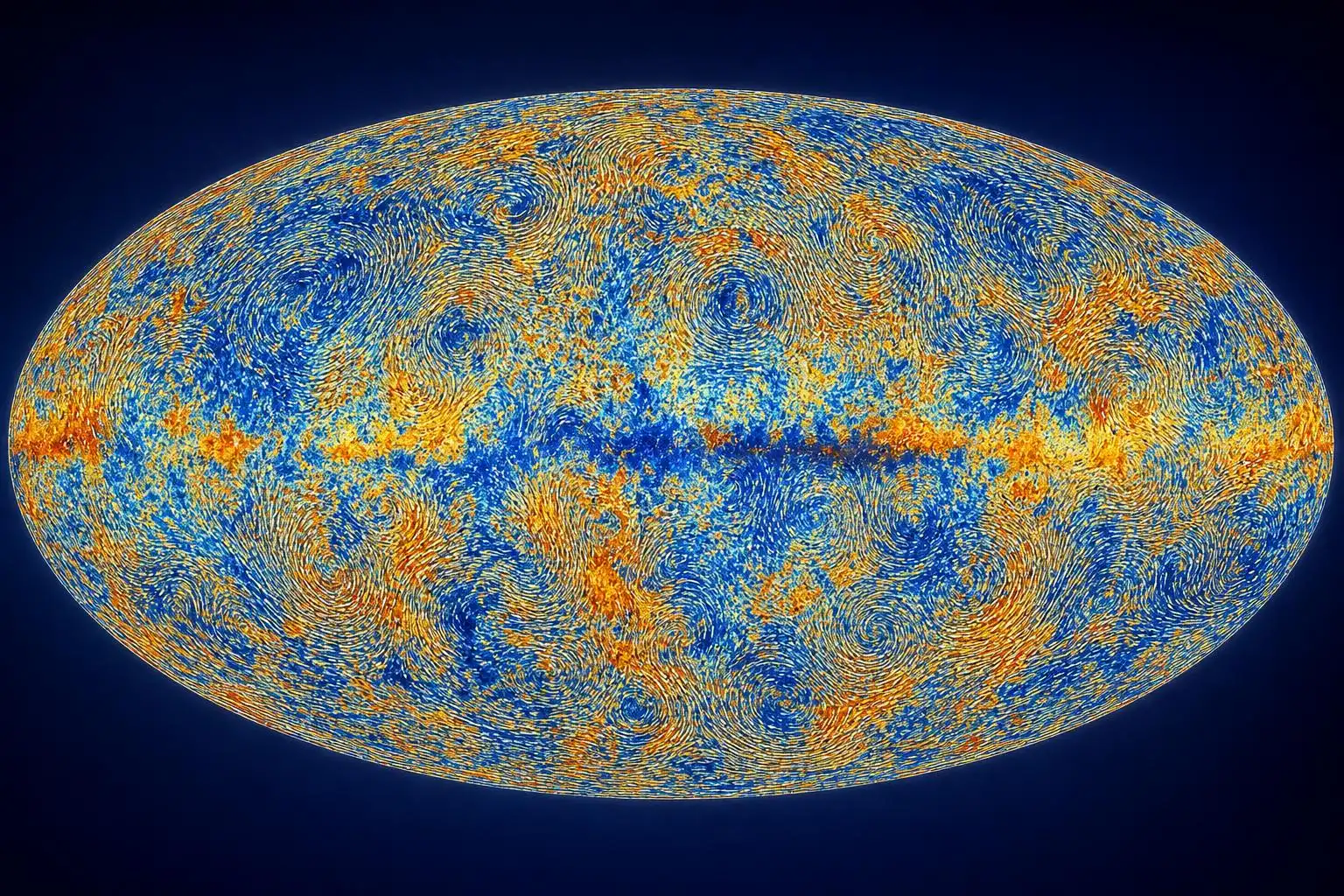

Somewhere in the first fraction of a second after the Big Bang, the universe may have stretched by a factor of at least 10^26 in less time than it takes light to cross a proton. This is the inflationary hypothesis, and it has become so embedded in cosmology’s working vocabulary that it’s easy to forget we have never directly confirmed it happened. We infer inflation from what it would explain: the flatness of space, the near-uniform temperature of the cosmic microwave background across regions that should never have been in causal contact, and the particular statistical pattern of density fluctuations imprinted on the sky. What we lack is a smoking gun — a signal that would offer especially strong, distinctive support for inflation.
That smoking gun has a name: primordial gravitational waves. If inflation happened, quantum fluctuations in spacetime itself would have been stretched to cosmic scales alongside the fluctuations in matter and radiation, producing a background of gravitational waves so faint that no direct detector built or planned could register them. But these waves would have left an indirect signature on the oldest light we can see, and for two decades that signature has been the object of one of the most demanding measurement campaigns in observational cosmology.
The B-mode Signal Everyone Wants
The cosmic microwave background is polarized, a consequence of the last scattering of photons off free electrons roughly 380,000 years after the Big Bang. That polarization pattern can be decomposed mathematically into two types, called E-modes and B-modes, borrowing terminology from electromagnetism. E-modes, the dominant pattern, arise naturally from density fluctuations and were confirmed by DASI in 2002. B-modes are different: at the largest angular scales, they are not produced by density fluctuations alone. Ordinary, nonchiral gravitational waves passing through the plasma at recombination can generate this parity-odd pattern, though lensing, cosmic defects, and foregrounds can also produce B-modes.
The amplitude of this primordial B-mode signal is conventionally expressed through the tensor-to-scalar ratio, r, which compares the strength of gravitational-wave-induced fluctuations to the density fluctuations we already see. Different inflationary models predict wildly different values of r, from nearly zero to several tenths, which is precisely what makes the measurement so valuable. A detection, or even a sufficiently tight non-detection, directly discriminates between whole families of theories about what drove the universe’s earliest expansion.
BICEP2’s False Dawn
In March 2014, the BICEP2 collaboration announced a detection of B-mode polarization at a level corresponding to r ≈ 0.2, a result that made front-page news and briefly looked like a Nobel-caliber discovery of gravitational waves from the birth of the universe. The euphoria did not survive contact with the data from Planck. Joint analysis published in 2015 showed that galactic dust in the Milky Way, aligned by magnetic fields, produces polarized emission that mimics the same B-mode pattern at the frequencies BICEP2 had observed. Once the dust foreground was properly subtracted, the primordial signal was consistent with zero.
The episode became a case study in how foregrounds can masquerade as cosmology, and it reshaped the field’s strategy. Rather than observing at a single frequency and hoping foregrounds were negligible, experiments now observe simultaneously across multiple frequency bands, since synchrotron and dust emission scale differently with frequency than the primordial CMB signal does. This is expensive, technically demanding, and unglamorous work, but it is the only way to trust a detection if one ever comes.
Where the Limits Stand Today
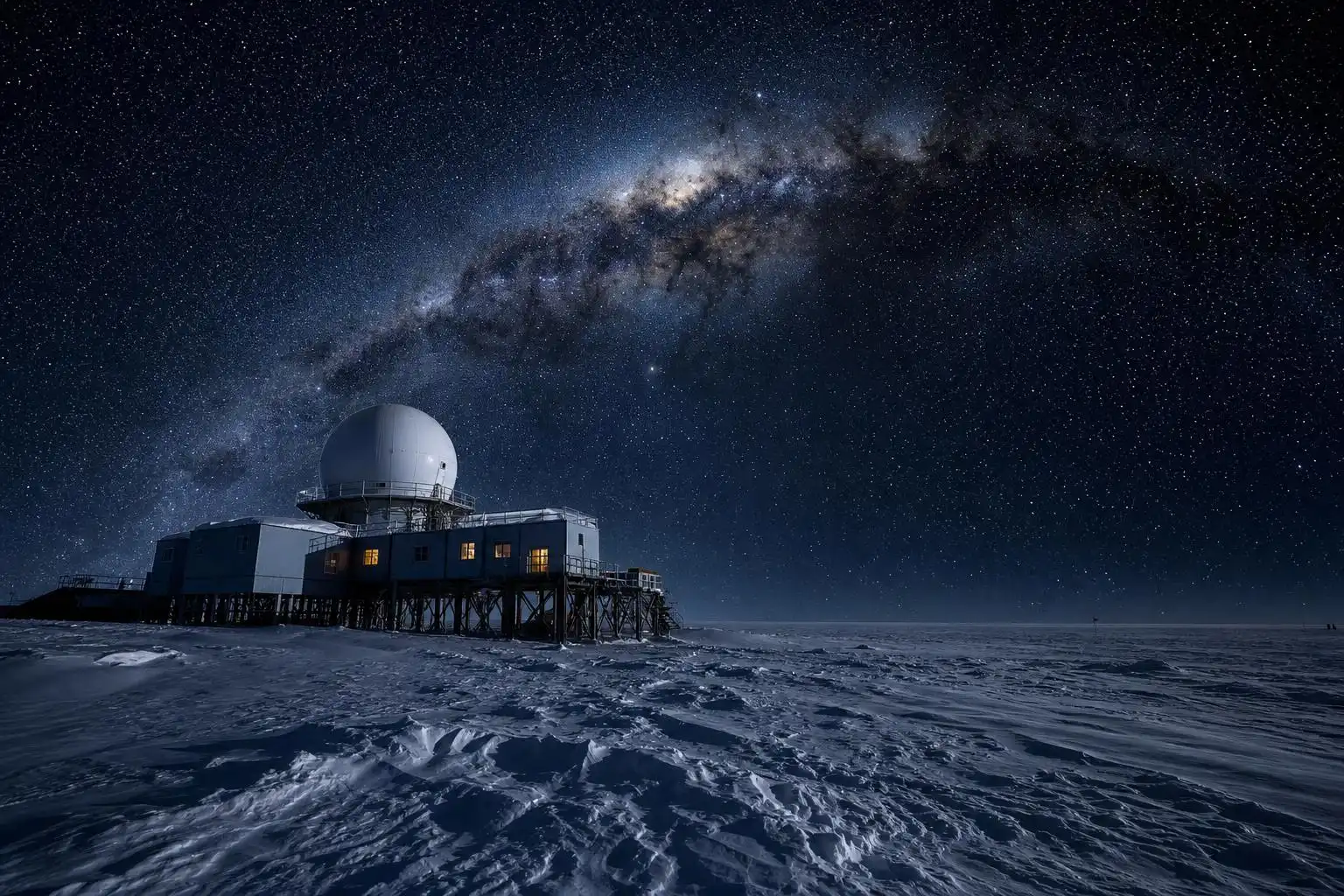
The successor experiment, BICEP/Keck Array, has continued accumulating data from the South Pole for over a decade, and its combined analysis with Planck data placed the tensor-to-scalar ratio constraint at r < 0.036 at 95% confidence, as reported in the 2021 BICEP/Keck results. That single number has already eliminated some of the most cherished inflationary models. Simple chaotic inflation with a quadratic potential — long a textbook example — is now excluded. So are several other models that predicted r values close to the current limit.
What survives are models predicting smaller values of r, including versions of Starobinsky inflation and Higgs inflation, both of which predict r in the range of a few thousandths, an order of magnitude below the current sensitivity. This is not a comfortable place for a young theory to sit. The absence of a signal doesn’t falsify inflation as a paradigm, but it increasingly disfavors the simplest, most naturally motivated versions of it, pushing viable models toward flatter, more fine-tuned potentials.
The Next Generation of Instruments
Closing that remaining order of magnitude in sensitivity is the explicit goal of the next generation of CMB experiments. The Simons Observatory, now collecting data in Chile’s Atacama Desert, combines large-aperture and small-aperture telescopes across six frequency bands specifically to separate primordial signal from galactic foregrounds. Its design target is a measurement uncertainty of σ(r) ≈ 0.003, which would meaningfully narrow the space around Starobinsky-class models without necessarily confirming or excluding them outright.
Beyond Simons Observatory sits CMB-S4, a proposed successor combining telescopes at the South Pole and in Chile into a unified survey with roughly ten times the mapping speed of current instruments. Its stated goal is either detecting r at the level of 0.001 or ruling out an entire class of inflationary models that predict signals above that threshold. Meanwhile, the Japanese-led LiteBIRD satellite mission, targeted for launch in the early 2030s, would observe the full sky from space, avoiding atmospheric contamination entirely and providing an independent cross-check on any ground-based claim — a lesson learned directly from the BICEP2 episode.
What a Detection Would Actually Mean
It’s worth being precise about what a confirmed B-mode detection would establish, because the popular framing — “seeing gravitational waves from the Big Bang” — undersells how much theoretical weight the measurement carries. A confirmed detection would fix the energy scale of inflation, since the amplitude of tensor fluctuations depends directly on the energy density of the inflationary potential. Current limits already tell us that if inflation happened with an r anywhere close to 0.01, it occurred at energies around 10^16 GeV, comparable to the scale where grand unified theories predict new physics — a tantalizing but unconfirmed connection between cosmology and particle physics that no accelerator on Earth can test directly.
A confirmed non-detection down to r ~ 0.001, by contrast, would not kill inflation, but it would force the field to take seriously alternative or complementary scenarios — models with multiple inflationary fields, scenarios where the inflaton couples to other fields in ways that suppress tensor modes, or even non-inflationary alternatives like bouncing cosmologies that predict little to no primordial gravitational wave signal by construction. The measurement, in other words, is a genuine fork in the road for early-universe physics, not a confirmation exercise.
Sitting With the Uncertainty
There is something clarifying about a field where the two possible outcomes — detection or exclusion — are both scientifically thrilling. A positive signal would hand us direct evidence of quantum gravity’s effects made macroscopic, stretched across the observable universe by inflation itself. A sufficiently tight null result would tell us that the simplest stories about cosmic inflation are wrong, sending theorists back toward stranger, more constrained models, or toward ideas we haven’t yet taken seriously.
For now the honest answer is that we don’t know which future we’re in. The tensor-to-scalar ratio could be 0.02 or 0.0002 or effectively zero, and each of those numbers describes a different infancy for the universe we inhabit. Somewhere in the polarization pattern of the oldest light in the sky, the answer is already written, faint and buried under galactic dust, waiting for an instrument precise enough to read it.


Leave a Reply