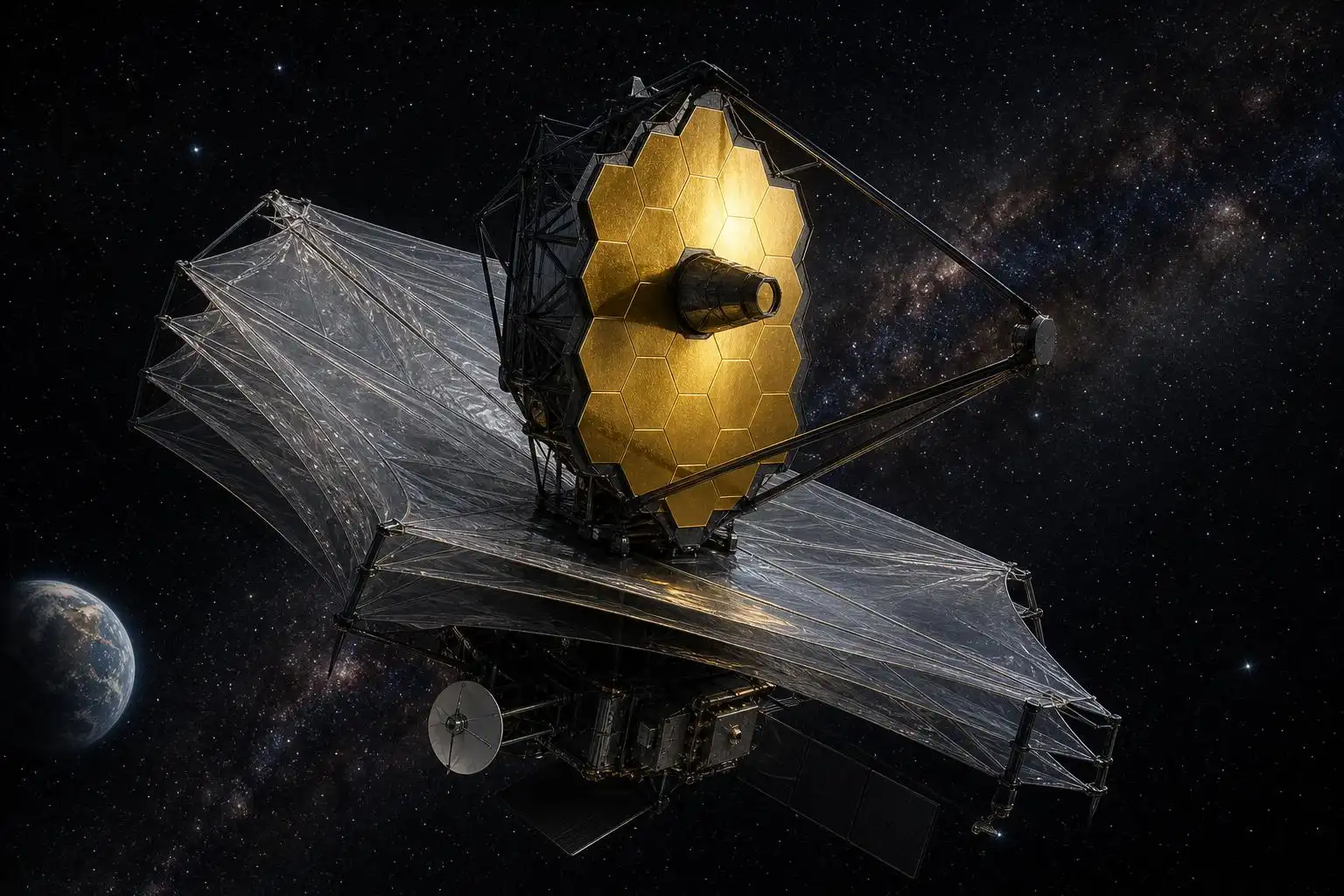

There is a moment in every major space telescope program when the engineering team stops talking about what they want and starts talking about what they can actually build. For the Habitable Worlds Observatory — the mission NASA’s 2020 Decadal Survey handed to the astronomy community as its top large-mission priority — that moment is arriving right now, and the numbers being written on whiteboards are simultaneously thrilling and terrifying.
HWO is the direct descendant of the LUVOIR study, a decade-long community effort that produced two reference architectures: LUVOIR-A, with a 15-meter segmented primary mirror, and the more conservative LUVOIR-B at 8 meters. The Decadal Survey’s endorsement landed somewhere in between — a flagship observatory in the 6-to-8-meter class, optimized for ultraviolet, optical, and near-infrared wavelengths, with a coronagraph capable of suppressing starlight by a factor of roughly ten billion. That last number is not a typo. To image an Earth-twin at the distance of a nearby star, you need to dim the host star by ten orders of magnitude while leaving the planet’s faint reflected light intact. No instrument in the history of spaceflight has come close to that contrast ratio in flight.
Why the Mirror Size Matters So Much
The relationship between aperture and exoplanet yield is not linear — it is brutal. The number of Earth-like planets a coronagraph can characterize scales roughly as the fourth power of the mirror diameter, because you need both the angular resolution to separate planet from star and the raw photon count to take a spectrum in a reasonable integration time. LUVOIR-A’s 15-meter primary would have delivered spectra of perhaps 54 potentially habitable planets; LUVOIR-B’s 8-meter drops that to around 28. A 6-meter mirror — the lower bound of current HWO discussions — might yield a sample of a dozen. That is still a scientifically transformative number. It is also the difference between a robust statistical statement about life in the universe and a handful of tantalizing but ambiguous data points.
The mirror itself presents manufacturing challenges that dwarf anything previously attempted. JWST’s 6.5-meter primary is composed of 18 beryllium hexagonal segments, each polished to a surface error of roughly 20 nanometers RMS and aligned by seven actuators. HWO’s coronagraph will demand wavefront stability at the picometer level — one-thousandth of a nanometer, or roughly one-hundredth the diameter of a hydrogen atom — sustained over hours-long integration times. JWST’s mirror needs to be stable enough to do infrared astronomy; HWO’s mirror needs to be stable enough to not let a single photon of starlight sneak around the coronagraph mask. Those are categorically different engineering problems.
The Coronagraph: A Machine for Suppressing Starlight
The coronagraph at HWO’s heart is descended from technology being validated right now on the Roman Space Telescope’s Coronagraph Instrument — a technology demonstration that will be the first high-contrast coronagraph ever flown in space. Roman’s coronagraph targets a contrast of roughly 10⁻⁸ (one part in a hundred million) in a narrow-angle field, which is impressive but still two orders of magnitude short of what HWO needs. The gap between Roman’s demonstration and HWO’s science requirement is where most of the mission’s technical risk currently lives.
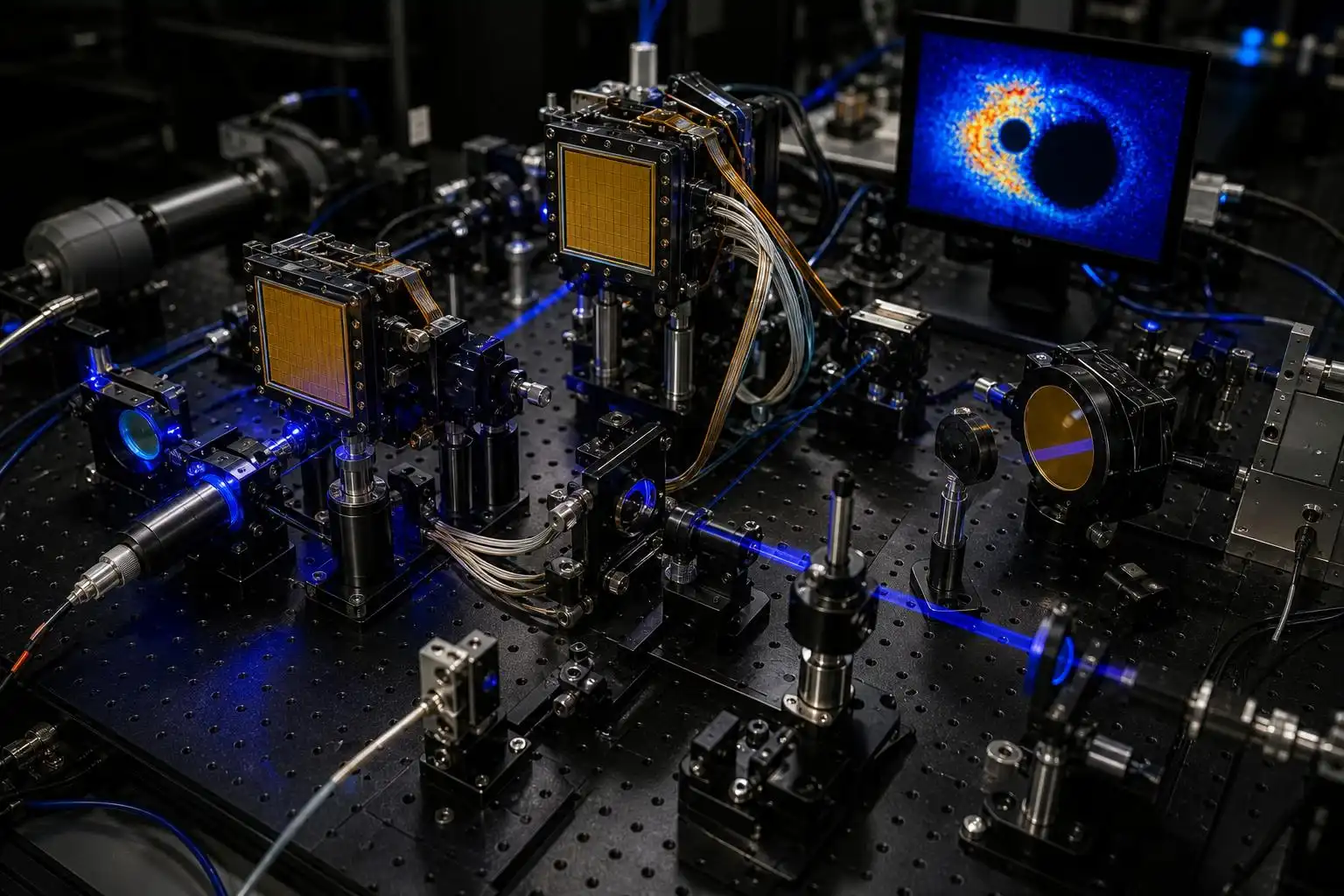
The baseline HWO coronagraph architecture involves a deformable mirror with thousands of actuators — current designs reference mirrors with 64×64 or larger actuator arrays — that continuously reshape the wavefront to cancel diffracted starlight in a “dark hole” region of the focal plane. The physics is elegant: you are using destructive interference to extinguish light. The engineering is nightmarish: every actuator must be commanded with sub-nanometer precision, the mirror itself must not drift thermally between commands, and the entire optical train must be isolated from vibrations at the level of picometers per second. On the ground, lab coronagraphs at JPL’s High Contrast Imaging Testbed have demonstrated contrasts approaching 10⁻¹⁰ in a controlled environment. Getting that performance into space — with launch loads, thermal cycling, and the absence of any servicing — is the central engineering challenge of the next two decades of astronomy.
The Orbit Question: L2 Versus High Earth Orbit
Like JWST, HWO will almost certainly operate at the Sun-Earth L2 point, roughly 1.5 million kilometers from Earth. L2 offers a thermally stable environment and a clear view of the sky, but it also means no servicing missions. This is a point of genuine tension in the HWO community. LUVOIR’s original design explicitly assumed serviceable optics — the ability to swap out the coronagraph, upgrade detectors, or replace a failed component. Hubble’s five servicing missions transformed a flawed observatory into a scientific institution; the STIS spectrograph failure in 2004 was repaired by hand in orbit, extending the instrument’s life by years. At L2, none of that is possible with current technology.
Some advocates are pushing for a high Earth orbit, between roughly 10,000 and 40,000 kilometers, where servicing by crewed Orion missions or commercial vehicles would be geometrically feasible. The cost premium is real but not prohibitive; the thermal environment is less benign; and the radiation environment — passing through the Van Allen belts repeatedly — imposes its own detector shielding penalties. The debate is unresolved, and it will likely remain so until NASA commits to a formal Phase A study, which the Decadal Survey recommended beginning no later than 2029.
Wavelength Coverage and the Biosignature Problem
HWO’s science case rests on a specific set of spectral features. Oxygen, at 760 nanometers (the A-band), is the canonical biosignature — a molecule that should not persist in a planetary atmosphere without continuous biological replenishment. Water vapor absorbs at 940 nanometers and 1.14 microns. Ozone, a photochemical product of oxygen, has a broad feature centered at 9.6 microns in the thermal infrared, but HWO is primarily an optical/UV/near-IR instrument and will not cover that band. Carbon dioxide appears at 1.05 and 1.21 microns. Methane, intriguing because its simultaneous presence with oxygen is a strong abiotic disequilibrium signal, absorbs at 890 nanometers and 1.0 micron.
The UV capability — covering roughly 100 to 300 nanometers — is not just a bonus. It is essential for characterizing the host star’s UV flux, which drives photochemistry in the planet’s atmosphere and determines whether oxygen detections are biogenic or the result of abiotic water photolysis. Hubble’s STIS and COS instruments cover this band, and there is currently no planned successor. HWO would fill that gap for an entire generation of astronomers, making it a general-purpose UV/optical/NIR observatory with the coronagraph as its crown jewel.
Cost, Schedule, and the Budget Reality
The Decadal Survey estimated HWO’s cost at roughly $11 billion in 2020 dollars, with a launch no earlier than the late 2030s. That number has already begun to drift. JWST’s final cost was approximately $10 billion — more than double its original estimate — and the astronomy community is acutely aware that another cost overrun of that magnitude could crowd out an entire generation of smaller missions. The Decadal Survey built in explicit cost guardrails: if HWO’s projected cost exceeds 150% of its original estimate during formulation, the community is supposed to descope or restructure rather than let it consume the entire NASA astrophysics budget.
The technology maturation program — funded at roughly $1.6 billion over the coming decade to develop the coronagraph, the ultra-stable mirror, and the starshade technology that might serve as a backup suppression method — is the critical path item. A starshade is a separate free-flying spacecraft, shaped like a giant sunflower, that physically blocks the host star’s light before it enters the telescope. It requires formation flying at separations of tens of thousands of kilometers with meter-level precision, which is its own engineering odyssey. Whether HWO flies with an internal coronagraph, an external starshade, or both in sequence is a trade study that will define the mission’s architecture for decades.
What Success Looks Like
Imagine the data product: a spectrum of a pale blue dot, taken over perhaps 100 hours of integration time, showing the oxygen A-band in absorption, a water vapor feature, and a Rayleigh scattering slope that tells you the atmosphere is predominantly nitrogen and oxygen. That spectrum would be, without exaggeration, the most important scientific measurement in human history. It would not prove life — abiotic chemistry can mimic some biosignatures — but combined with the context of the host star, the planet’s orbital parameters, and the absence of obvious false-positive mechanisms, it would be a result that the scientific community would spend the following century trying to refute or confirm.
The engineering team building HWO knows this. They are working backward from that spectrum, from those ten billion to one contrast ratios and those picometer stability requirements, trying to find a path through the maze of thermal control, vibration isolation, actuator precision, and detector noise that ends with photons from another world landing on a detector and telling us something true. It is the most demanding optical engineering problem ever posed to a space telescope program. It is also, arguably, the most important one.
Kepler showed us that planets are everywhere. TESS refined the target list. Roman will validate the coronagraph technology. HWO will go to the addresses Kepler gave us and knock on the doors. Whether anyone answers is a question the universe has been keeping to itself for four billion years.



Leave a Reply