

A launch toward a small, consequential world
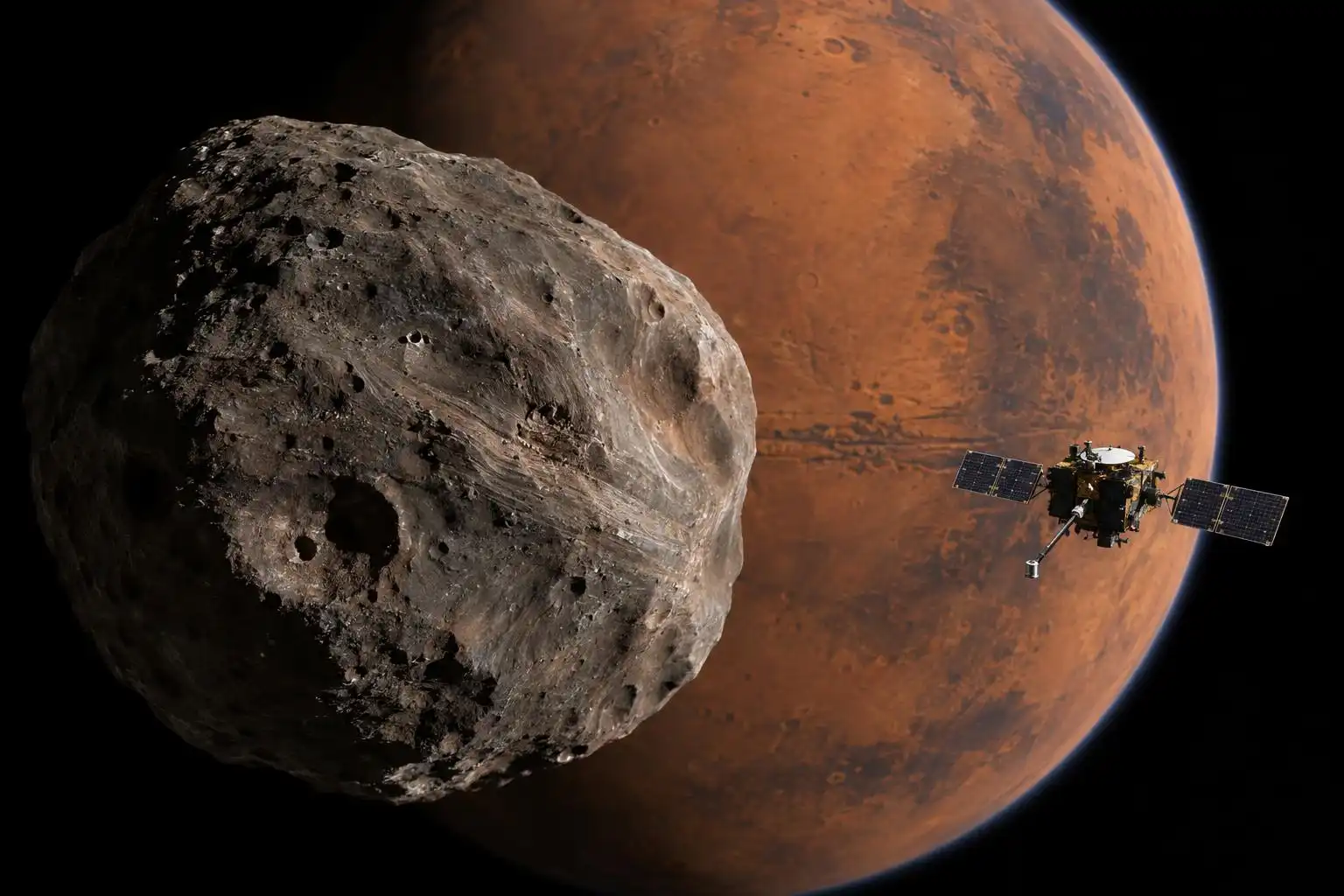
On October 20, before dawn in Japan, an H3 rocket lifted the Martian Moons eXploration spacecraft—MMX—from Tanegashima Space Center. About 71 minutes later, the spacecraft separated from the rocket’s upper stage. Its destination is Phobos, a moon so small that a brisk run would cover a noticeable fraction of its circumference, yet large enough to preserve evidence about the early history of Mars. JAXA aims to bring some of that evidence home.[1]
This is not a dash straight to the surface. MMX must travel to Mars, enter the Martian system, survey both Phobos and its smaller companion Deimos, select a safe sampling site, collect material, and send a return capsule toward Earth. The mission’s central question sounds simple: Did Mars’s moons form from debris thrown up by an ancient impact, or are they captured asteroids? Remote observations have kept both possibilities alive. A few grains examined in laboratories may finally change that.[2]
Phobos: a moon that races across the sky
Phobos is roughly 22 kilometres across on average, irregular rather than round, and marked by Stickney, an impact crater about nine kilometres wide. From its surface, Mars would dominate the view: a huge, rust-coloured disc hanging above a dark, dusty landscape. Phobos circles only about 6,000 kilometres above the planet’s surface and completes an orbit in roughly seven hours and 39 minutes—faster than Mars rotates. To an observer on Mars, it rises in the west and sets in the east.
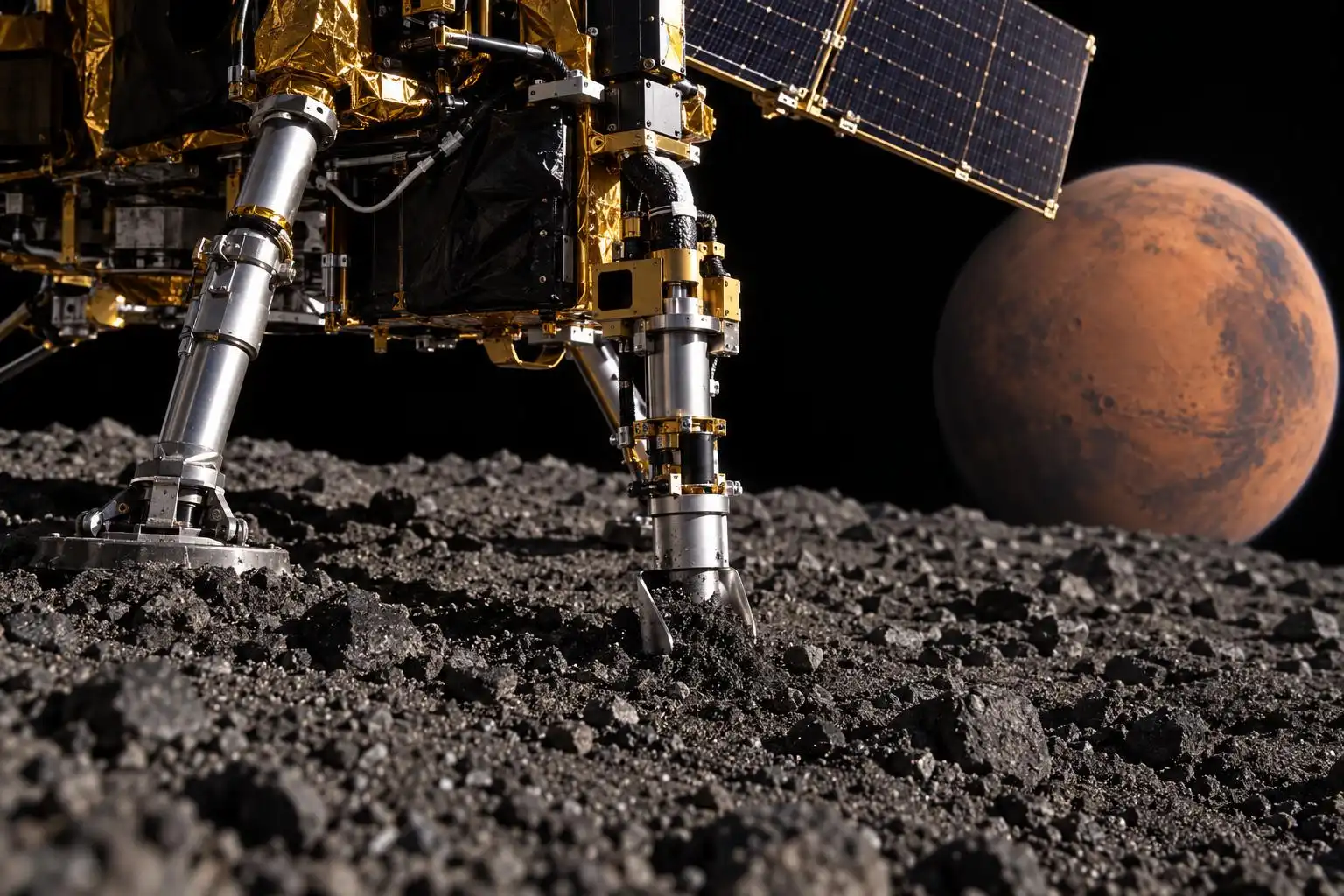
That proximity makes Phobos scientifically tempting and operationally awkward. Mars’s gravity pulls strongly on the spacecraft, while Phobos’s own gravity barely holds loose material down. A landing is therefore less like setting down a lunar lander than making carefully controlled contact with a drifting pile of rubble. The depth and texture of the surface matter: a sampling tool that works in fine dust may behave differently against a crust or a field of blocks.
Spacecraft have looked before. Mariner 9 photographed the moons in the 1970s; later Mars missions, including Mars Express, provided closer views and measurements. They revealed Phobos’s grooves, craters, and dark surface, but a photograph cannot establish the history of an individual grain. MMX is designed to connect the large-scale landscape seen from orbit with the material that makes it.
Two origin stories, neither without problems
Phobos and Deimos look, in broad terms, like dark asteroids. That resemblance invites a capture scenario: small bodies formed elsewhere in the solar system, wandered inward, and became Mars’s moons. But their nearly circular orbits lie close to Mars’s equatorial plane. Capturing an object is difficult enough; settling two captured objects into such orderly paths demands an effective way to remove orbital energy.
An alternative begins with a violent impact into early Mars. Debris thrown into orbit could gather into moons, naturally favouring orbits near the planet’s equator. The difficulty here is compositional. If Phobos formed largely from Martian and impactor material, why does its dark surface sometimes look so unlike the brighter, familiar minerals seen across much of Mars? Space weathering and mixing might disguise its ancestry, but those explanations need tests.
A returned sample can provide them. Researchers can examine minerals, elemental abundances, and isotopic ratios grain by grain, then compare them with Martian meteorites and asteroid samples. A strong resemblance to primitive asteroid material would support capture; evidence for substantial Martian material could favour an impact origin. Neither outcome is guaranteed to be perfectly tidy: Phobos’s surface may contain material from several sources, including debris blasted off Mars by later impacts. That possibility is another reason to study individual grains rather than treat the entire sample as one uniform rock.[8]
The instruments that put the sample in context
Before MMX touches Phobos, its cameras will have to turn an unfamiliar surface into a map for both geology and navigation. TENGOO is a telescopic camera for close, detailed views of rocks, craters, and potential landing hazards. OROCHI observes in multiple visible-light bands, helping researchers trace differences across the surface. Together, they can show whether a chosen sampling spot resembles the rest of Phobos—or sits in an unusual patch that would complicate the sample’s interpretation.
MIRS, the mission’s near-infrared spectrometer, tackles composition differently. Sunlight reflected from the ground carries telltale dips at wavelengths absorbed by particular minerals and other materials. Mapping those spectral signatures across Phobos and Deimos helps identify promising sites and tests whether the moons’ dark surfaces actually share a composition. Similar colours alone would be a weak argument for a shared origin; matching or contrasting spectra offer a sharper comparison.
MEGANE looks below the optical surface. Energetic particles striking Phobos generate neutrons and gamma rays whose energies reflect the elements in the uppermost ground. By measuring them, MEGANE can estimate bulk elemental composition over broader areas than a tiny returned scoop could represent. Its name means “eyeglasses” in Japanese, and the analogy fits: it provides a different way of seeing the moon, one less dependent on how sunlight happens to illuminate the dust.
A laser altimeter will measure distance to the surface by timing reflected laser pulses. Repeated measurements build topographic profiles and help MMX maintain its position during close operations. This combination matters because a laboratory result without a location is an incomplete story. If a grain turns out to be Martian ejecta, investigators will want to know whether it came from an unusual deposit, a crater rim, or apparently ordinary Phobos soil.
Touching down without trusting appearances
MMX carries two complementary ways to collect Phobos material. JAXA’s C-Sampler is intended to reach a few inches beneath the surface, while NASA’s P-Sampler, mounted on a landing leg, uses bursts of high-pressure nitrogen gas to gather material at ground level. Sampling at different depths could reveal whether the exposed surface has been altered by radiation and micrometeorite impacts while slightly deeper grains retain a clearer record. The tools also offer different chances of collecting material if the ground proves unexpectedly coarse or cohesive.[2]
A small rover, IDEFIX, is planned to explore the surface before the main spacecraft’s sampling attempt. Its cameras can inspect the ground at wheel level, where apparently smooth terrain may resolve into pebbles, cavities, or powder. Its RAX Raman spectrometer uses laser light scattered by minerals to look for their molecular fingerprints; the miniRAD radiometer measures heat emission to probe surface temperature and texture. Those measurements can help connect orbital maps with what a spacecraft actually encounters on the ground.
The mission will also observe Deimos rather than treating it as a background object. Deimos is about 12 kilometres across and takes roughly 30 hours to orbit Mars. If its surface composition and terrain differ substantially from Phobos’s, that difference may challenge a simple story in which both moons came from the same event. If they look alike, scientists will still need to ask whether common appearances reflect common origins or later processes that altered both surfaces.
What an Earth laboratory can do that an orbiter cannot
A spacecraft instrument must make its measurements within severe limits on mass, power, and time. On Earth, researchers can place a single grain under successive microscopes, measure its isotopes with specialised instruments, and preserve the rest for techniques not yet invented. NASA expects to curate about 15% of the returned material at its Johnson Space Center astromaterials laboratory, alongside JAXA’s broader sample effort. That division gives future researchers more than one route to the collection.[2]
There may be an especially intriguing bonus. Impacts on Mars can throw fragments beyond the planet; some may eventually land on nearby Phobos. Researchers have raised the possibility that MMX could return tiny grains of Mars mixed into its sample. Such grains would not make this a substitute for carefully selected rocks collected on Mars by a rover. But, if identified confidently, they could offer additional glimpses of Martian crust from places no lander has visited.[8]
The sample’s value will depend on keeping these histories separate. A primitive grain, a piece of impact melt, and a fragment launched from Mars could sit millimetres apart in Phobos soil. Their different chemistries would not be contradictory noise; together, they could record how the moon formed and what later landed on it. MMX’s orbital measurements, surface observations, and sampling hardware are designed to supply the context needed to read that record.
The question waiting at the end of the journey
Launch was the first decisive milestone, not the answer. MMX is now committed to a long sequence of navigation, mapping, close approaches, sampling, and return. Each stage narrows a different uncertainty: where it can safely touch, what kind of ground it encounters, and whether the grains it retrieves speak for Phobos as a whole.
When the capsule reaches Earth, the first close look may reveal whether Mars’s inner moon is principally a captured visitor or the remnant of a planetary collision. The result may also prove more complicated than either neat label. That is the appeal of Phobos: from Mars it is a quick-moving dark speck, but in a laboratory, a speck of Phobos could hold an unexpectedly long history.
References
- Japan launches historic MMX sample-return mission to Mars’ moon Phobos (video) | Space — https://www.space.com/space-exploration/launches-spacecraft/japan-launches-historic-mmx-sample-return-mission-to-mars-moon-phobos
- NASA to Help Unlock Mysteries of Mars’ Moons in Upcoming Mission – NASA Science — https://science.nasa.gov/directorates/smd/planetary-science-division/nasa-to-help-unlock-mysteries-of-mars-moons-in-upcoming-mission
- Japan’s MMX mission set to grab a piece of Mars’s moon Phobos — https://www.bbc.com/news/articles/cmvgxvkv54w1o


Leave a Reply
You must be logged in to post a comment.