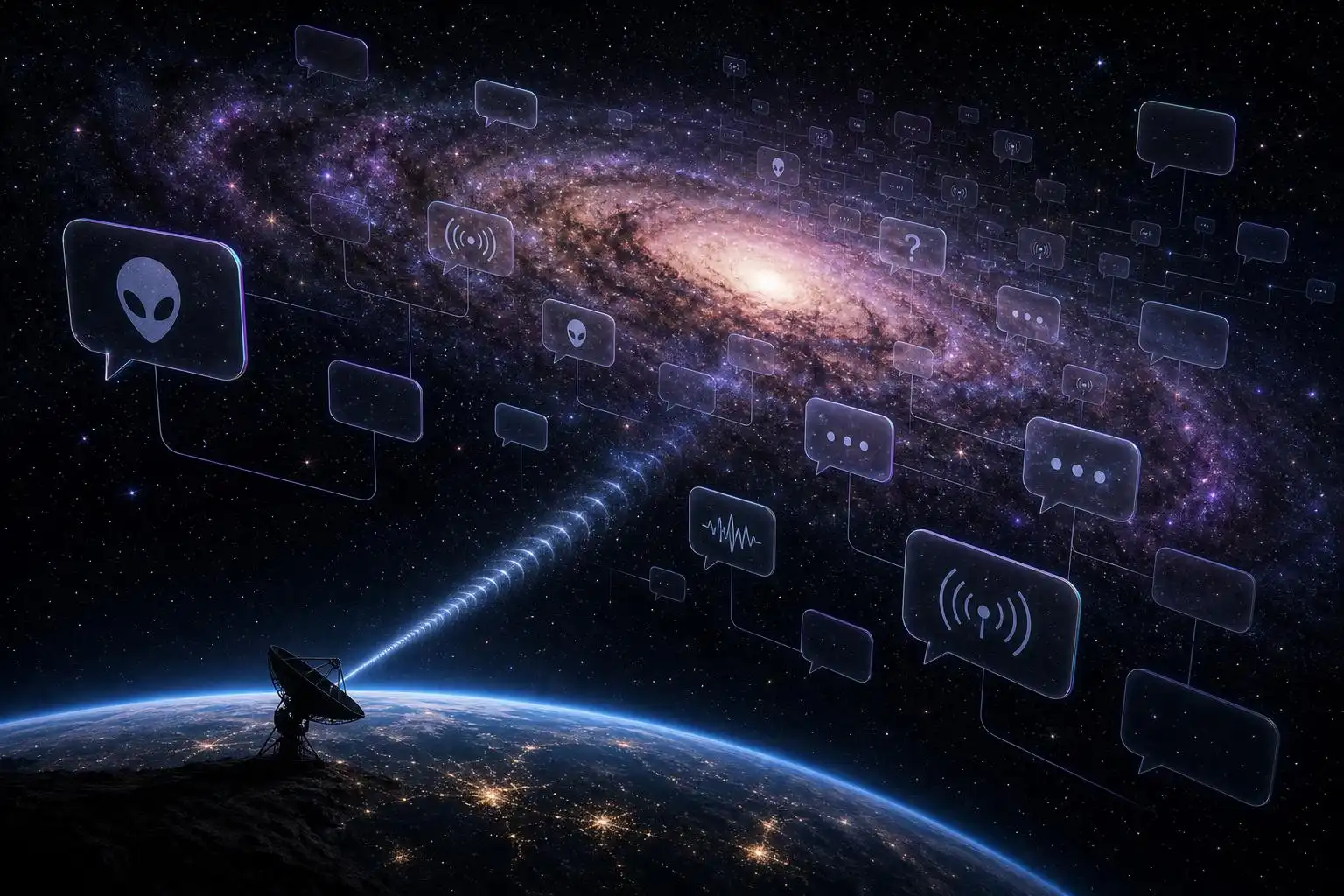

Picture the most unhinged Reddit argument you’ve ever scrolled through at 2 a.m. — hundreds of confident strangers, zero consensus, every reply more unhinged than the last, and somewhere buried in the comments is probably the actual answer. Now scale that up to the size of the observable universe, swap the strangers for entire civilizations, and make the stakes “the fate of all intelligent life.” Congratulations. You’ve just stumbled into the Fermi Paradox.
“But Wait — Where Is Everybody?”
In the summer of 1950, physicist Enrico Fermi was having lunch at Los Alamos National Laboratory with a few colleagues, idly chatting about a New Yorker cartoon depicting aliens stealing New York City’s trash cans. The conversation drifted, as physics conversations do, toward the existence of extraterrestrial life. Fermi did some napkin math — the galaxy is roughly 13 billion years old, stars have been forming planets for most of that time, and even at sublight speeds a civilization could colonize the entire Milky Way in a few tens of millions of years. Then he put down his fork and asked: “But where is everybody?”
That question has haunted science ever since. The universe is 13.8 billion years old. The Milky Way alone contains somewhere between 200 and 400 billion stars. Astronomers now estimate there are more stars in the observable universe than there are grains of sand on every beach on Earth — and we’ve confirmed over 5,700 exoplanets as of 2025, with thousands more candidates waiting in the queue. The math screams that we should not be alone. The radio silence screams back.
The Universe Is Not a Quiet Place — Except When It Comes to Aliens
Here’s what makes this so maddening. Space is loud. We’ve detected gravitational waves from black holes merging a billion light-years away. We’ve picked up fast radio bursts — millisecond flashes of radio energy that briefly outshine entire galaxies — from sources billions of light-years away. We’ve mapped the cosmic microwave background, the literal afterglow of the Big Bang. Our instruments are extraordinary.
And yet, in over 60 years of listening — from Project Ozma in 1960 to the SETI Institute’s modern Allen Telescope Array — we have detected exactly zero confirmed signals from another civilization. One blip, the famous “Wow! signal” of 1977, got researchers briefly electric with hope before it was never repeated and never explained. That’s it. One tantalizing anomaly in six decades of cosmic eavesdropping.
So either intelligent life is extraordinarily rare, or something is stopping it from talking, or we are genuinely, cosmically, profoundly alone. Pick your poison.
The Great Filter: The Universe’s Most Terrifying Plot Twist
Economist Robin Hanson introduced the concept of the Great Filter in 1998, and it remains the most unsettling idea in all of science — which is saying something for a field that also contains black holes and heat death.
The argument goes like this: somewhere between “dead chemistry” and “galaxy-spanning civilization,” there is a step — or several steps — that almost nothing gets past. A filter. The question that keeps astrobiologists awake at night is whether that filter is behind us or ahead of us.
If the filter is behind us — say, the jump from simple chemistry to self-replicating RNA, or from prokaryotes to eukaryotes, or from single-celled life to complex multicellular organisms — then we got lucky. We squeezed through. The universe is mostly empty not because civilizations destroy themselves, but because getting to us was almost impossible. That’s uncomfortable but survivable news.
If the filter is ahead of us — if the reason we see no alien civilizations is that every civilization that reaches our technological level eventually wipes itself out — then we are staring down the barrel of our own extinction and calling it a paradox.
This is why the discovery of simple microbial life on Mars would be deeply unsettling to many scientists. It would suggest that the origin of life itself is not the filter — but that would not rule out other later filters, such as the emergence of eukaryotes, multicellularity, or technological intelligence, still lying ahead of us. The silence could still be explained by any one of those later hurdles. The news would sharpen the question without answering it.
The Reddit Thread: Every Proposed Solution, Ranked by Anxiety Level
Let’s run through the main theories, because this is where the 2 a.m. Reddit energy really kicks in.
“They exist but haven’t reached us yet” — The galaxy is big. Even at 1% the speed of light, crossing it takes millions of years. Maybe no one’s had enough time. This is the optimistic reply that gets immediately buried by the next one.
“They exist but aren’t using radio waves” — We’ve been broadcasting radio for about 120 years. That signal has traveled 120 light-years, which is a tiny bubble in a galaxy 100,000 light-years across. Maybe everyone else moved on to quantum communication or something we can’t detect. This is the “you’re looking for them on MySpace” theory.
“The Zoo Hypothesis” — Advanced civilizations know we’re here and have agreed not to contact us, either to let us develop naturally or because we’re too primitive to bother with. This is the Star Trek Prime Directive, and it is simultaneously flattering and insulting.
“They’re here but we don’t recognize them” — What if alien intelligence doesn’t look like a radio signal or a spaceship? What if it looks like a weird repeating pattern in a pulsar, or an anomalous dimming star, or something we’ve already catalogued and filed under “unexplained”? This is the theory that makes you go back and reread every astronomy anomaly paper from the last 50 years.
“The Dark Forest” — Liu Cixin’s The Three-Body Problem trilogy popularized this one: the universe is silent because every civilization that announces itself gets destroyed by a more advanced one. Everyone is hiding. The silence isn’t peace — it’s predation. This is the reply that makes everyone else in the thread go quiet.
“We are genuinely the first” — Someone has to be first. In a universe 13.8 billion years old, the conditions for rocky, Earth-like planets around stable, long-lived stars only became widespread in the last few billion years. We might be early. The party hasn’t started yet. This is the loneliest theory, and also somehow the most hopeful.
What Interstellar Got Right (and What It Ducked)
Christopher Nolan’s Interstellar is one of the few films that takes the Fermi Paradox seriously as a plot device, even if it sidesteps it. The “they” who built the wormhole near Saturn are never explained — they’re future humans, it turns out, which is a clever dodge. But the film’s emotional core is built on the terrifying premise that Earth is dying and humanity might not survive. That’s a Great Filter scenario dressed up as a love story.
Kip Thorne, the Nobel Prize-winning physicist who served as the film’s scientific consultant, made sure Gargantua — the film’s central black hole — was rendered with genuine relativistic accuracy. The accretion disk appears above and below the black hole simultaneously because gravity is bending the light around it. That’s real. But the film’s aliens? Conveniently human-shaped in their motivations, conveniently benevolent, conveniently invested in our survival.
Real contact, if it ever came, would almost certainly be nothing like that. We might not even recognize it as contact.
The Drake Equation Is Just the Universe’s Most Depressing Mad Lib
Frank Drake wrote his famous equation in 1961 to structure the conversation about how many communicating civilizations might exist in the Milky Way right now. It multiplies together a chain of probabilities: the rate of star formation, the fraction of stars with planets, the fraction of those planets that could support life, the fraction where life actually develops, the fraction where intelligence emerges, the fraction that develop detectable technology, and the average lifetime of such a civilization.
Plug in optimistic numbers and you get millions of civilizations. Plug in pessimistic numbers and you get a fraction of one — meaning we might be it. The equation doesn’t solve anything; it just makes the uncertainty precise. It’s the universe’s most depressing Mad Lib, and the blank that matters most is the last one: L, the average lifespan of a technological civilization.
We have exactly one data point for L. We’ve been a radio-transmitting civilization for about 120 years. Whether that becomes 200 years or 200,000 years is entirely up to us.
Why This Isn’t Just a Science Question
The Fermi Paradox isn’t really about aliens. It’s about us. It’s about whether intelligence is a cosmic accident or a cosmic inevitability. It’s about whether the thing that makes us capable of asking the question also makes us capable of answering it — or whether it makes us capable of destroying ourselves before we do.
Every time a new exoplanet is confirmed in a habitable zone — and the James Webb Space Telescope is now probing their atmospheres for biosignatures like oxygen, methane, and water vapor — the paradox gets sharper. We’re not just theorizing anymore. We’re looking. And every year the answer is still silence.
Maybe the silence means we’re rare. Maybe it means we’re early. Maybe it means the filter is ahead of us and the clock is already running.
Or maybe — maybe — the answer is buried somewhere in the data we’ve already collected, waiting for someone to read the right comment in the thread.
The universe posted the question 13.8 billion years ago. We’ve been lurking. It’s time to reply.



Leave a Reply