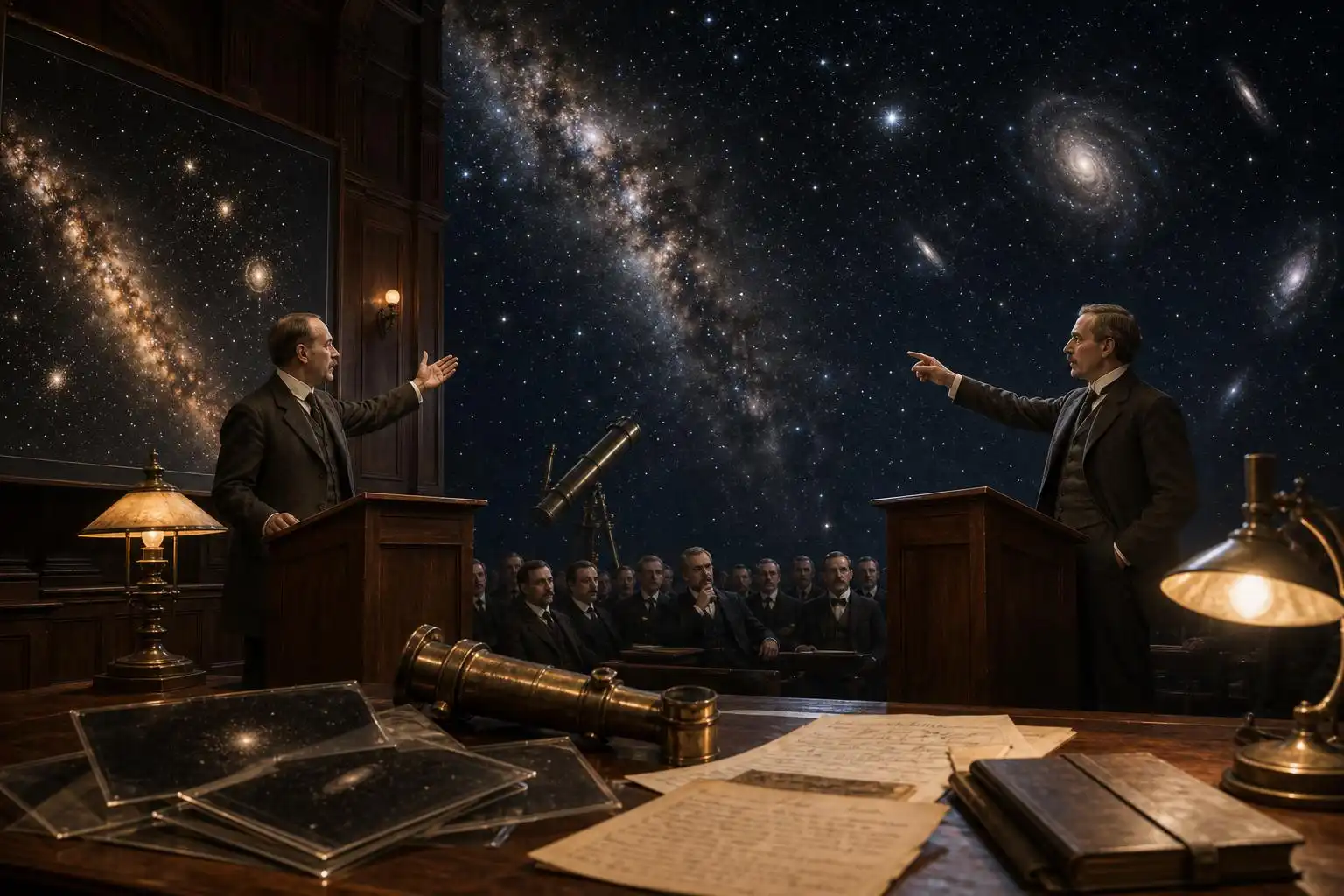

On the morning of April 26, 1920, Harlow Shapley sat in his room at the Cosmos Club in Washington, D.C., rereading a letter he had written weeks earlier to his Princeton colleague Henry Norris Russell. “I have been rather nervous about this affair,” he confessed, the ink barely dry on his anxieties. Outside, the cherry blossoms along the Mall had already peaked and fallen; the city smelled of wet brick and early spring mud. Shapley was thirty-four years old, the rising star of Mount Wilson Observatory, and he was about to walk into the Smithsonian’s U.S. National Museum, where the National Academy of Sciences meeting was being held, to argue, before the assembled cream of American astronomy, that the Milky Way was the whole of the universe — vast, yes, almost incomprehensibly vast, but singular and complete. His opponent, Heber Curtis of the Lick Observatory, would argue the opposite: that the spiral nebulae scattered across the sky were island universes unto themselves, galaxies as large as our own, lying in a cosmos that dwarfed anything Shapley had mapped.
History would remember this as the Shapley–Curtis Debate, or sometimes, with the grandiosity that the subject deserves, the Great Debate. But the participants themselves called it something more modest — a “discussion,” an exchange of views between two careful men. What it actually was, as the documentary record makes plain, was one of the most consequential arguments in the history of science, and one in which the man who turned out to be mostly wrong was, in crucial respects, the better scientist on the day.
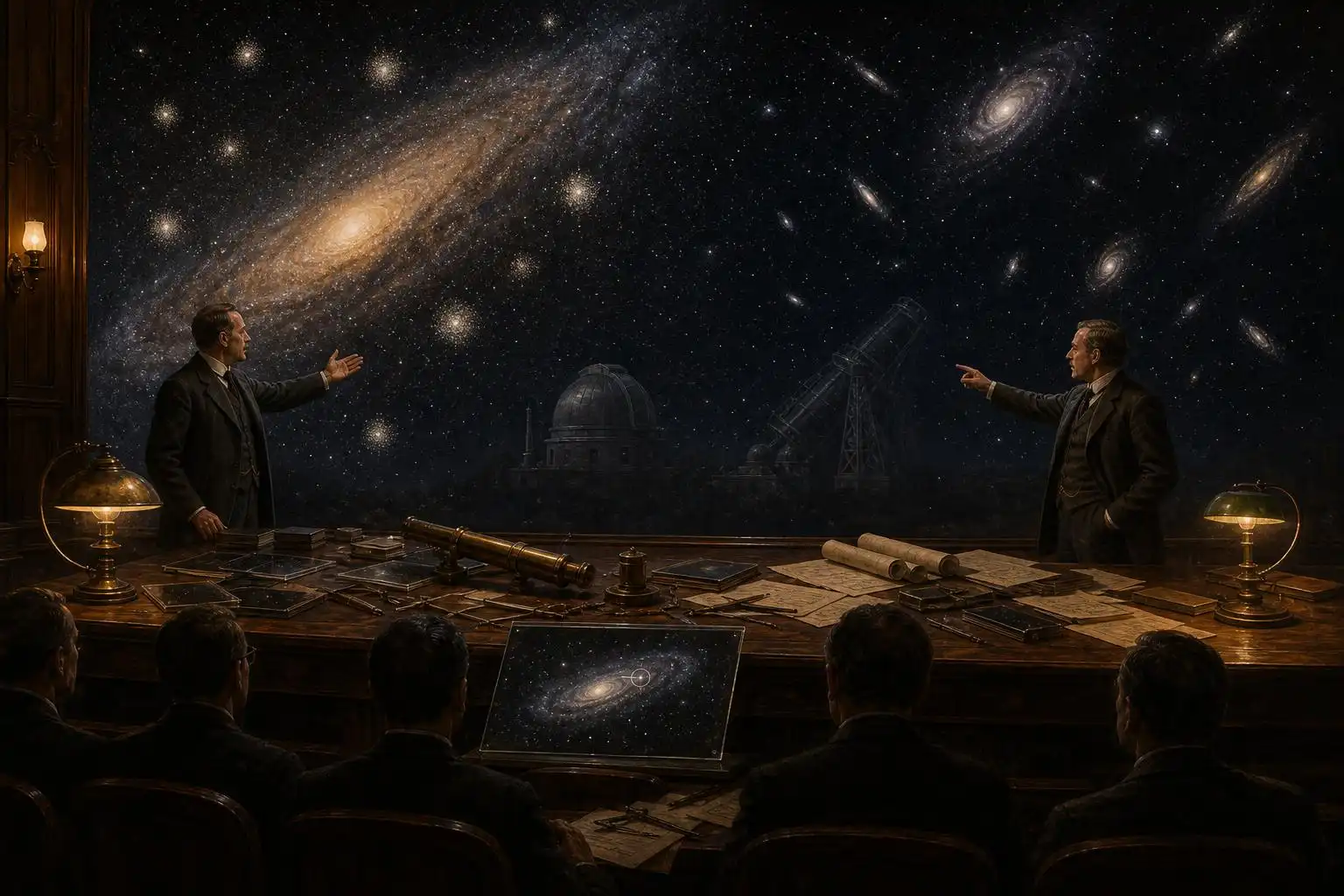
To understand what was at stake in that lecture hall, you have to go back to the instruments that made the argument possible in the first place. Shapley’s great weapon was variable stars — Cepheids, and the Cepheid-like “cluster variables” in globular clusters now understood mainly as RR Lyrae stars. Cepheids are those rhythmically pulsing giants whose period of brightening and dimming is directly tied to their intrinsic luminosity. Henrietta Leavitt had established that relationship in 1912, working from glass photographic plates at the Harvard College Observatory, measuring the periods of twenty-five Cepheids in the Small Magellanic Cloud with a hand-held magnifying loupe and a patience that bordered on the monastic. Her period-luminosity law was a cosmic ruler: if you knew how long a Cepheid took to pulse, you knew how bright it truly was, and from there you could calculate how far away it must be to appear as dim as it did in the sky.
Shapley had taken Leavitt’s ruler, along with related variable-star calibrations, and used it aggressively. Working at Mount Wilson with the 60-inch reflector on the slopes above Pasadena — a powerful instrument that had been the largest operational telescope in the world until the 100-inch Hooker telescope entered service — he had measured the distances to dozens of globular clusters, those dense spherical swarms of ancient stars that hang above and below the plane of the Milky Way like bees around a hive. His results, published in a series of papers between 1917 and 1919, were staggering. The globular clusters were not clustered symmetrically around the Sun; they were centered on a point far away in the direction of Sagittarius. Shapley concluded that this distant point was the true center of the Milky Way, and that the Sun was a provincial body far out in the galactic suburbs. The Milky Way, by his reckoning, was roughly 300,000 light-years across — ten times larger than anyone had previously supposed.
It was a genuinely revolutionary result, and it was largely correct. The Sun is indeed far from the galactic center. The globular clusters do trace the shape of the Galaxy. Shapley’s Milky Way was too big — the modern figure is closer to 100,000 light-years — but the architecture he described was real. He had dethroned the Sun from the center of the Galaxy just as Copernicus had dethroned the Earth from the center of the solar system, and he knew it. In a letter to Russell dated January 1918, he wrote with barely suppressed excitement: “I have been rather inclined to think that we are not in the center of things — and now it looks as though we are pretty definitely not.”
Curtis was a different kind of man — methodical, skeptical, with a dry wit that occasionally sharpened into something close to contempt. He had spent years at Lick photographing spiral nebulae with the Crossley reflector, a 36-inch instrument whose open-truss tube rattled alarmingly in the wind off the Santa Cruz Mountains but which produced photographs of extraordinary quality when the seeing cooperated. What Curtis saw in those photographs convinced him that the spirals were not gas clouds inside the Milky Way but separate stellar systems at enormous distances. Several lines of evidence pointed this way. The spirals showed novae — stellar explosions — at rates comparable to the novae seen in our own Galaxy, which implied they contained comparable numbers of stars. The dark lanes visible edge-on in some spirals resembled the obscuring dust lane that ran along the plane of the Milky Way. And the spectra of the spirals, measured by Vesto Slipher at the Lowell Observatory in Flagstaff between 1912 and 1917, showed Doppler shifts of a magnitude that implied velocities of hundreds of kilometers per second — far too fast for objects gravitationally bound to our Galaxy.
Curtis’s island-universe hypothesis was not new; it descended in a direct line from Immanuel Kant’s 1755 Universal Natural History and Theory of the Heavens, in which Kant had proposed, on purely philosophical grounds, that the nebulae were “island universes” analogous to the Milky Way. But Curtis was not philosophizing. He was arguing from plates and spectra, from the Crossley’s photographs and Slipher’s logbooks at Lowell. The evidence, he believed, was overwhelming.
The problem was that the two men’s conclusions were mutually exclusive in one key respect. If Shapley’s Milky Way was 300,000 light-years across, then the spiral nebulae — which showed no measurable parallax and whose Cepheids, if they contained any, were invisible to existing telescopes — would have to be millions of light-years away to be comparable in size. That was a distance so vast that it strained credulity. But if Curtis was right and the spirals were island universes, then Shapley’s Milky Way had to be much smaller than he claimed, or the spirals would be implausibly tiny by comparison.
The debate itself, when it came, was less a clash of titans than a polite academic disagreement conducted in a lecture hall that smelled of old wood and pipe tobacco. Each man read a prepared paper. Shapley, conscious that his audience included older, more conservative astronomers, pitched his remarks at a general level, avoiding the most technical details of his distance measurements. He was, by several accounts, nervous — more nervous than the occasion seemed to require. Curtis was cooler, more forensic, working through the evidence point by point with the satisfaction of a man who believes the facts are on his side.
Both men made errors. Shapley’s most damaging mistake involved a young Dutch astronomer named Adriaan van Maanen, who had claimed to measure the rotation of the spiral nebula M101 directly from photographs taken years apart. If van Maanen was right — if the spirals were visibly rotating on a human timescale — then they had to be close, because at the distances Curtis proposed, the rotation would be physically impossible (the outer arms would have to move faster than light). Shapley trusted van Maanen, in part because van Maanen was his friend and colleague at Mount Wilson, and leaned on the rotation measurements as a trump card. The measurements were wrong. Van Maanen’s errors, almost certainly unconscious, were the kind that creep in when a careful observer knows what result he expects to find. It would take years, and Edwin Hubble’s intervention, to expose them.
Curtis, for his part, was forced to argue that Shapley’s Milky Way was far too large, and in doing so he underestimated the Galaxy’s true dimensions. He also had no good explanation for why the spirals appeared to avoid the plane of the Milky Way — a phenomenon called the “zone of avoidance” — which he attributed, correctly as it turned out, to obscuring dust, but which he could not prove at the time.
The verdict of history came not in 1920 but in 1923, when Edwin Hubble, working with the new 100-inch Hooker telescope at Mount Wilson — its primary mirror ground from a disk of French plate glass, its mounting so massive that the dome floor had to be raised and lowered by a hydraulic platform to allow observers to reach the eyepiece — finally resolved individual stars in the Andromeda Nebula. Among them, on a plate designated H335H and dated October 5–6, 1923, Hubble identified a Cepheid variable. He calculated its period, applied Leavitt’s law, and arrived at a distance of roughly 900,000 light-years — far beyond the boundaries of even Shapley’s enlarged Milky Way. (The modern figure is about 2.5 million light-years; Hubble’s Cepheid scale was off by a factor that would not be corrected until the 1950s, but the qualitative conclusion was unambiguous.) Hubble wrote to Shapley with the result. Shapley, according to the story — perhaps apocryphal, but too good to omit — read the letter and said to a colleague: “Here is the letter that has destroyed my universe.”
What is remarkable about that phrase, if Shapley said it, is its honesty. He had not been a fool. He had built the best possible argument from the best possible data available to him, and he had been undone by an instrument — the 100-inch Hooker — that could do something his 60-inch simply could not. He had also been undone by his trust in van Maanen, a trust that was not irrational given what he knew. Science is not a machine for producing correct answers on demand; it is a human enterprise in which the quality of the evidence available at any given moment sets a ceiling on the quality of the conclusions that can be reached.
Curtis, who had been right about the island universes, had been wrong about the size of the Milky Way and wrong to dismiss Shapley’s globular-cluster distances as quickly as he did. The debate’s “winner,” in retrospect, is a composite figure assembled from both men’s contributions — which is to say, the winner was the argument itself, the process of public contestation and evidence-marshaling that forced both positions to be stated precisely enough to be tested.
There is a letter Shapley wrote to Russell in the weeks after the debate, in which he sounds less like a defeated man than like someone recalibrating. “I am not at all sure,” he wrote, “that the last word has been said.” It had not. Shapley would go on to become the director of the Harvard College Observatory, where he would employ a new generation of “computers” — women working on glass plates, as Leavitt had worked — and would make important contributions to the study of galaxies and the large-scale structure of the universe. Curtis would become director of the Allegheny Observatory in Pittsburgh, where the skies were increasingly ruined by steel-mill smoke, and would spend his later years fighting for dark skies with the same methodical stubbornness he had brought to the Crossley photographs.
What the Great Debate reveals, finally, is something that the textbook version of scientific progress tends to obscure: that the losers are not always wrong, and the winners are not always right, and that the most important thing is not who prevails on a given afternoon in April but whether the question has been asked precisely enough to be answered. Shapley asked the right question about the Galaxy’s structure and got the scale wrong. Curtis asked the right question about the nebulae and got the Galaxy’s size wrong. Between them, they triangulated a truth that neither could see whole — which is, in the end, how science has always worked, not as a procession of solitary geniuses but as an argument conducted across years, across continents, across the scratched surfaces of glass plates and the faded ink of letters that still survive in the archives at Harvard and Lick and Mount Wilson, waiting for someone to read them again.


Leave a Reply