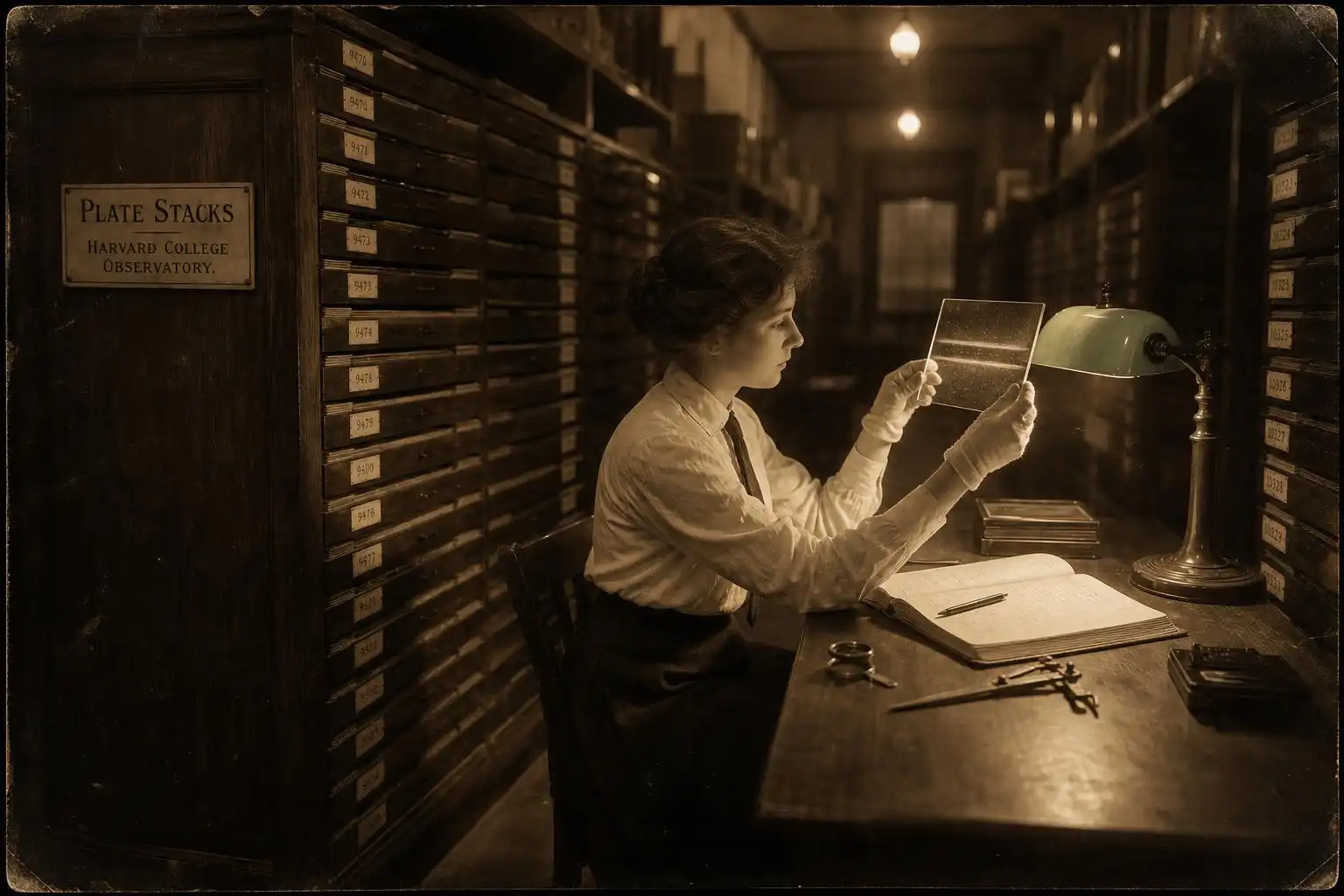

Cambridge, Massachusetts. November 1924. A young woman sat alone in the brick-and-glass warren of the Harvard College Observatory, surrounded by stacks of glass photographic plates and the faint chemical smell of the darkroom down the hall. Her name was Cecilia Helena Payne, she was twenty-four years old, and she was doing something that no astronomer had yet managed to do rigorously: she was reading the chemical fingerprints of the stars.
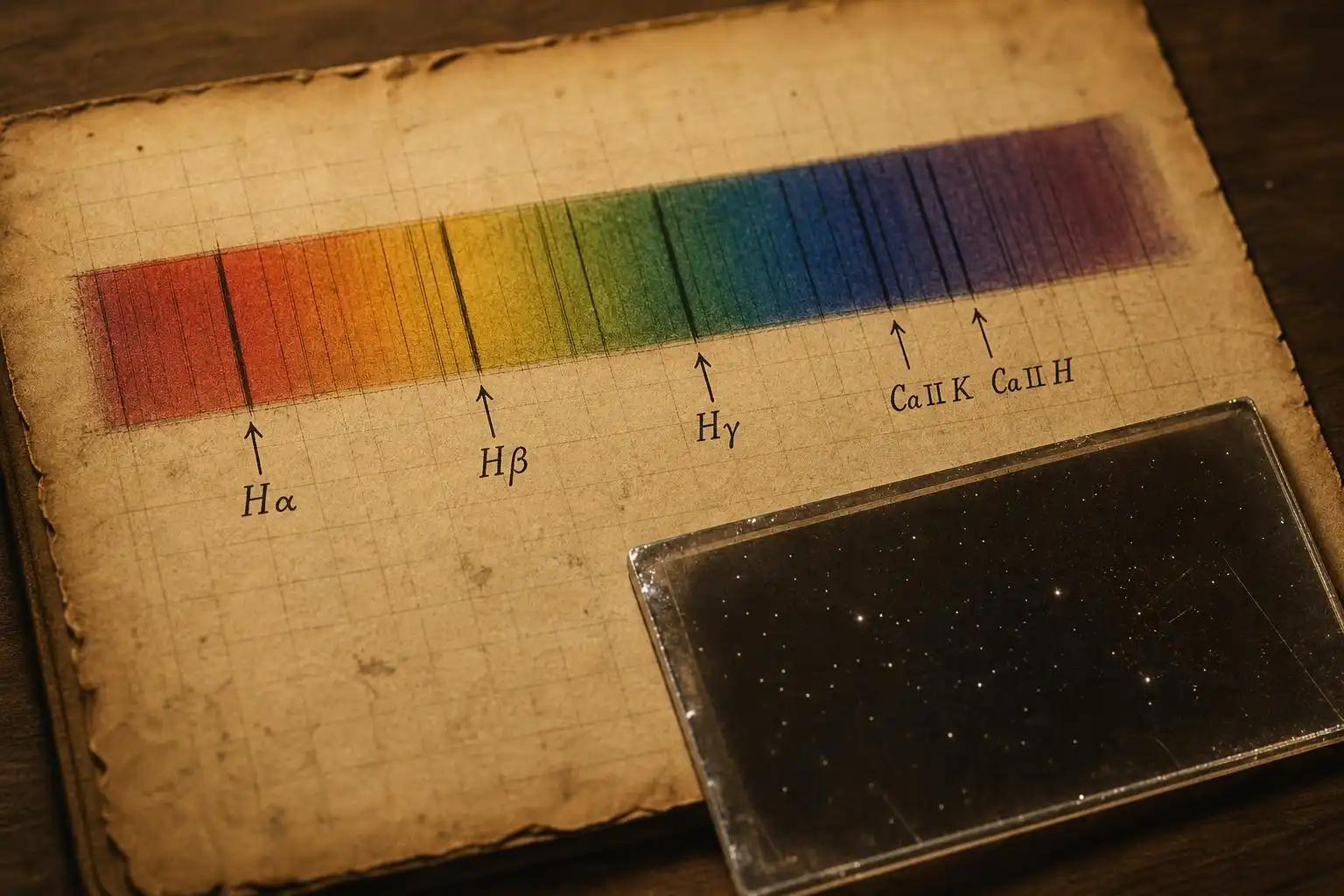
The plates before her were the legacy of decades of patient labor — spectra of hundreds of stars, each one a smear of rainbow light interrupted by dark absorption lines, each line a signature of a specific atom in the stellar atmosphere. The Harvard “computers,” women hired at twenty-five cents an hour to measure and classify these spectra, had catalogued them faithfully. Annie Jump Cannon had sorted nearly 400,000 stellar spectra into the OBAFGKM sequence that astronomers still use today. But nobody had yet asked the deeper question: why did the sequence run in that particular order? What physical reality lay beneath the letters?
Payne intended to find out. And what she found would overturn, quietly and irrevocably, everything astronomers thought they knew about what stars were made of.
She had arrived in Cambridge from England only two years earlier, in 1923, having attended a lecture by Arthur Eddington at Cambridge University that left her trembling with excitement. Eddington had just returned from the 1919 solar eclipse expedition to Príncipe Island, where photographs of stars near the sun’s limb had confirmed Einstein’s prediction of light deflection — a result Eddington announced with the theatrical flair of a man who knew he was rewriting physics. Payne, then a botany student at Newnham College, switched immediately to physics and astronomy. But Cambridge offered women no degrees. She wrote to Harlow Shapley, the newly appointed director of Harvard Observatory, and he offered her a fellowship. She sailed west.
The Harvard Observatory she entered was a peculiar institution — part factory, part salon, part archive. Shapley, still stinging from his humbling in the Great Debate of April 1920 (where Heber Curtis had argued persuasively that the spiral nebulae lay far beyond the Milky Way), was rebuilding the observatory’s intellectual ambitions. He welcomed Payne not merely as a computer but as a research student, the first person to pursue a doctoral degree through what would become Radcliffe College’s astronomy program. Her desk was in the plate stacks. Her laboratory was the accumulated light of a hundred thousand stars.
The tool Payne wielded was the Saha ionization equation, published in 1920 by the Indian physicist Meghnad Saha. Saha had shown mathematically how temperature determined which ionization states of each element would be present in a stellar atmosphere — and therefore which spectral lines would appear. At low temperatures, atoms hold onto their electrons and produce one set of lines; at high temperatures, electrons are stripped away and the lines shift or vanish entirely. The equation was elegant, but nobody had yet applied it systematically to the entire zoo of stellar spectral types.
Payne did exactly that. Working from the Harvard plate collection — particularly the Henry Draper Catalogue spectra, named for the physician-astronomer whose widow had funded the project — she measured the intensities of spectral lines for eighteen elements across a wide range of stellar temperatures. She then used Saha’s equation to infer the actual abundances of those elements from the line strengths. The calculation was laborious. There were no electronic computers. Each number was ground out by hand, cross-checked against the plates, refined, and ground out again.
What emerged was startling. For most elements — calcium, iron, silicon, magnesium — the abundances she derived were broadly similar to what one found in the Earth’s crust and in meteorites. The sun and the Earth seemed to be made of roughly the same stuff, at least for the heavy elements. This was reassuring. It fit the prevailing assumption that the cosmos was chemically uniform, a kind of cosmic democracy of elements.
But for hydrogen and helium, the numbers were monstrous. Hydrogen appeared to be not merely abundant but overwhelmingly abundant — roughly a million times more common than the metals. Helium was similarly off the charts. The sun, if Payne’s calculations were right, was not a ball of iron and rock lightly seasoned with lighter gases. It was an ocean of hydrogen and helium with everything else dissolved in it in trace amounts.
She wrote up her findings in the winter of 1924–1925, producing a dissertation that her supervisor Shapley sent to Henry Norris Russell at Princeton for review. Russell was the most eminent astrophysicist in America, the architect of the Hertzsprung-Russell diagram, a man whose opinion could make or break a career. His response arrived in a letter that Payne would remember for the rest of her life.
Russell told her, in measured but unmistakable terms, that her hydrogen abundance result was “almost certainly not real.” The numbers, he wrote, were “improbably high.” He urged her to note in her dissertation that the apparent overabundance was “almost certainly due to some cause other than a real excess of these elements.”
Payne complied. On page 186 of her 1925 dissertation — published as Stellar Atmospheres: A Contribution to the Observational Study of High Temperature in the Reversing Layers of Stars — she inserted a hedge that she did not believe: “The enormous abundance derived for these elements in the stellar atmosphere is almost certainly not real.” It is one of the most poignant sentences in the history of science: a young researcher burying her own correct result under the authority of an older man’s incredulity.
The dissertation was nonetheless extraordinary. The astronomer Otto Struve later called it “the most brilliant Ph.D. thesis ever written in astronomy.” It established the temperature sequence of stellar spectral types on a rigorous physical foundation for the first time. It showed that the OBAFGKM classification was fundamentally a temperature sequence, not a chemical one. Even with the hydrogen result suppressed, it transformed the field.
The vindication came four years later, and it came from Russell himself.
By 1929, Russell had been independently working on stellar compositions using a different method — analyzing the solar spectrum directly, comparing line intensities with laboratory measurements. His results, published in The Astrophysical Journal in 1929, pointed unmistakably to the same conclusion Payne had reached: hydrogen was vastly, preposterously abundant in the sun. In his paper, Russell acknowledged Payne’s prior work — though the acknowledgment was buried in a footnote, and the result entered the literature largely as “Russell’s finding.”
The irony was not lost on Payne, though she expressed it with characteristic restraint. In her 1979 autobiography, The Dyer’s Hand, she wrote: “The most exciting thing I had done was to prove that hydrogen was the most abundant element in the Universe. And it was taken away from me.” She did not say this with bitterness, exactly — she had a scientist’s understanding that ideas belong to whoever proves them convincingly to the community. But the chronology is clear. The plates, the Saha equations, the laborious line measurements, the dissertation: all of it was Payne’s, done in 1924.
What had made Russell so certain she was wrong? It is worth pausing here, because the history of science is littered with correct results that were initially rejected, and the reasons are always more interesting than simple stubbornness or jealousy.
Russell’s skepticism was, by the standards of 1925, entirely rational. The prevailing model of stellar composition was built on spectroscopy of a different kind — not the quantitative Saha-equation approach, but a more intuitive reading of line strengths. Calcium produced spectacularly strong lines in the solar spectrum; iron produced hundreds of lines; hydrogen’s Balmer lines were prominent but not overwhelming. To the naked eye of an experienced spectroscopist, the sun looked calcic and ferrous. The idea that hydrogen’s apparent modesty in the spectrum was a temperature artifact — that at solar temperatures most hydrogen was in states that didn’t produce visible Balmer lines — required the kind of quantum mechanical intuition that Saha’s 1920 paper had made possible but that most astronomers had not yet internalized.
Russell had also seen other students produce wildly anomalous abundance results that turned out to be errors. The history of astrophysics in the 1910s and 1920s was strewn with overclaims. His caution was the caution of a man who had been burned before, and who — crucially — had not yet run the numbers himself. When he did run them, he found what Payne had found. He changed his mind. That, at least, is what science is supposed to do.
The story of Cecilia Payne is set in a world of photographic glass and hand calculation, but it resonates forward into every era of science. Consider what she was working with: not a telescope of her own, not a spectrograph she had built, not even a computer in the modern sense. Her instrument was the accumulated archive of other people’s observations, reinterpreted through a theoretical tool — Saha’s equation — that had been published only four years earlier. She was, in modern parlance, doing data science on the universe, and she was doing it in a borrowed office surrounded by the work of women who were paid a quarter an hour to do the measuring she was now reinterpreting.
The Harvard plate collection — now preserved as the Digital Access to a Sky Century at Harvard (DASCH) archive — contains roughly 500,000 glass plates spanning over a century of sky observations. Payne worked from a small fraction of that archive, but she worked from it with a theoretical sophistication that her predecessors lacked. The lesson is not that Cannon and Fleming and the other computers were less intelligent; it is that the right theoretical framework transforms what data can tell you. Saha’s equation was to Payne what Kepler’s laws were to Newton: not a discovery in itself, but the key that unlocked a deeper discovery.
Cecilia Payne spent the rest of her career at Harvard, eventually becoming the first woman to be appointed full professor in Harvard’s Faculty of Arts and Sciences, in 1956. She married the Russian-born astronomer Sergei Gaposchkin in 1934, and together they published extensive studies of variable stars — work that was careful, voluminous, and somewhat less celebrated than her 1925 dissertation. She taught generations of students, ran the graduate program, and presided over the plate stacks with the authority of someone who had learned, early, that the archive rewards patience.
She died in 1979, the same year her autobiography appeared. By then, the composition of the sun was so well established — hydrogen roughly 73% by mass, helium roughly 25%, everything else a rounding error — that it had the quality of obvious fact, the kind of thing students learn in their first week of astrophysics without any sense that it was once a heresy.
What does the episode of Cecilia Payne’s dissertation reveal about how science actually works? Not, I think, the simple morality tale of a woman suppressed by a patriarchal establishment — though that element is real and should not be minimized. What it reveals is something more structural: that even correct results require an audience prepared to receive them. Payne’s hydrogen abundance was not wrong; it was premature in the sense that the community’s intuitions had not yet caught up with the implications of Saha’s equation. Russell’s skepticism was not malice; it was the reasonable prior of a man who had not yet done the calculation himself.
The correction came from inside the system — from Russell running his own numbers, changing his mind, and publishing. It came slowly and with imperfect credit. But it came. The sun is made of hydrogen. The stars are made of hydrogen. The universe, in its first moments, was almost nothing but hydrogen. Cecilia Payne, alone in the plate stacks in Cambridge in 1924, holding a glass spectrum up to the light, was the first person to read that truth clearly — and to write it down, even if she was made to half-unsay it on page 186.



Leave a Reply