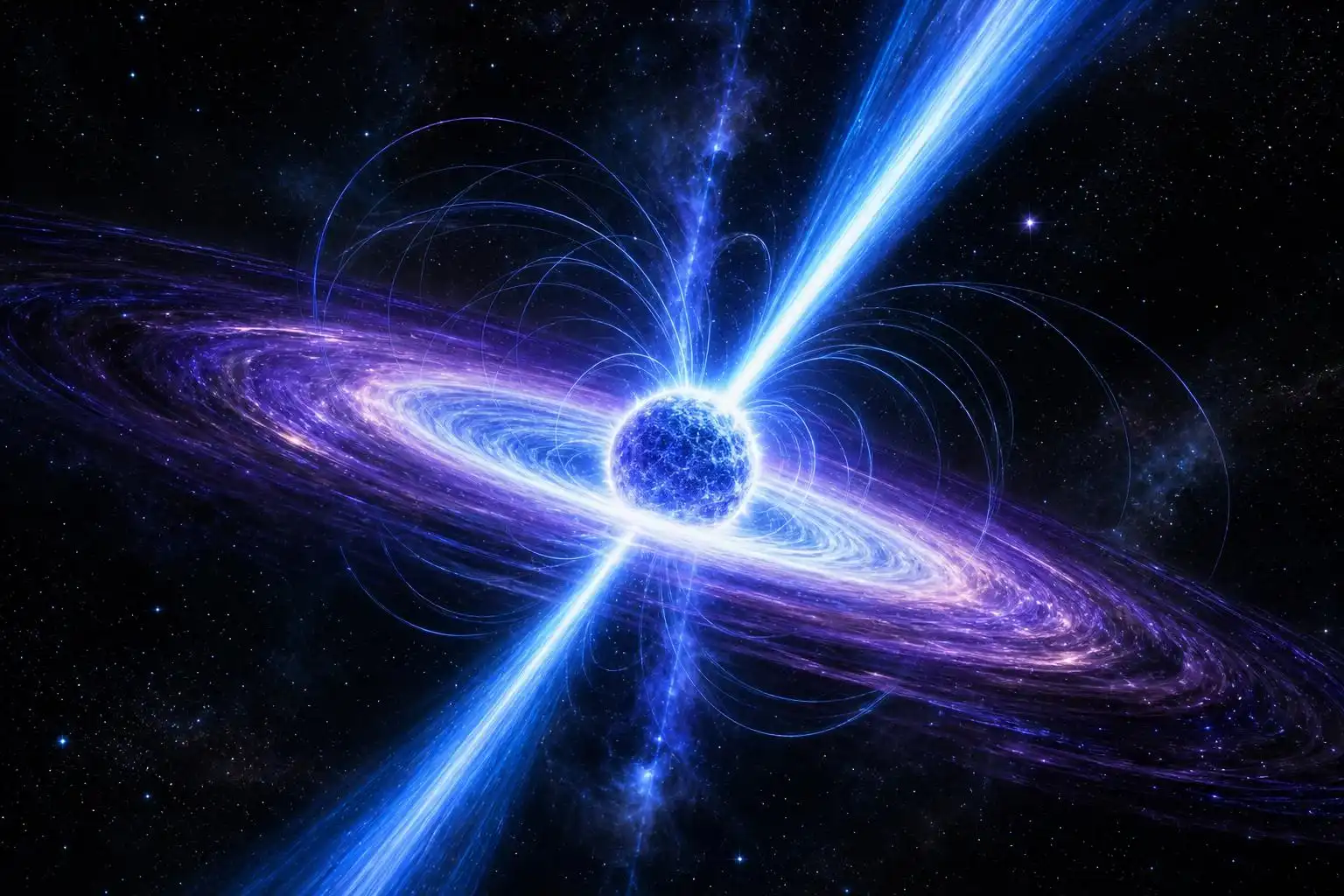

Take a city. Not a small one — Manhattan, say, about 20 kilometres end to end. Now pack 1.4 times the mass of the entire Sun inside it. Set it spinning 700 times per second. That is a neutron star. It is real, it exists right now, and the universe does not care how impossible it sounds.
Let’s set the scene properly, because the numbers deserve a dramatic entrance.
The Collapse That Starts Everything
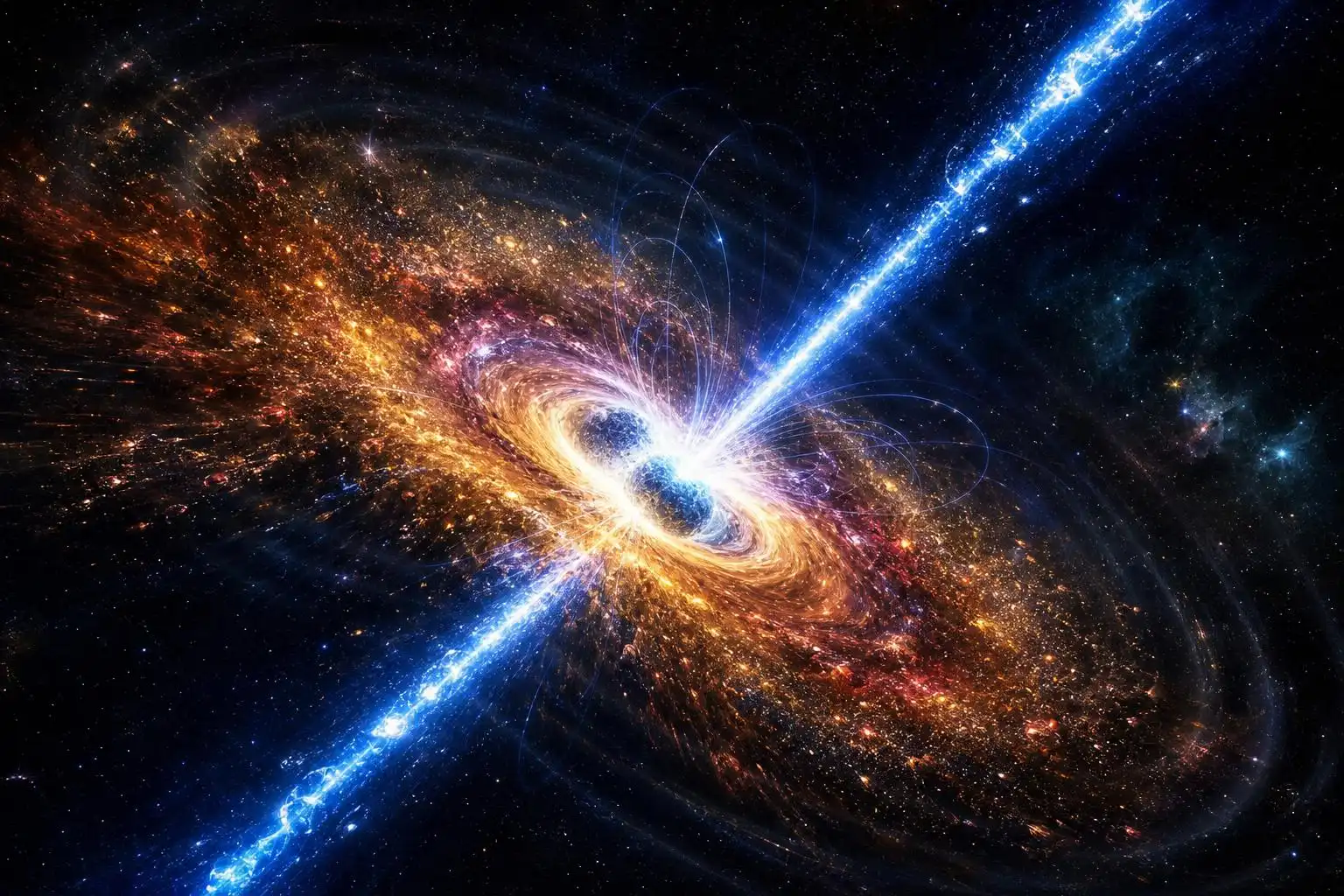
When a massive star—something between eight and twenty times the mass of our Sun—runs out of nuclear fuel, it doesn’t just quietly fade out like a spent candle. It collapses. In less than a second, the iron core at its center, roughly the size of Earth, implodes to a ball about 20 kilometers across. That’s the diameter of a mid-sized city. Manhattan is about 21 kilometers long. So picture Manhattan, end to end, and then stuff 1.4 times the mass of the entire Sun inside it.
The density you get from that transaction is staggering: a single teaspoon of neutron star material would weigh hundreds of millions of tons, and estimates often run even higher. That’s an absurd amount of mass, packed into something you could theoretically balance on a spoon—if the spoon and your hand and the planet beneath you weren’t instantly annihilated by the gravitational consequences.
This is what’s left after one of the universe’s most spectacular explosions: a core-collapse supernova. The same kind of event, by the way, that seeded the cosmos with the iron currently circulating in your bloodstream. Supernova 1987A, which lit up the sky over the Southern Hemisphere in February 1987, was the closest supernova observed in nearly 400 years, and it gave us a front-row seat to the process. Astronomers detected a burst of neutrinos from it—a flood of nearly massless particles that passed through the entire Earth like it wasn’t there, because to neutrinos, it basically wasn’t.
What Neutrons Have to Do With Any of This
Normal matter—the stuff you, your coffee, and your car are made of—is mostly empty space. Atoms are like tiny solar systems: a dense nucleus surrounded by a vast, electron-filled void. In a neutron star, all of that space gets squeezed out. The electrons and protons in the collapsing core are forced together under such extreme pressure that they merge into neutrons. The whole star becomes, essentially, one giant atomic nucleus.
This is where the name comes from, and it’s one of the few cases in astrophysics where the naming committee actually did a decent job.
The result is a surface gravity roughly 200 billion times stronger than what you feel standing on Earth. If you dropped a marshmallow onto a neutron star from one meter up, it would hit the surface with the energy of several tons of TNT. A marshmallow. Think about that the next time you’re making s’mores.
The Spin That Makes Pulsars Feel Like Science Fiction
Here’s where things get genuinely cinematic. When a star collapses, it conserves angular momentum—the same principle that makes a figure skater spin faster when they pull their arms in. A star that rotated once every few weeks suddenly collapses to a tiny ball and starts spinning hundreds of times per second. Some neutron stars, called millisecond pulsars, rotate up to 716 times per second. That’s been clocked. That’s a real number.
As they spin, many neutron stars emit beams of radio waves from their magnetic poles—like a lighthouse, but the lighthouse is 20 kilometers wide, weighs more than the Sun, and is rotating faster than a blender. When those beams sweep past Earth, we detect a precise, metronomic pulse. Hence: pulsars.
Pulsars are so mind-bendingly regular that when Jocelyn Bell Burnell first detected one in 1967, she and her supervisor Antony Hewish briefly labeled it “LGM-1.” Little Green Men 1. Not as a joke—as a genuine placeholder for the possibility that something intelligent was producing that signal. (The Fermi paradox crowd would have had a field day.) It turned out to be nature, not neighbors, but the fact that a natural object was so precise it got mistaken for an alien broadcast tells you something important about how extreme neutron stars really are.
Magnetars: When Neutron Stars Decide to Overachieve
If a regular neutron star isn’t enough to break your brain, allow me to introduce the magnetar. A magnetar is a neutron star with a magnetic field roughly a quadrillion times stronger than Earth’s. Standing within 1,000 kilometers of one would be fatal—the magnetic field would disrupt the quantum states of the atoms in your body before you got anywhere close to the surface.
On December 27, 2004, a magnetar called SGR 1806-20 released a burst of energy in about two-tenths of a second that was more powerful than anything our Sun will emit in 100,000 years. It was 50,000 light-years away. It still measurably ionized Earth’s upper atmosphere. Let me say that again: an explosion halfway across the galaxy noticeably affected our planet’s atmosphere. If that magnetar had been within a few thousand light-years, the effects on Earth’s atmosphere and biosphere could have been far more serious.
Why You Should Care About a Dead Star
Here’s the thing about neutron stars that I keep coming back to: they are not abstract. They are not a thought experiment. They are tied to the same broad chain of stellar evolution and nucleosynthesis that helped build many of the elements in your body. The calcium in your bones, the iron in your blood, the oxygen in every breath—all of it was forged in stars and dispersed by supernovae, stellar winds, and other cosmic events, including explosions like the ones that can leave neutron stars behind.
When LIGO detected gravitational waves from two merging neutron stars in August 2017—an event called GW170817—astronomers pointed every telescope they had at the source. What they found was a kilonova: a collision so energetic it synthesized gold, platinum, and other heavy elements in real time. The gold in your jewelry? Some of it may have come from a neutron star merger billions of years ago. Your engagement ring could be a souvenir from one of the most violent events in the observable universe.
Interstellar had Gargantua. The Martian had a dust storm. But no Hollywood production has yet done justice to the neutron star—a dead city-sized star that spins like a blender, turns a falling marshmallow into an explosion measured in tons of TNT, wears a magnetic field that could kill you from a continent away, and may be responsible for some of the gold that exists in the universe.
The universe built the most extreme object imaginable, left it sitting in plain sight, and we’ve been pointing radio telescopes at it since 1967. The least you can do is tell someone about it.



Leave a Reply