
In the spring of 2019, Adam Riess stood before a packed auditorium at the Space Telescope Science Institute in Baltimore and delivered what amounted to a declaration of war. The Johns Hopkins astrophysicist and Nobel laureate had just published, in the Astrophysical Journal, a new measurement of the Hubble constant — the rate at which the universe is expanding — that was precise enough, he argued, to be irreconcilable with the number coming out of Europe. His team’s value: 74.03 kilometers per second per megaparsec, with an uncertainty of just 1.91 percent. The Planck satellite team’s value, derived from the cosmic microwave background: 67.4. The gap between them — roughly 9 percent — sounds like a rounding error. In cosmology, it is a crisis.
That crisis now has a name. Physicists call it the “Hubble tension,” and it has consumed large amounts of telescope time and funding, produced public disagreements among prominent researchers, generated more than 1,000 papers in five years, and produced no resolution. What it has produced is something rarer and more instructive: a window into how Big Science actually adjudicates disagreements when the stakes are existential for entire theoretical frameworks, and when the people doing the measuring have spent decades — and careers — on opposite sides of the ledger.
Two Measurements, Two Empires
To understand the Hubble tension, you have to understand that it is not, at its core, a dispute about a number. It is a dispute about two entirely different ways of measuring the universe — and two institutional cultures that have grown up around each method.
The first method is called the “distance ladder.” It is the older approach, championed by Riess and his colleague Wendy Freedman at the University of Chicago, and it works by chaining together a series of calibrated distance measurements: Cepheid variable stars to anchor the nearby universe, Type Ia supernovae to extend the reach to cosmological distances. The distance ladder has been refined over decades, most famously through the Hubble Space Telescope Key Project, which concluded in 2001 under Freedman’s leadership with a value of 72 ± 8 km/s/Mpc. Riess’s 2019 result, produced by his SH0ES (Supernova H0 for the Equation of State) collaboration, was the culmination of 15 years of incremental tightening of that same ladder.
The second method is “early-universe cosmology.” The Planck satellite, operated by the European Space Agency and launched in 2009, mapped the cosmic microwave background — the afterglow of the Big Bang — with extraordinary precision. From those temperature fluctuations, the Planck team derived a value of H₀ that depended not on direct distance measurements but on a theoretical model: the Lambda-CDM framework, which assumes the universe is flat, dominated by cold dark matter and a cosmological constant. The Planck team’s 2018 final data release, published in Astronomy & Astrophysics, gave 67.4 ± 0.5 km/s/Mpc.
The tension between these two numbers reached 4.4 sigma in Riess’s 2019 paper — close enough to the 5-sigma threshold that physicists traditionally require to claim a discovery that the community began to take it seriously as something other than systematic error.
The Wendy Freedman Complication
What makes the Hubble tension more than a two-party dispute is the existence of a third measurement — one that has made the politics considerably messier. In 2019, Wendy Freedman, whose own career was built on the distance ladder, announced a new result using the Hubble Space Telescope and a different set of distance calibrators: the tip of the red giant branch (TRGB) method, which relies on the predictable luminosity at which helium ignites in low-mass stars. Her value: 69.8 ± 1.9 km/s/Mpc. Squarely between the two warring camps.
Freedman’s result landed like a grenade in a trench war. Riess immediately disputed it, arguing that the TRGB calibration contained systematic errors that pushed the result artificially low. Freedman pushed back, questioning whether Riess’s Cepheid measurements were themselves contaminated by crowding effects in dense stellar fields — a known source of bias. The exchange, conducted partly in published papers and partly at conferences, became one of the more public scientific feuds of the decade.
By 2021, Freedman had sharpened her TRGB result and published a revised value of 69.6 ± 1.9 km/s/Mpc in the Astrophysical Journal. She also began developing a third independent calibrator — the J-region asymptotic giant branch (JAGB) method — which gave 69.9 ± 2.5 km/s/Mpc. In a 2021 paper, she wrote pointedly that “the Cepheid distance scale has not yet been independently verified at the level of precision claimed by the SH0ES team.” Riess’s team responded with equal precision and equal sharpness.
The dispute had by then acquired a dimension that went beyond methodology. Freedman had led the HST Key Project that established the modern distance ladder. Riess had built his career extending and refining it. The argument between them was, in part, an argument about intellectual inheritance and credit — about who owned the ladder.
JWST Enters the Arena
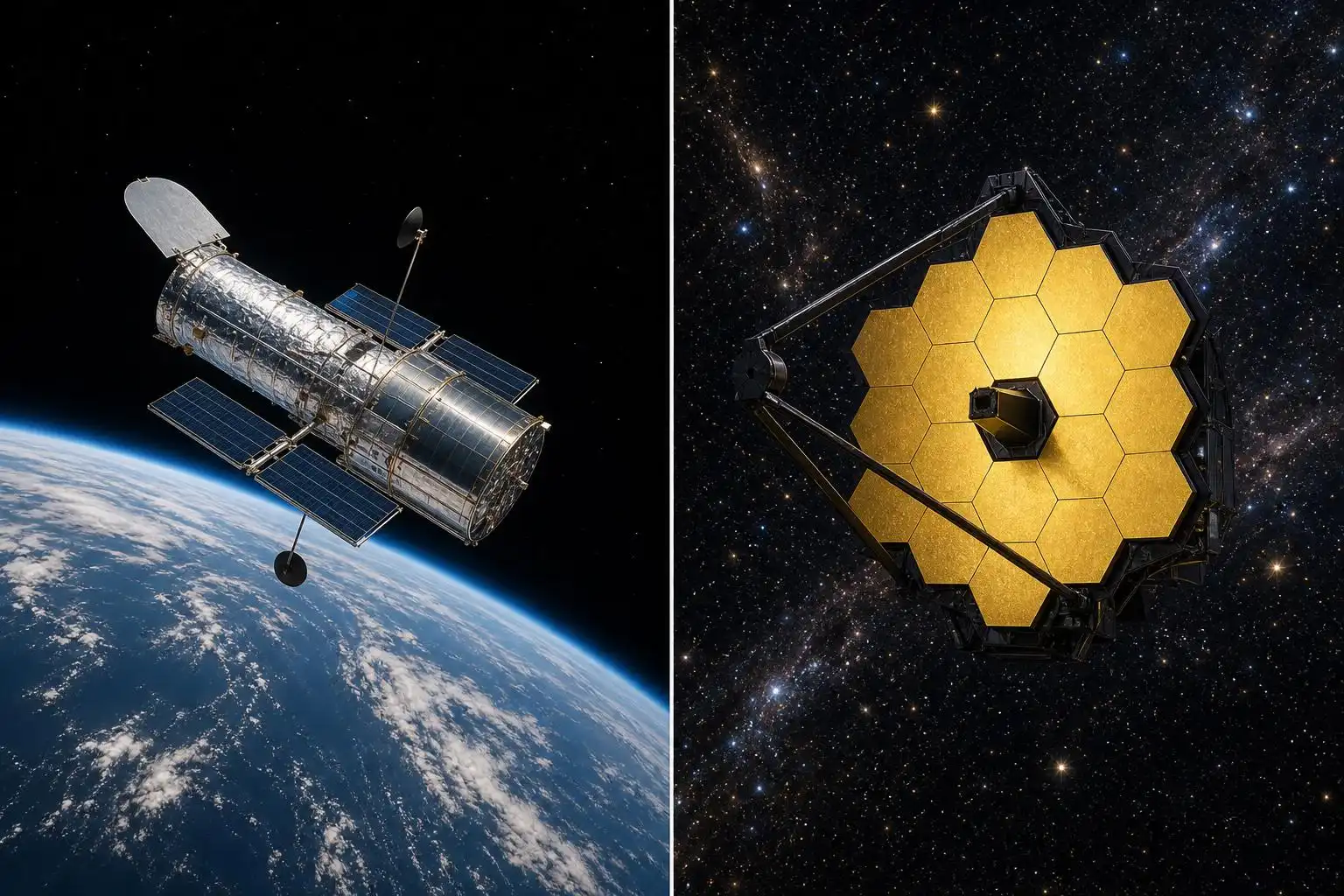
The James Webb Space Telescope was supposed to help settle the debate. Its infrared capabilities can cut through the dust that complicates Cepheid measurements, and its resolution was expected to dramatically reduce the crowding systematics that Freedman had flagged. NASA press materials after Webb’s launch described the Hubble tension as one important science case for the telescope, though not as one of JWST’s original primary mission pillars.
The first JWST analyses of Cepheids by Riess and the SH0ES team, released in 2023 and published in 2024, did not settle anything. The Webb data were used chiefly to test whether crowding and related systematics in Hubble Space Telescope Cepheid photometry could explain the SH0ES result, and the team concluded that they could not. Crowding, in their analysis, was not the problem. Riess told Science magazine that the new data “now firmly rule out” the possibility that the tension is caused by Cepheid systematics. “We’ve now spanned the full range of environments,” he said, “and the answer keeps coming back the same.”
Freedman’s team published their own JWST-based analyses in 2024, using Cepheid, TRGB and JAGB calibrators. Their combined result was about 70 km/s/Mpc, but the individual calibrators did not all land on the same number: the Cepheid calibration came out higher, while the TRGB and JAGB calibrations were lower or intermediate within their uncertainties. The result still sat between SH0ES and Planck — a point Freedman has emphasized repeatedly. If multiple independent methods continue to favor values below the SH0ES Cepheid scale, she argues, the problem may lie with that scale, not with the early-universe measurement.
The JWST results, rather than resolving the dispute, have sharpened it: the tension remains, the leading proposed systematics have not ended the argument, and the two camps are now arguing about which intermediate value is correct, not whether there is a discrepancy at all.
What a Ceasefire Would Actually Cost
The institutional stakes of the Hubble tension are considerable. The Lambda-CDM model — the “standard model” of cosmology — is the organizing framework for major planned and ongoing experiments. The Vera C. Rubin Observatory in Chile, whose Legacy Survey of Space and Time (LSST) was already under construction by the time of the 2021 Decadal Survey, is designed in part to constrain dark energy parameters that assume Lambda-CDM is basically correct. The Nancy Grace Roman Space Telescope, NASA’s next flagship, originated as WFIRST from the 2010 decadal process and carries similar assumptions into its survey design.
If the Hubble tension is not a systematic error but a genuine signal of new physics — if it means Lambda-CDM is wrong — then the science cases for those missions shift dramatically. Early dark energy, interacting dark matter, extra relativistic species, modified gravity: these are the theoretical patches that physicists have proposed to close the gap, and each one implies different observational priorities. The 2010 decadal process elevated WFIRST, later renamed Roman, and the 2021 survey proceeded in a landscape where Roman and Rubin were already central parts of the U.S. cosmology program. Both processes unfolded against the backdrop of dark-energy questions that the Hubble tension has only made sharper.
The National Science Foundation, NASA and ESA have invested heavily in telescope time, missions and instrument development relevant to precision cosmology, including work that bears directly on the Hubble constant debate. That investment includes the ESA’s Planck mission, which cost approximately €700 million. The argument about 74 versus 67 is, in institutional terms, an argument about whether those programs are pointing toward a missing systematic, new physics, or some still-unrecognized combination of both — and about who gets to define “correct.”
The Arbitration Problem
What the Hubble tension reveals, more than any physics, is the absence of a neutral arbiter in Big Science. The two main camps — SH0ES and Planck — are led by scientists whose careers are deeply invested in their methods. The journals that publish their results are peer-reviewed by members of the same community. The granting agencies that fund the follow-up work are advised by panels that include the disputants themselves.
This is not a scandal. It is the normal structure of science. But it means that the resolution of the Hubble tension, when it comes, will not look like a courtroom verdict. It will look like a slow accumulation of independent measurements from sufficiently different methods — baryon acoustic oscillations, strong gravitational lensing time delays (the H0LiCOW program, led by Sherry Suyu), water masers (the Megamaser Cosmology Project) — that eventually make one value untenable.
The H0LiCOW collaboration published a value of 73.3⁺¹·⁷₋₁.₈ km/s/Mpc in 2020, based on six gravitationally lensed quasars — consistent with SH0ES, inconsistent with Planck. The Megamaser Cosmology Project, which measures geometric distances to galaxies using water masers orbiting supermassive black holes, published 73.9 ± 3.0 km/s/Mpc in 2020. Also consistent with SH0ES.
Freedman’s intermediate values remain the outlier — or the mediator, depending on your priors.
The Lesson the Tension Teaches
The Hubble tension is not, at bottom, a story about cosmology. It is a story about what happens when a scientific community’s most fundamental measurement — the age and expansion rate of the universe — turns out to be contested at the level of precision that the community itself demanded. For decades, astronomers argued that the Hubble constant was uncertain by 50 percent, and that precision was the cure. They got precision. The cure produced a new disease.
The institutional lesson is this: precision without independence is not resolution. The distance ladder, no matter how carefully calibrated, is a chain of assumptions built by a community with shared training, shared instruments, and shared incentives. The CMB measurement is a chain of different assumptions, built by a different community. When the two chains disagree, the disagreement is not just about numbers — it is about which community’s assumptions the field is willing to bet its future on.
That bet is now being made, quietly, in grant proposals and Decadal Survey white papers and JWST observing programs. The Hubble tension will eventually be resolved, either by new physics or by a systematic error that someone finally finds. When it is, the history of how the community managed — or failed to manage — the dispute will matter as much as the answer itself. Science is not just what you discover. It is what you do when you cannot agree on what you’ve found.



Leave a Reply