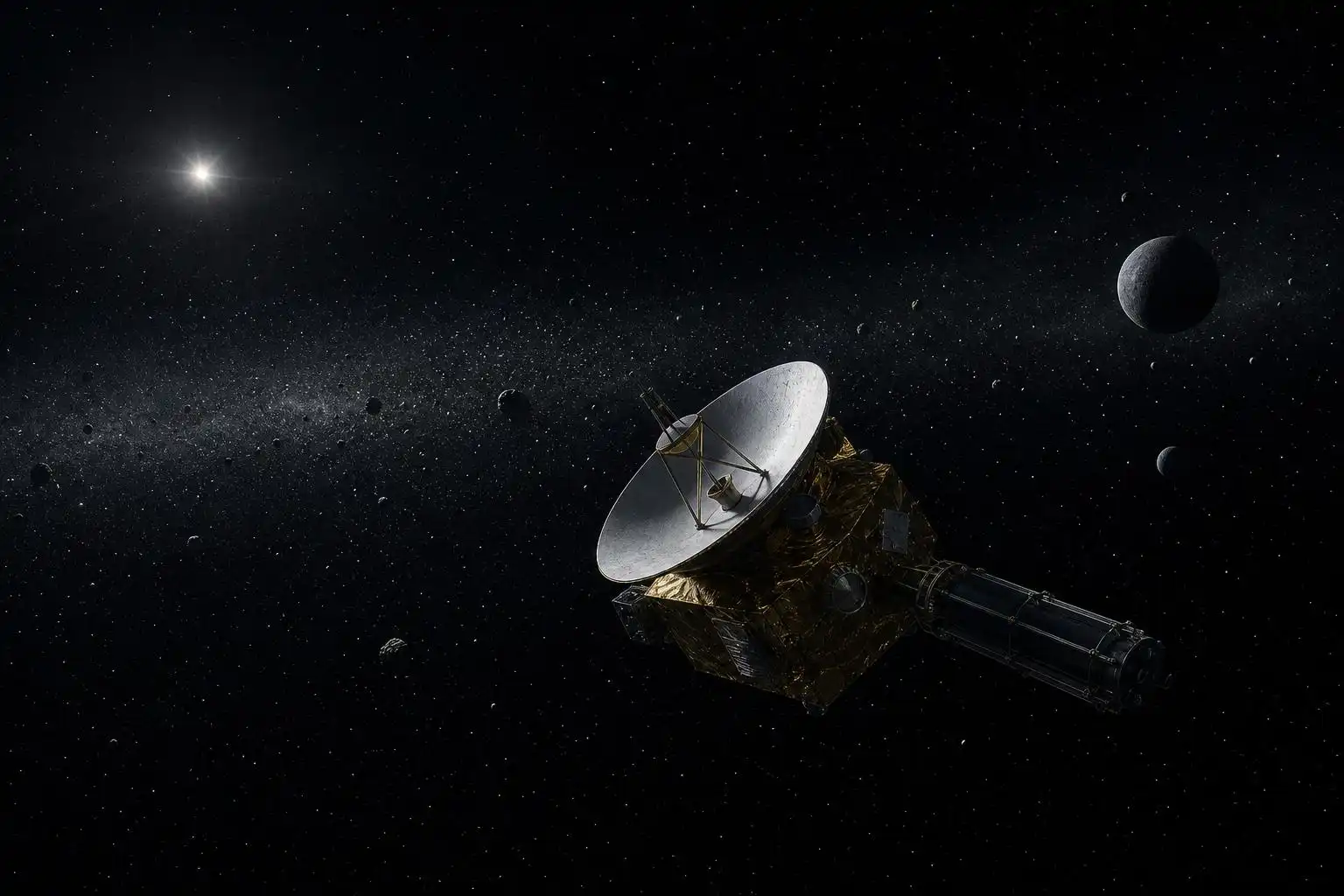

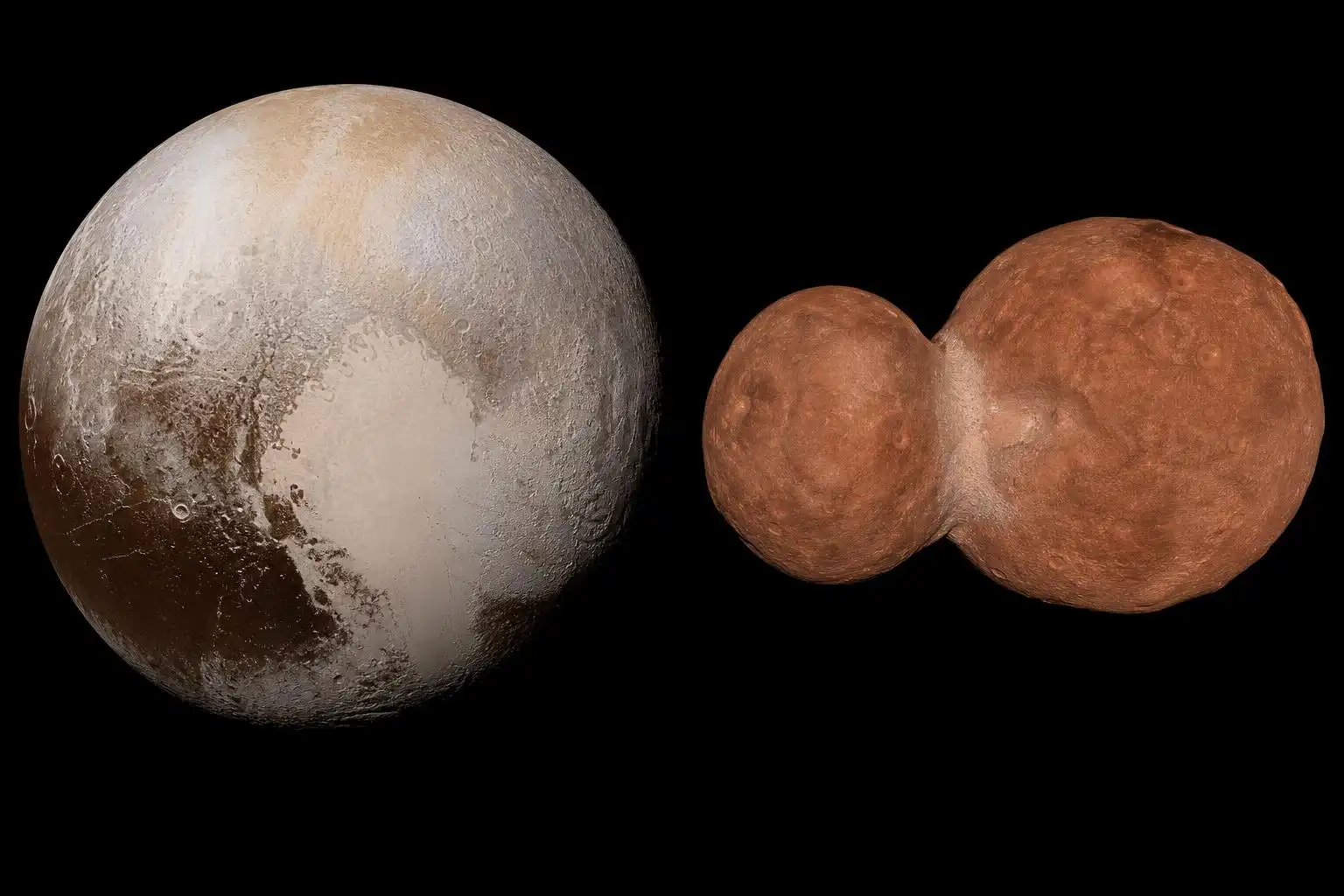
Somewhere beyond 60 astronomical units from the Sun — so far out that sunlight takes more than eight hours to reach it — a spacecraft the size of a baby grand piano has just opened its eyes again. NASA’s New Horizons emerged from hibernation in good health this week,[1] a quiet but significant milestone for a mission that has already rewritten our understanding of the outer solar system twice over. The first time was July 2015, when it swept past Pluto at 14 kilometres per second and showed us Sputnik Planitia — a nitrogen-ice basin the size of Texas sitting inside a heart-shaped feature that nobody had predicted. The second was January 2019, when it photographed Arrokoth, a contact-binary Kuiper Belt Object (KBO) that looks like a reddish snowman and turned out to be the most pristine remnant of solar system formation ever studied up close. Now, with the spacecraft healthy and its instruments still drawing power, the question the planetary science community is wrestling with is deceptively simple: what should New Horizons do next?
A Mission Built for the Edge
New Horizons launched on January 19, 2006, carrying seven instruments packed into a 478-kilogram bus. The most famous of those instruments is Ralph, a combined visible-colour imager and near-infrared spectral mapper that gave us Pluto’s geology in stunning colour and mapped the distribution of methane, carbon monoxide, and nitrogen ices across the surface. Working alongside Ralph was Alice, an ultraviolet imaging spectrograph that probed Pluto’s atmosphere — revealing a haze-laden nitrogen envelope that extends 1,600 kilometres above the surface, far higher than models had predicted. LORRI, the Long Range Reconnaissance Imager, is the telephoto camera that captured those iconic approach shots of Pluto’s mountain ranges and the smooth plains of Sputnik Planitia from tens of millions of kilometres away. REX, the Radio Science EXperiment, used Earth-based radio transmissions to measure atmospheric temperature and pressure profiles by watching how signals bent as the spacecraft passed behind Pluto. And SWAP and PEPSSI, two charged-particle detectors, mapped the solar wind interaction at Pluto and will continue measuring the heliospheric environment all the way to the heliopause.
That last point matters enormously. New Horizons is now in a regime where only Voyager 1 and Voyager 2 have gone before, and unlike those 1970s probes, it carries modern instruments with far greater sensitivity and spectral resolution. The heliosphere — the vast bubble of solar wind that the Sun inflates around itself — has a boundary called the heliopause sitting somewhere around 120 AU. New Horizons is currently past 60 AU and closing on that boundary at roughly 3.5 AU per year. Every kilometre it travels is a measurement of how the solar wind thins, cools, and eventually meets the interstellar medium.
The Hibernation Cycle and Why It Matters
Hibernation is not a dramatic event for New Horizons — it is a carefully managed power-conservation strategy. The spacecraft’s plutonium-238 thermoelectric generator (RTG) produces less electricity each year as the fuel decays, and the team at the Johns Hopkins Applied Physics Laboratory has to budget every watt. Putting the spacecraft into a low-power sleep mode for months at a time preserves enough energy to keep the instruments warm and the transmitters ready. Waking up healthy means all seven instruments are still functional, the onboard computers responded correctly to uplink commands, and the downlink antenna is still pointing well enough to bridge a light-travel time of more than eight hours each way.
That communication lag is one of the stranger operational realities of deep-space missions. When mission controllers sent the wake-up command, they had to wait roughly sixteen hours for confirmation that it had worked — eight hours for the signal to reach the spacecraft, eight hours for the acknowledgment to come back. It is a reminder that New Horizons is not being flown in real time; it is being guided by sequences uploaded weeks in advance, and the spacecraft’s autonomy software handles anything unexpected in between.
Heliophysics at the Edge of Everything
The most immediate science New Horizons is doing right now is heliospheric. SWAP — the Solar Wind Around Pluto instrument, which kept its name even after the Pluto flyby — measures the flux and energy of solar wind ions. At 60-plus AU, the solar wind has expanded so much that its density is a tiny fraction of what it is near Earth, and the particles have cooled dramatically. PEPSSI, the Pluto Energetic Particle Spectrometer Science Investigation, complements SWAP by detecting higher-energy particles, including those accelerated by shocks in the outer heliosphere. Together, they are building a continuous record of how the heliosphere behaves at distances no instrument has measured with this precision before.
There is a genuine mystery here worth dwelling on. The Voyager spacecraft crossed the heliopause — the boundary where the solar wind gives way to the interstellar medium — and found that it was not where theorists expected. The heliosphere is not a perfect sphere; it is distorted by the Sun’s motion through the local interstellar cloud, and there may be a blunt “nose” and a long tail. New Horizons is travelling in a direction different from either Voyager, which means its measurements sample a different slice of this asymmetric bubble. When SWAP’s count rates eventually show the dramatic drop that signals the spacecraft has crossed into interstellar space — probably sometime in the 2040s — it will be the third independent measurement of where the heliosphere ends, and the geometry will finally become clear.
KBO Targets and the Kuiper Belt Survey
Beyond heliophysics, the New Horizons team has been using the Hubble Space Telescope and ground-based observatories to search for another KBO close enough to the spacecraft’s trajectory for a flyby. The geometry is brutally constraining: New Horizons cannot change course by more than a tiny fraction of a degree without exhausting its hydrazine supply, so any target must lie almost exactly along the current flight path. Arrokoth (2014 MU69) was found this way in 2014, just in time for the team to plan the January 2019 encounter.
The search for a third target has been ongoing, and the results so far highlight how sparsely populated the classical Kuiper Belt is in the specific corridor New Horizons is travelling. Even so, the mission’s extended phase has produced real science without a flyby: LORRI has been used to measure the cosmic optical background — the faint glow of all the galaxies in the universe — from a vantage point so far from the Sun and the zodiacal dust cloud that the foreground contamination is negligible. Those measurements have produced genuinely surprising results, suggesting the optical background may be brighter than the known population of galaxies can explain, a puzzle that is still being debated.
CAPSTONE and the Near-Term Lunar Context
While New Horizons operates at the solar system’s frontier, NASA has also been extending its reach at the other end of the distance scale. CAPSTONE — the Cislunar Autonomous Positioning System Technology Operations and Navigation Experiment — recently completed its extended mission testing lunar technologies in the near-rectilinear halo orbit (NRHO) that will eventually host the Gateway lunar station.[1] CAPSTONE is a 25-kilogram CubeSat, roughly the mass of a carry-on suitcase, and it has been demonstrating that small spacecraft can navigate autonomously in the chaotic gravitational environment near the Moon without constant ground support. That capability matters enormously for Artemis logistics, but it also has implications for future small-spacecraft missions to the outer solar system — where communication delays make autonomous navigation not a convenience but a necessity.
The contrast between CAPSTONE and New Horizons captures something essential about where planetary exploration stands in the mid-2020s. One spacecraft is a shoebox-sized technology demonstrator proving out the infrastructure for humans to return to the Moon. The other is a 20-year-old piano-sized probe measuring the edge of the Sun’s domain from a distance that makes the Moon seem like a next-door neighbour. Both have been active participants in expanding our knowledge of the solar system. The solar system, it turns out, is large enough to accommodate every scale of ambition simultaneously.
What Comes After New Horizons?
The planetary science community’s 2023–2032 Decadal Survey identified the Kuiper Belt as a high-priority target and called for a dedicated KBO mission — one that would not just fly past a single object but orbit it, studying its surface composition, interior structure, and interaction with the solar environment over months rather than hours. Such a mission would carry a mass spectrometer to sample any tenuous coma, a ground-penetrating radar to probe subsurface layering, and a near-infrared spectrograph to map the distribution of complex organics and ices that give KBOs their characteristic reddish colour. New Horizons showed us what a flyby can reveal; the next generation will need to linger.
Until that mission launches — and given the distances involved, it would not arrive at a KBO target until the 2050s at the earliest — New Horizons remains humanity’s only active emissary to the Kuiper Belt and the heliospheric frontier. Its wake-up this week is not a dramatic event. There were no fireworks, no press conferences with live countdown clocks. But somewhere past 60 AU, a spacecraft opened its instruments to the void and began, once again, to listen. That quiet persistence — still functional, still measuring, still sending data home across eight hours of light-travel time — is its own kind of extraordinary.
References
- Gallery: Revealing the Invisible with Moon Data — NASA Science — https://science.nasa.gov/moon/image-galleries/revealing-the-invisible/


Leave a Reply