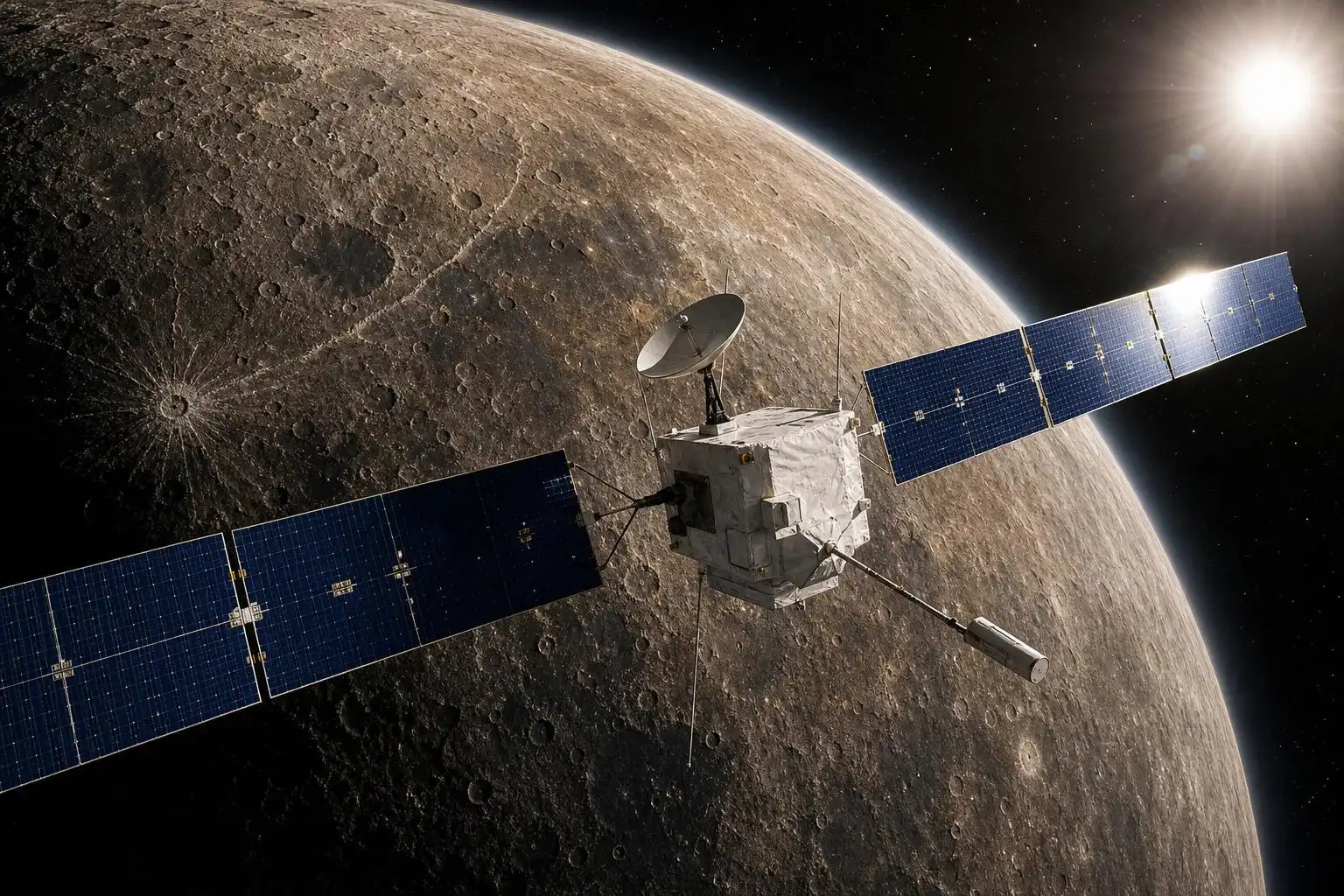

Picture the smallest planet in the solar system — a scorched, cratered world barely larger than our Moon, baking at temperatures above 430°C on its sun-facing side while plunging to -180°C in the dark. Mercury has been visited by only two spacecraft in the entire history of planetary exploration: Mariner 10, which made three flybys between 1974 and 1975, and MESSENGER, which orbited from 2011 until it was deliberately crashed into the surface in 2015. That thin data record is about to change dramatically. On September 3, 2026, BepiColombo initiated its arrival phase at Mercury, separating its propulsion module from the two science orbiters that will spend years unravelling the planet’s secrets.[2] And a brand-new study published in the journal Planetary Research has just given those orbiters their first major target: Mercury’s surprisingly silica-poor crust, and what it reveals about the planet’s deep interior.
Eight Years to Get Here
BepiColombo launched in October 2018 — a joint mission between the European Space Agency and the Japan Aerospace Exploration Agency — and has spent nearly a decade threading its way through the inner solar system, using flybys of Earth, Venus, and Mercury itself to bleed off speed. Getting to Mercury is genuinely hard. You might expect that falling toward the Sun would be simple, but the problem is exactly that: the Sun’s gravity accelerates you so much that arriving at Mercury without overshooting requires shedding enormous amounts of velocity. BepiColombo has used planetary gravity assists and its ion propulsion system together to manage this, a choreography that took the spacecraft past Mercury six times before the arrival phase even began.
Now the two science orbiters — ESA’s Mercury Planetary Orbiter (MPO) and JAXA’s Mercury Magnetospheric Orbiter (Mio) — are in the homestretch. If the arrival sequence proceeds as planned, they will begin looping around Mercury on November 21, 2026, separate from each other roughly three weeks later, and begin their primary science phase in April 2027.[2] It is one of the most complex planetary arrival sequences ESA has ever attempted, and it marks only the third time humanity has sent a spacecraft to study this world in any detail.
The Silica Surprise
Against that backdrop of anticipation, a research team led by Christian Renggli has published a study that reframes one of Mercury’s oldest puzzles: what exactly is its crust made of, and where did those rocks come from?[1]
The key tool in their analysis is something called the Christiansen Feature (CF) — a spectral signature in the mid-infrared range that shifts predictably depending on how much silicon dioxide (silica, SiO₂) a rock contains. Think of it like a colour-coded barcode for mineralogy: the more silica in a rock, the more the CF shifts toward shorter wavelengths. By reading this barcode from orbit, you can distinguish between silica-rich rocks like granite (which form when magma cools slowly deep inside a planet) and silica-poor rocks like basalt (which form from rapid volcanic eruptions at the surface).
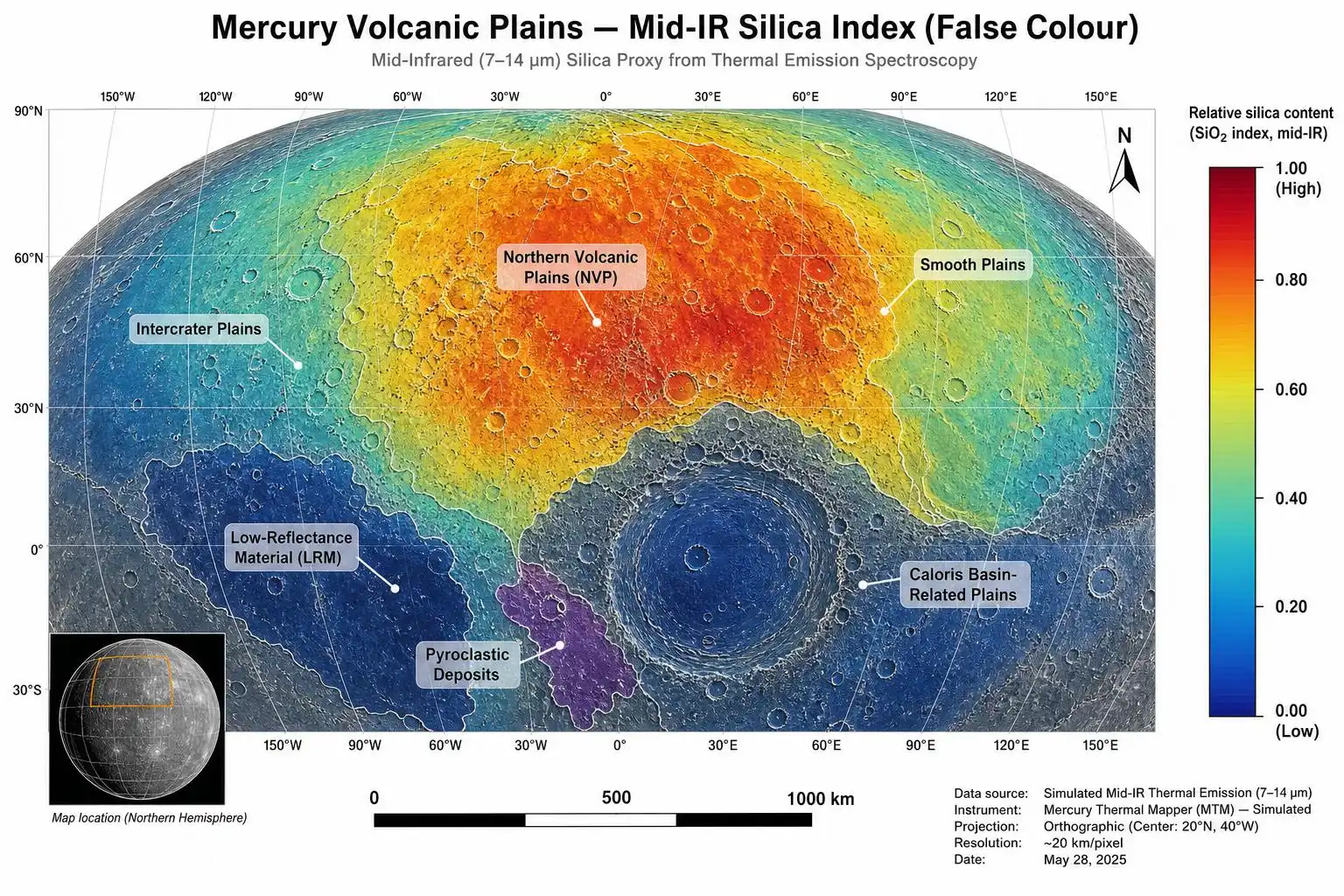
What Renggli’s team found for Mercury is striking. The planet’s volcanic surface rocks contain far less silica than previously assumed — a composition that points toward magma generated by unusually deep melting within Mercury’s mantle. On Earth, rocks with this kind of silica-poor signature typically originate from the deepest parts of the mantle, where pressures are extreme and melting conditions are very different from the shallower sources that produce more familiar basaltic lavas. Mercury’s volcanic plains, which cover enormous swaths of the planet, may therefore be the surface expression of a mantle that was either hotter, deeper-melting, or compositionally distinct from anything we see on the inner planets today.
“Our findings suggest that the volcanic rocks on Mercury formed from more deeply melted mantle material than previously assumed,” the team wrote.[1] The implication is significant: if Mercury’s ancient lavas came from such depth, the planet’s mantle structure — and by extension, the history of its enormous metallic core — may be more exotic than MESSENGER’s data alone could reveal.
Enter MERTIS
This is where BepiColombo becomes indispensable. The new silica study was built on a novel laboratory calibration applied to global data from NASA’s Lunar Reconnaissance Orbiter Diviner instrument for the Moon, and to a decades-old Earth-based infrared measurement for Mercury — with the resulting Mercury estimate compared against earlier MESSENGER-derived estimates. The researchers are explicit about what they need next: confirmation from BepiColombo’s MERTIS instrument.[1]
MERTIS — the Mercury Radiometer and Thermal Infrared Spectrometer — sits aboard the MPO and operates in exactly the mid-infrared wavelength range where the Christiansen Feature lives. It will measure thermal emission from Mercury’s surface at spatial resolutions that MESSENGER’s instruments never achieved, allowing the team to map silica content across the planet’s volcanic provinces with genuine precision rather than broad-brush estimates. Where MESSENGER’s MASCS spectrometer worked primarily in the ultraviolet and visible range, MERTIS pushes into the thermal infrared, giving it sensitivity to the very spectral signature that Renggli’s method depends on.
The science phase begins in April 2027, and MERTIS will almost certainly be one of the first instruments pointed at Mercury’s volcanic plains. The researchers have said explicitly that they hope to confirm the low silica content of Mercury’s surface using BepiColombo data — and that the method they have developed could even be applied to rocky exoplanet surfaces observed by the James Webb Space Telescope, though Mercury itself is the immediate prize.[1]
Mercury’s Core: The Real Mystery Beneath the Mystery
The silica story connects directly to Mercury’s most famous puzzle: its core. Mercury is, proportionally, the most metal-rich planet in the solar system. Its iron-nickel core makes up roughly 85% of the planet’s radius — if you stripped away Mercury’s thin rocky mantle and crust, what remained would be a metal ball not much smaller than the planet itself. For comparison, Earth’s core accounts for about 55% of our planet’s radius.
Why Mercury ended up so core-heavy is genuinely unresolved. The leading hypotheses include a giant impact that blasted away much of the original mantle, intense solar radiation that vaporised lighter silicate material early in the solar system’s history, or some combination of processes during planetary formation. The silica-poor volcanic rocks now identified by Renggli’s team add another piece to this puzzle: if Mercury’s mantle was being tapped at unusual depths to generate surface lavas, then the mantle itself may be thinner or more depleted than models predict — which would be consistent with a core that is even larger than current estimates suggest.
BepiColombo’s MPO carries an instrument specifically designed to probe this: BELA, the BepiColombo Laser Altimeter. By bouncing laser pulses off Mercury’s surface and timing the return signal, BELA will map the planet’s topography to centimetre-scale precision. Combined with radio science measurements of Mercury’s gravity field, those topographic data will let scientists infer how the planet’s interior is structured — how thick the crust is, how the mantle deforms, and ultimately how large and how dense the core must be to produce the gravitational signature BELA and the radio science experiment measure together.
Then there is the magnetic field. Mercury has one, which is surprising for a planet so small — small planets cool faster, and a solidified core cannot sustain a dynamo. MESSENGER confirmed that Mercury’s magnetic field is also bizarrely offset: its dipole axis is shifted roughly 480 kilometres north of the geographic equator, a lopsidedness with no clear parallel elsewhere in the solar system. JAXA’s Mio orbiter is purpose-built to study this. Mio carries a suite of magnetometers and plasma instruments that will characterise the field’s structure in three dimensions and track how Mercury’s thin magnetosphere interacts with the solar wind. Whether the offset dipole reflects an unusual pattern of convection inside a partially liquid core, or something stranger still about Mercury’s deep interior, is exactly the question Mio is designed to answer.
SIMBIO-SYS and the Surface in Detail
While MERTIS reads the chemistry and BELA maps the shape, another MPO instrument will give us our sharpest-ever view of Mercury’s surface: SIMBIO-SYS, the Spectrometers and Imagers for MPO BepiColombo Integrated Observatory System. This is actually a suite of three instruments bundled together — a high-resolution imager, a stereo camera for three-dimensional mapping, and a visible and near-infrared spectrometer. Together they will produce global colour maps of Mercury at resolutions that will make MESSENGER’s best images look like rough sketches.
Those maps matter for the silica story directly. Renggli’s method relies on connecting spectral signatures to geological units — volcanic plains, ancient cratered terrain, the bright hollows that MESSENGER discovered and that have no counterpart anywhere else in the solar system. SIMBIO-SYS will let scientists tie MERTIS’s thermal infrared measurements to specific surface features with the kind of spatial precision that makes geological interpretation possible. A silica measurement is most useful when you know exactly which rock unit it belongs to.
What 2027 Looks Like
When BepiColombo’s science phase opens in April 2027, the picture of Mercury that emerges will be built instrument by instrument. MERTIS will begin mapping silica and other mineral signatures across the volcanic plains, testing Renggli’s prediction that the deep-melting signal holds up at global scale. BELA will accumulate topographic returns, building the elevation model that will eventually let scientists calculate crustal thickness. Mio’s magnetometers will begin characterising the offset dipole in detail, looking for the asymmetries in field strength between the northern and southern hemispheres that might explain why the dynamo generates such a lopsided field. SIMBIO-SYS will photograph the surface at resolutions that reveal metre-scale features, turning geological mapping from a coarse exercise into something approaching the precision we take for granted at Mars.
Mercury has waited a long time for this level of attention. Mariner 10 photographed barely 45% of the surface during its three flybys. MESSENGER filled in the rest and found a world far stranger than anyone expected — a planet with bright hollows that appear to be actively forming today, with radar-bright deposits of water ice hiding in permanently shadowed polar craters, and with a magnetic field that defies simple explanation. BepiColombo’s two orbiters will spend years building on that foundation, and the new silica research has already given the MERTIS team a specific, testable hypothesis to pursue the moment the instrument opens its eye on Mercury’s volcanic plains.
The solar system’s most metal-rich planet is finally getting the scrutiny it deserves.
References
- Mercury’s Crust May Hide Metal beneath Its Surface | Sci.News — https://www.sci.news/space/moon-mercury-silica-15029.html
- After an Eight-Year Journey, Two Spacecraft Have Begun Their Arrival to Mercury | Smithsonian Magazine — https://www.smithsonianmag.com/smart-news/after-an-eight-year-journey-two-spacecraft-have-begun-their-arrival-to-mercury-the-inner-solar-systems-most-mysterious-planet-180989458


Leave a Reply