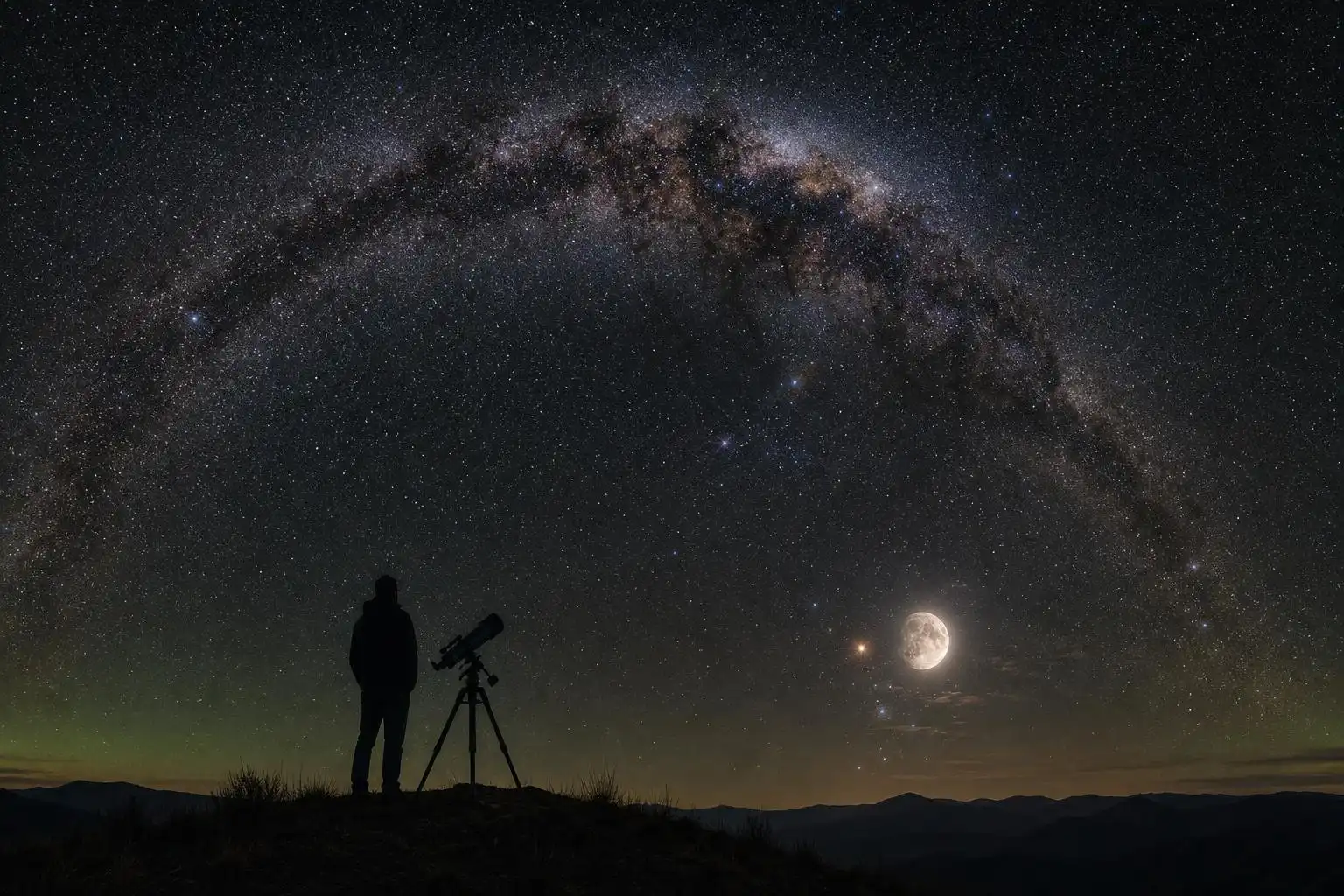

The last week of July is one of those stretches that rewards patience at the eyepiece. The Moon is waxing toward full, which means deep-sky work gets harder as the week goes on — but there’s plenty to keep you busy. A comet is doing something genuinely unusual, the Moon is acting as a guided tour of summer’s brightest stars, a meteor shower is trying to compete with the moonlight, and a faint planetary nebula near the Teapot is worth hunting down if you’ve got the aperture for it. Let me walk you through what’s worth stepping outside for.
Comet Tempel 2 and Its Knife-Edge Tail
This is the headline event for telescopic observers right now, and it’s one of those phenomena that sounds subtle on paper but looks genuinely strange through the eyepiece. Comet 10P/Tempel 2 is currently plunging through the plane of Earth’s orbit on its way to perihelion, and as it does, we’re seeing its dust tail almost exactly edge-on.[1]
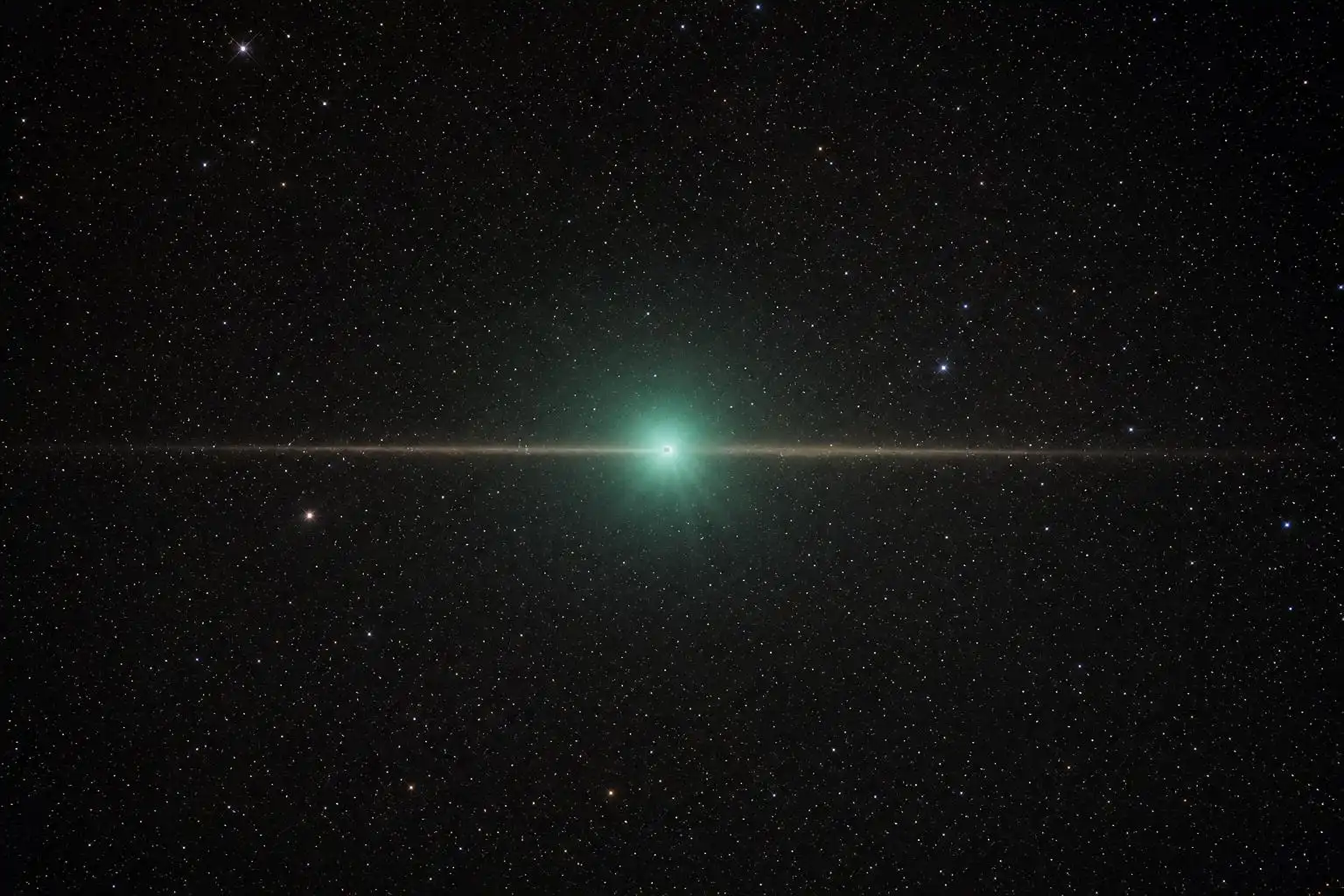
What that means visually is that instead of the usual fan-shaped or gently curved dust tail spread across a degree or two of sky, you get a razor-thin spike — a knife-edge of reflected sunlight compressed into a single bright line. Imagers caught this effect beautifully around July 10, showing the comet’s bright green coma (that color comes from diatomic carbon fluorescing under ultraviolet sunlight) with a hair-thin tail extending from it. Visually, in a 6-inch or larger scope at moderate magnification, the green nucleus should be obvious, and the thin tail is a wonderful test of your sky’s transparency and your scope’s collimation.
Tempel 2 is a short-period comet with an orbital period of about 5.3 years, and it’s been observed at every return since Edward Tempel discovered it in 1873. It’s not a spectacular naked-eye object, but it rewards time at the eyepiece — and catching it during this edge-on geometry is a genuine once-per-apparition opportunity. Check current ephemeris data for its precise position before you go out; it’s moving fast enough that charts from even a few days ago may put it noticeably off.
The Moon’s Grand Tour: Spica and Antares
If you’ve got newer observers in your family or at your club, this week is a gift. The waxing gibbous Moon is making close passes to two of summer’s most iconic stars, and it’s doing the finder work for you.
On July 20, the Moon shines close to Spica in Virgo — the blue-white first-magnitude star that anchors the southern end of the “arc to Arcturus, speed on to Spica” mnemonic.[4] Spica is actually a spectroscopic binary, two hot blue stars so close together they’re tidally distorted into egg shapes — you’ll never split them visually, but knowing that makes the single point of blue-white light feel a little more alive.
Then on Friday, July 24, the Moon passes just 0.6° south of Antares, the heart of Scorpius, at 6 P.M. EDT.[3] By evening, the pair is beautifully placed in the south as twilight fades — around 9:30 P.M. local daylight time, they’re about 20° high, the bright waxing Moon sitting to the lower left of ruby-red Antares.[5] The Moon won’t set until after 1 A.M., so you’ve got a long window to enjoy the pairing.
Antares is worth lingering on. It’s a red supergiant roughly 550 light-years away,[4] and its M1 spectral class means even a quick glance with the naked eye reveals that warm, ember-like orange-red color. Through a telescope at low power, it’s one of the most satisfying stellar colors in the sky. If you’ve got a 4-inch or larger scope and steady seeing, hunt for its companion — Antares B, a blue-green star at about 2.5 arc-seconds separation. It’s notoriously difficult because the primary is so blazingly bright, but it’s one of those challenges that feels genuinely earned when you nail it.
A Faint Planetary Nebula Near the Teapot
For those with 8 inches or more of aperture, NGC 6563 in Sagittarius is worth tracking down on any clear night this week when the Moon is still low.[2] It’s an oval-shaped planetary nebula — a shell of gas expelled by a dying Sun-like star — floating near the base of the Teapot asterism. At around 11th magnitude it’s not a casual target, but it’s attainable with patience.
The Teapot is your finder. Identify the four stars that form the base of the pot: Ascella (ζ Sgr), Kaus Australis (ε Sgr), Kaus Media (δ Sgr), and Nunki (σ Sgr). NGC 6563 sits roughly 2.5° west of Kaus Australis. It’s best around 11 P.M. local daylight time when it’s near its highest point from mid-northern latitudes — and even then it’s only climbing to about 20° altitude for observers around 40°N, so a steady, transparent southern horizon matters a great deal.
At the eyepiece, use an OIII filter if you have one. Planetary nebulae glow strongly in the doubly-ionized oxygen line at 500.7 nm, and the filter will darken the sky background dramatically while letting the nebula’s light through. Through most modestly large scopes, NGC 6563 will look like a featureless compact disk; if you’ve got a bigger scope of 14 inches or more, you will start to notice the outer edge is a bit brighter than the inner regions. At the center, a faint central star is responsible for ionizing the whole cloud — a white dwarf remnant, the eventual fate of our own Sun, compressed into a sphere roughly the size of Earth.
Mercury Ends Its Retrograde
On July 23, Mercury came to a standstill in its apparent retrograde path and began moving east again — ending its current retrograde period.[6] The planet is now a morning object in Gemini, rising before the Sun but extremely challenging to observe. It’s only about 2° above the horizon around 5:10 A.M. local daylight time, glowing at magnitude 2.2 — faint for Mercury, which can reach magnitude −2 near greatest elongation. Binoculars will help, and it sits to the far lower-left of Betelgeuse, which is itself low in the east before dawn.
I’ll be honest: this is a “check the box” observation rather than a rewarding one. But if you’re the type who likes to have seen Mercury in every apparition — and I know that type well, because I am that type — binoculars and a very clear eastern horizon will do it.
The Southern Delta Aquariids: Fighting the Moon
The Southern Delta Aquariid meteor shower peaks this week, but it’s doing so under rough conditions.[5] The July Full Buck Moon is approaching, and a bright waxing gibbous Moon washes out all but the brightest meteors. The shower’s zenithal hourly rate under ideal conditions is about 25 meteors per hour, but in practice with a bright Moon you’ll be lucky to catch a handful of the brightest ones per hour.
That said, the Southern Delta Aquariids produce a disproportionate number of long, slow meteors — the kind that leave glowing trains across a wide arc of sky. Those are the ones that punch through moonlight. The radiant in Aquarius rises in the southeast after midnight, so the hours before dawn on the morning of July 30 and 31 are your best window. Face southeast, let your eyes adapt as much as the Moon allows, and be patient. Even a single brilliant fireball makes it worth the lawn chair.
Planning Notes
The bright Moon this week means your deep-sky window is narrow — focus on the first half of the night before the Moon climbs high, or target objects like NGC 6563 that benefit from a filter. Seeing has been variable across much of North America this month; the planetary nebula and the Antares companion both demand steady air, so check your local forecast for nights when the jet stream is relaxed overhead.
For Comet Tempel 2, pull a fresh ephemeris from JPL Horizons or your planetarium software the night you observe — the comet is moving fast enough that a week-old chart will mislead you. A 6-inch or larger scope will show the green coma well; the edge-on tail is more of a 10-inch-and-up treat visually, though imagers with smaller apertures have captured it beautifully.
Clear skies, and take a moment to just stand outside before you set up — the summer Milky Way is arching high overhead, and even a bright Moon can’t entirely erase it.
References
- The Sky Today on Saturday, July 18: Comet Tempel’s knife-edge tail — Astronomy Magazine — https://www.astronomy.com/observing/the-sky-today-saturday-july-18-2026/
- The Sky Today on Sunday, July 19: An oval-shaped nebula — Astronomy Magazine — https://www.astronomy.com/observing/the-sky-today-sunday-july-19-2026/
- The Sky Today on Friday, July 24: The Moon passes Antares — Astronomy Magazine — https://www.astronomy.com/observing/the-sky-today-friday-july-24-2026/
- See The Moon Meet Two Of Summer’s Brightest Stars: Night Sky This Week — Forbes — https://www.forbes.com/sites/jamiecartereurope/2026/07/20/see-the-moon-meet-two-of-summers-brightest-stars-night-sky-this-week/
- The Sky This Week from July 24 to 31: The Southern Delta Aquariids peak — Astronomy Magazine — https://www.astronomy.com/the-sky-this-week/the-sky-this-week-from-july-24-to-31-2026/
- The Sky Today on Thursday, July 23: Mercury’s retrograde path ends — Astronomy Magazine — https://www.astronomy.com/observing/the-sky-today-thursday-july-23-2026/



Leave a Reply