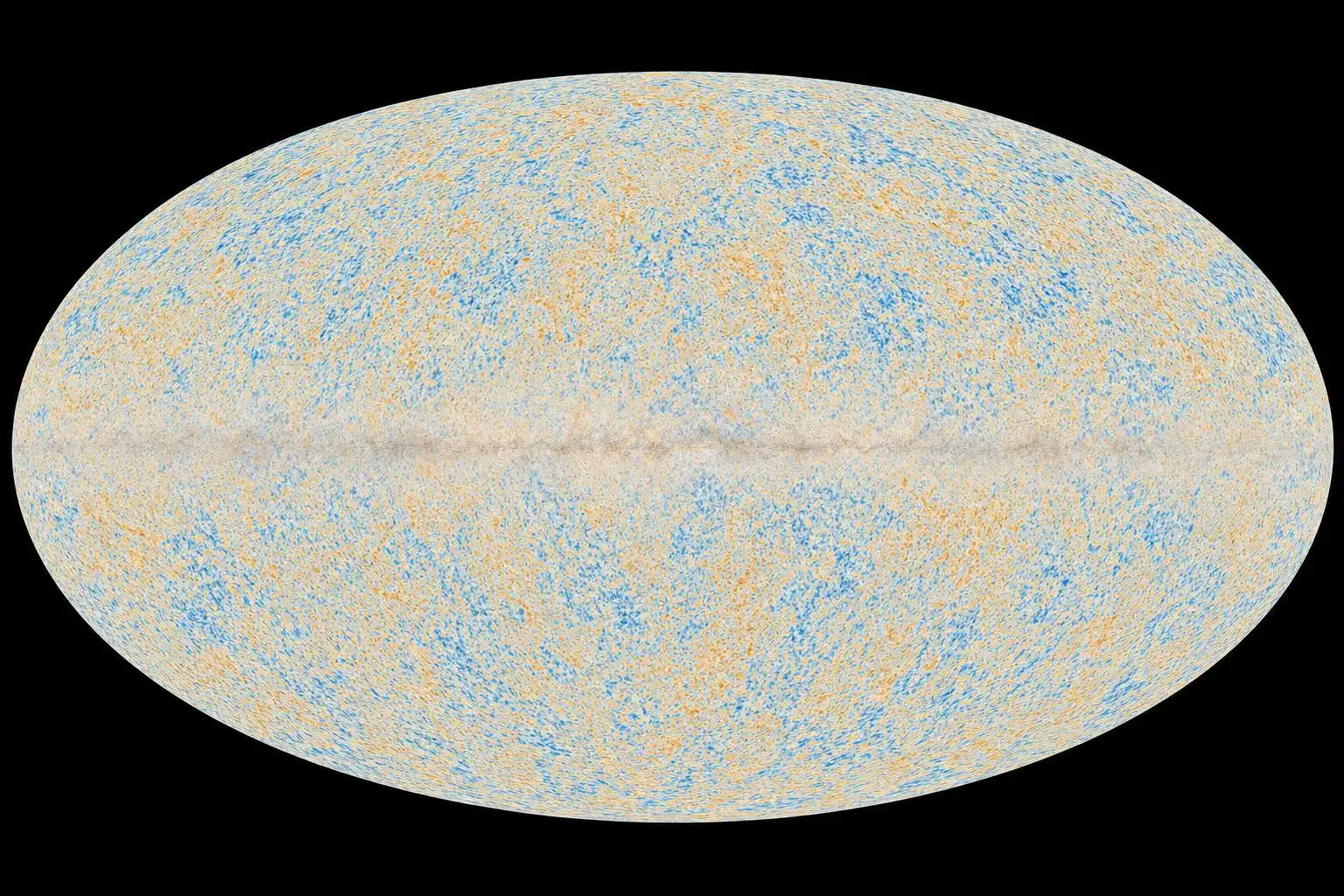

Thirteen point eight billion years ago, the universe was a ferociously hot, opaque plasma — a soup of protons, electrons, and photons so densely packed that light was continually scattered and could not stream freely across cosmic distances. Then, roughly 380,000 years after the Big Bang, something remarkable happened: the universe cooled enough for electrons and protons to combine into neutral hydrogen. In an instant, cosmologically speaking, the fog lifted. Photons streamed freely across space for the first time, and the universe became transparent.
Those photons are still traveling today. We call their collective glow the Cosmic Microwave Background — the CMB — and it is the oldest light in the universe, a snapshot of the cosmos at an age of just 380,000 years, stretched by 13.8 billion years of cosmic expansion into microwave frequencies we can detect with the right instruments. It is, in every meaningful sense, the universe’s baby picture.
A Faint Hiss That Changed Everything
The CMB wasn’t discovered by someone looking for it. In 1964, Arno Penzias and Robert Wilson were trying to calibrate a microwave antenna at Bell Labs in Holmdel, New Jersey, when they found an irreducible noise in their data — a faint, uniform signal coming equally from every direction in the sky. They famously blamed pigeons roosting in the antenna horn. The pigeons were evicted. The noise remained.
What Penzias and Wilson had stumbled upon was the afterglow of the Big Bang itself, a prediction made years earlier by Ralph Alpher and Robert Herman. The discovery earned Penzias and Wilson the 1978 Nobel Prize in Physics and dealt a decisive blow to the rival Steady State model of cosmology. The universe had a beginning, and this faint hiss was its echo.
The CMB arrives at Earth with a nearly perfect blackbody spectrum at a temperature of 2.72548 ± 0.00057 Kelvin — a measurement so precise it stands as one of the most accurate in all of physics. But the word “nearly” carries enormous weight. Buried within that uniform glow are tiny temperature fluctuations, deviations of roughly one part in 100,000. Those fluctuations are not noise. They are the seeds of everything.
The Map That Remade Cosmology
For decades after its discovery, the CMB was known only as a featureless glow. The real revolution came when we learned to map it. The COBE satellite (1989–1993) was the first to detect the temperature anisotropies — the tiny hot and cold spots — earning its principal investigators George Smoot and John Mather the 2006 Nobel Prize. Stephen Hawking called it “the scientific discovery of the century, if not all time.”
COBE’s resolution was coarse, roughly 7 degrees on the sky. The WMAP mission (2001–2010) sharpened the picture dramatically, revealing a rich tapestry of fluctuations and allowing cosmologists to measure the fundamental parameters of the universe with unprecedented precision. Then came Planck, the European Space Agency’s flagship CMB observatory, which operated from 2009 to 2013 and released its final data products in 2018 and 2020.
Planck’s maps of the CMB are staggering in their detail. With angular resolution down to about 5 arcminutes and sensitivity to temperature differences of a few microkelvin, Planck resolved the CMB’s acoustic peaks — oscillations in the primordial plasma that encode the universe’s composition like a cosmic tuning fork. From those peaks, cosmologists extracted a portrait of the universe that would have seemed like science fiction a generation ago.
What the Fluctuations Tell Us
The physics behind the CMB fluctuations is, at its core, a story about sound. In the early universe, the plasma of photons and baryons (ordinary matter) was subject to two competing forces: gravity pulling matter together and radiation pressure pushing it apart. This tug-of-war set up acoustic oscillations — pressure waves rippling through the plasma at roughly half the speed of light.
When the universe recombined and the photons decoupled, those oscillations were frozen in place, imprinted on the last-scattering surface like a photograph of a sound wave mid-vibration. The characteristic scale of those frozen waves — the sound horizon, approximately 147 megaparsecs in comoving coordinates — appears as a preferred angular scale in the CMB power spectrum, giving rise to a series of peaks and troughs.
The positions and heights of those peaks are extraordinarily sensitive to the universe’s contents. The first peak tells us about the total energy density; its location shows the universe’s spatial geometry is remarkably close to flat, and combined Planck-plus-BAO analyses constrain the curvature parameter to Ω_k = 0.0007 ± 0.0019. The ratio of the first to second peak constrains the baryon density. The third peak is sensitive to the dark matter density.
Planck’s final results give us a universe that is 68.3% dark energy, 26.8% dark matter, and just 4.9% ordinary baryonic matter — the stuff of stars, planets, and people. These numbers are not abstract. They are read directly from the geometry of temperature fluctuations in a 13.8-billion-year-old glow of light.
Polarization: A Second Language
Temperature is only half the story. The CMB is also polarized — the photons’ electric fields have preferred orientations that encode additional information about the early universe. CMB polarization comes in two types, named after their curl properties: E-modes and B-modes.
E-modes arise from density fluctuations in the primordial plasma and were first detected by the DASI experiment in 2002. They have been mapped in exquisite detail by Planck and ground-based experiments like the South Pole Telescope (SPT) and the Atacama Cosmology Telescope (ACT). E-modes independently confirm the acoustic peak structure seen in temperature and provide powerful constraints on reionization — the epoch when the first stars re-ionized the neutral hydrogen that had formed at recombination.
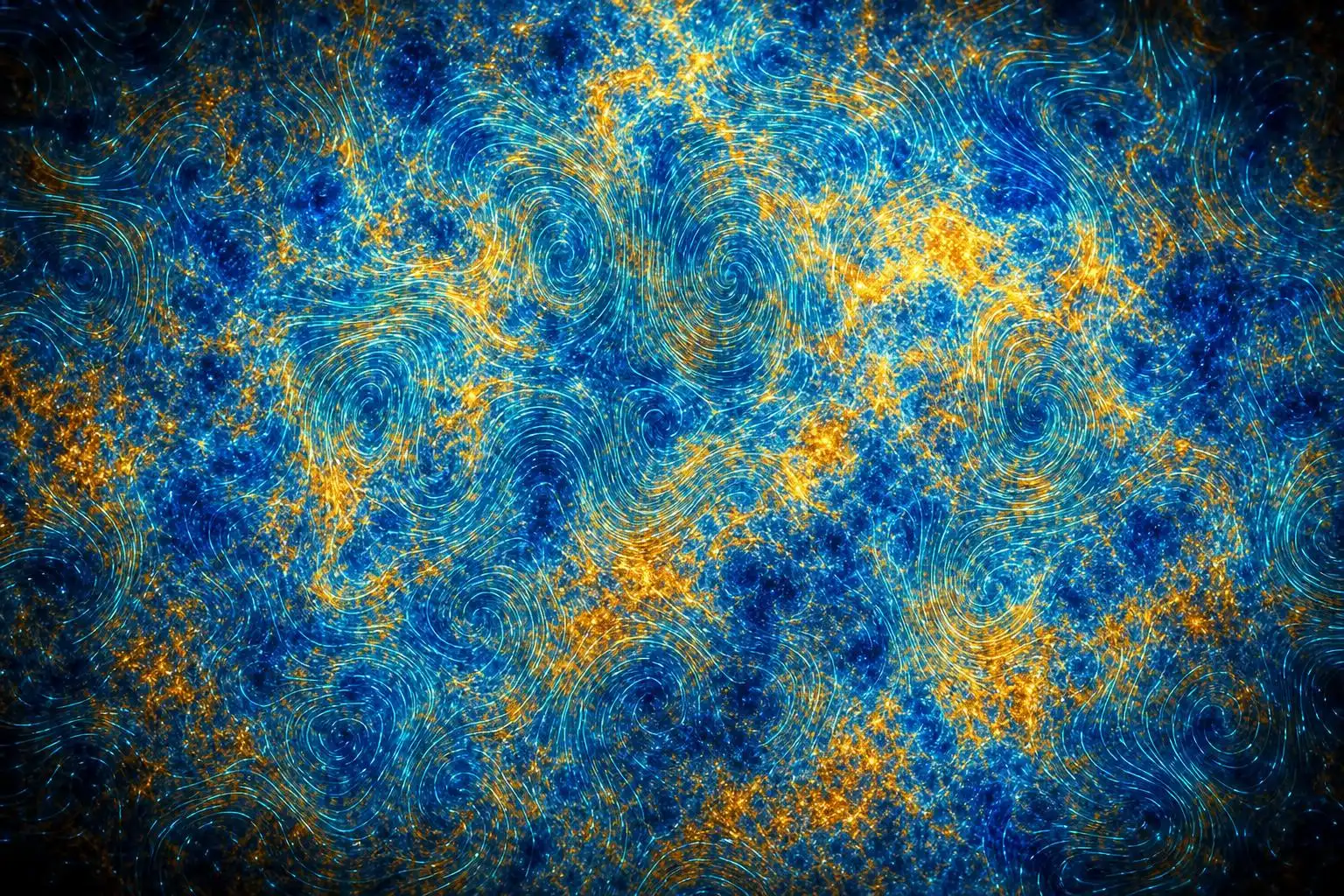
B-modes are more exotic and more coveted. They can be generated by two sources: gravitational lensing of E-modes by large-scale structure (a “secondary” signal now detected routinely), and — far more tantalizing — primordial gravitational waves from cosmic inflation. If inflation occurred, the violent exponential expansion of the universe in its first tiny fraction of a second would have generated a stochastic background of gravitational waves, and those waves would have imprinted a characteristic swirling pattern in the CMB’s polarization: primordial B-modes.
The amplitude of this signal is parameterized by the tensor-to-scalar ratio r. Current upper limits, from the BICEP/Keck Array collaboration’s 2021 results combined with Planck data, place r < 0.036 at 95% confidence — the most stringent constraint ever achieved. No detection yet. But the search is far from over. The CMB-S4 experiment, a next-generation ground-based array planned for the South Pole and the Chilean Atacama, aims to reach a sensitivity of r ~ 0.003, probing inflationary energy scales near the GUT (Grand Unified Theory) threshold.
The Tension That Won’t Go Away
The CMB’s greatest gift to cosmology may also be its greatest provocation. Planck’s precise measurement of the Hubble constant — the rate at which the universe is expanding today — yields H₀ = 67.4 ± 0.5 km/s/Mpc. This is derived not by measuring expansion directly, but by fitting the full Lambda-CDM cosmological model to the CMB power spectrum and extrapolating forward in time.
The problem: direct, late-universe measurements of H₀ consistently give higher values. The SH0ES collaboration, using Cepheid-calibrated Type Ia supernovae, measures H₀ = 73.04 ± 1.04 km/s/Mpc (Riess et al. 2022). The discrepancy sits at roughly 5 sigma — a tension that has resisted every systematic explanation thrown at it and now commands the attention of virtually every cosmologist on the planet.
This is the Hubble tension, and it lives in the gap between what the CMB tells us and what the local universe shows us. Either one or both measurements harbor unidentified systematic errors, or — the more thrilling possibility — the standard Lambda-CDM model is missing something fundamental. Early dark energy, extra relativistic species, modified gravity, interacting dark matter: all have been proposed, all have difficulties. None have resolved the tension cleanly.
The CMB, then, is not just a solved problem. It is an active frontier, a source of both our best cosmological knowledge and our deepest current crisis.
What We’re Still Listening For
The next decade of CMB science is ambitious. The Simons Observatory, now coming online in the Atacama Desert of Chile, will map CMB polarization with dramatically improved sensitivity and resolution, probing the sum of neutrino masses through their effect on structure growth, tightening B-mode limits, and measuring the optical depth to reionization more precisely. CMB-S4, with its 500,000+ detectors, will push further still.
In space, the proposed LiteBIRD satellite (JAXA, with international partners) is designed specifically to search for primordial B-modes on large angular scales — the regime where the inflationary gravitational wave signal is expected to peak, and where ground-based experiments struggle due to atmospheric contamination. LiteBIRD aims for a sensitivity of r ~ 0.001, enough to either detect inflation’s gravitational wave fingerprint or place strong limits on many large-field inflationary models.
Meanwhile, cross-correlations between the CMB and large-scale structure surveys — Euclid, the Rubin LSST, the DESI spectroscopic survey — are opening new windows. The kinetic Sunyaev-Zel’dovich effect, which imprints the bulk motions of galaxy clusters onto the CMB, is becoming a precision tool for mapping the universe’s velocity field. The integrated Sachs-Wolfe effect, a subtle imprint of dark energy on the CMB’s photons as they traverse large-scale potential wells, ties the CMB to the late-time accelerating expansion.
The CMB is 13.8 billion years old, and we are still learning to read it.
Sitting with the Mystery
There is something quietly astonishing about the fact that we can hold the universe’s infancy in a data table. That the temperature of a photon that last scattered off matter before the Earth existed, before the Sun existed, before the Milky Way had assembled its spiral arms, can be measured to six significant figures in a laboratory on this pale blue dot.
But precision is not the same as understanding. The CMB tells us with extraordinary confidence what the universe is made of. It does not tell us why dark energy has the value it has, why dark matter is dark, or whether the inflationary epoch that smoothed the universe and seeded its fluctuations actually happened — and if so, what drove it. It presents us with a Hubble constant that disagrees with the universe we can see around us, and offers no resolution.
The baby picture is breathtaking. But like all baby pictures, it raises questions the subject has not yet answered. We are still waiting for the universe to grow up and explain itself.



Leave a Reply